The Adriatic in Three Acts: A Boutique Coastal Trail Through Croatia
The Croatian coast has changed its public identity twice in the last twenty years. First it was the post-war Adriatic, the cheap-and-beautiful alternative to Italy. Then it was the Game of Thrones backdrop, with Dubrovnik turned into a film set. The version that arrives now, in 2026, is the third one: slower, more local, and considerably more interesting. This guide is a seven-night coastal trail along that third Croatia, in three acts, with one boutique hotel per stop.
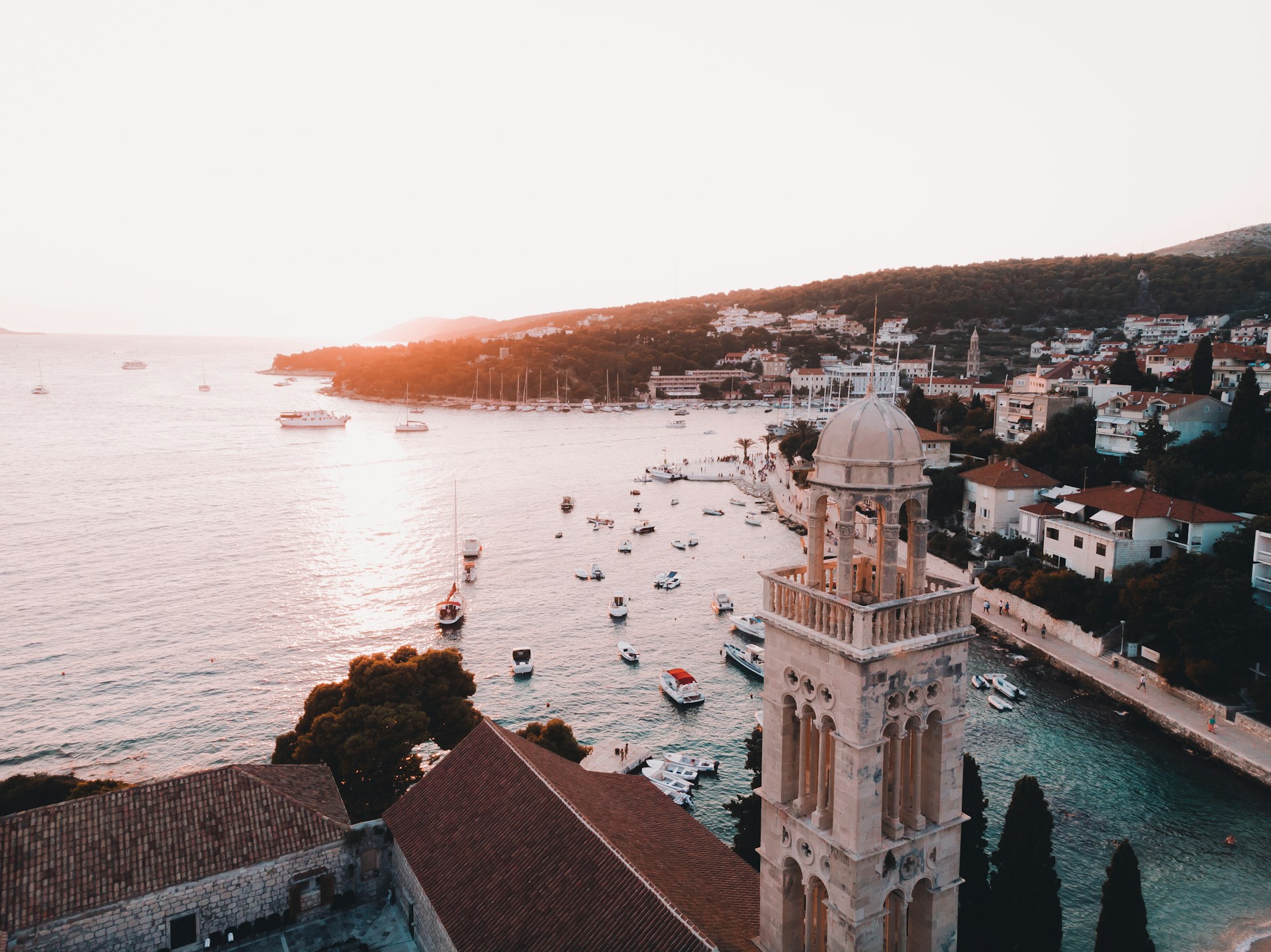
The coast is roughly 1,800 kilometres long, with more than a thousand islands. Trying to cover it in one trip is the standard mistake. Trying to do it from a single base is the opposite mistake. The right structure is short. Three stops along the southern half of the country, between Dubrovnik and the central Dalmatian islands, with two nights at each. Two scheduled boat crossings between them. No rental car necessary.
The three stops form a north-south rhythm with deliberate variation: a walled stone city, a living Roman palace, a small island that has been quietly producing olive oil and lavender for three thousand years. Three different Croatias inside one continuous coastline.
01Why this trail, and why now
Three reasons the moment is right for this trip.
The first is timing inside the season. May, June and September are the three best months for the Dalmatian coast, with sea temperatures from 21 to 24 degrees, daytime air in the high twenties, and the historic centres usable rather than packed. July and August remain crowded, especially Dubrovnik on cruise days, though the islands further north absorb the traffic better.
The second is the maturation of the hotel scene. Croatia produced very little serious boutique accommodation until around 2018. In the last six years the small-property sector has caught up substantially, with a generation of restored stone houses and family-run properties that finally match the geography. The three hotels below all belong to that generation.
The third is the transport infrastructure. The Krilo and Jadrolinija catamarans now run reliable summer schedules between the major Dalmatian ports, including the direct Dubrovnik-Hvar service that did not exist a decade ago. The coast can now be travelled by sea without a chartered boat, which is how it was meant to be done.
Three different Croatias inside one continuous coastline.
| Act | Base | Nights | What sets it apart |
|---|---|---|---|
| Act I — Dubrovnik | Palace Natali | 2 | The stone city at eight in the morning, Pelješac wineries in the afternoon |
| Act II — Split | Hotel Ambasador | 2 | A working Roman palace, the most layered urban experience on the coast |
| Act III — Hvar | Maslina Resort, Stari Grad | 3 | UNESCO Greek plain, lavender, olive, the slowest Adriatic island |
02When to go
The Dalmatian coast has a Mediterranean climate with hot dry summers and mild wet winters. Inside that pattern, four windows are worth knowing.
Mid-May to mid-June is the strongest window for travellers who care about the historic centres. The sea is warming through 21 to 23 degrees by early June, the lavender is in flower across Hvar in mid-June, the restaurants are open but not booked weeks ahead, and Dubrovnik in the morning is quiet enough to walk the city walls without queuing.
Late June to mid-July is high summer in the local sense, when Croatian families take their first holidays. Beaches fill, the islands are busy, and the energy is at peak. Sea temperatures peak around 25 degrees.
Mid-August to mid-September is when international tourism reaches its concentrated peak. Avoid Dubrovnik between 10 August and 25 August unless the rest of the schedule cannot be moved.
Mid-September to mid-October is the second strongest window of the year. The sea is still warm (around 22 degrees through early October), the light has changed to a softer autumn tone, the harvest is happening on the islands (olives, late grapes, lavender oil distillation), and the cruise season has eased.
The single best week, for most travellers, is the first week of June or the last week of September.
03How to move along the coast
Three principles that change the experience.
Use boats, not cars. The Adriatic coast was built around its boats. The Krilo Eclipse and Jadrolinija catamarans connect Dubrovnik, Korcula, Hvar, Split and the smaller islands on daily summer schedules. The journeys are short (Dubrovnik to Hvar takes around three and a half hours direct), the views are part of the trip, and the alternative (a rental car driving the coastal road south of Split) involves several ferry crossings anyway.
Fly into Dubrovnik, fly out of Split. The open-jaw is the right structure. Dubrovnik (DBV) is the southern airport, twenty minutes from the old town. Split (SPU) is the central one, half an hour from the centre by the new road. Round-trip tickets through either airport force a long backtrack.
Take the morning catamaran, not the afternoon. Sea conditions in the central Adriatic are calmer in the morning, particularly in June when the maestral wind picks up reliably from late morning. The morning crossings are the more pleasant journeys.
For travellers who insist on a rental car, the coastal D8 road between Dubrovnik and Split is one of the most dramatic drives in Europe, with the catch that the section through Bosnia (a twenty-kilometre stretch around Neum) requires a passport and adds significant border-crossing time in summer. The alternative is the inland A1 motorway, which is fast and unscenic.
Act I. Dubrovnik: The Stone City
Palace Natali, Dubrovnik (two nights)
Dubrovnik has been studied to death and is still extraordinary. The trick is to time it right.
The old town is at its best between seven and ten in the morning, before the cruise passengers come ashore (the ships dock in Gruz, the cargo port two kilometres north, and the buses arrive at Pile gate around 10:30). The walls walk, which is the single highest-value tourist activity in the city, should be done starting at eight in the morning, not later. By ten the light is already harder and the queues at the wall entrances have formed.
The other window is the evening, after the last cruise ship has departed, usually around six. From 18:30 to 23:00 the old town becomes the working evening city again, with the locals back on the Stradun and the restaurants in the smaller side streets serving Dalmatian food to people who are mostly Croatian. This is the window for dinner.
Between the two windows, the middle of the day in the old town is best avoided. Spend it on the water, on the headland north of the city, or at the property.
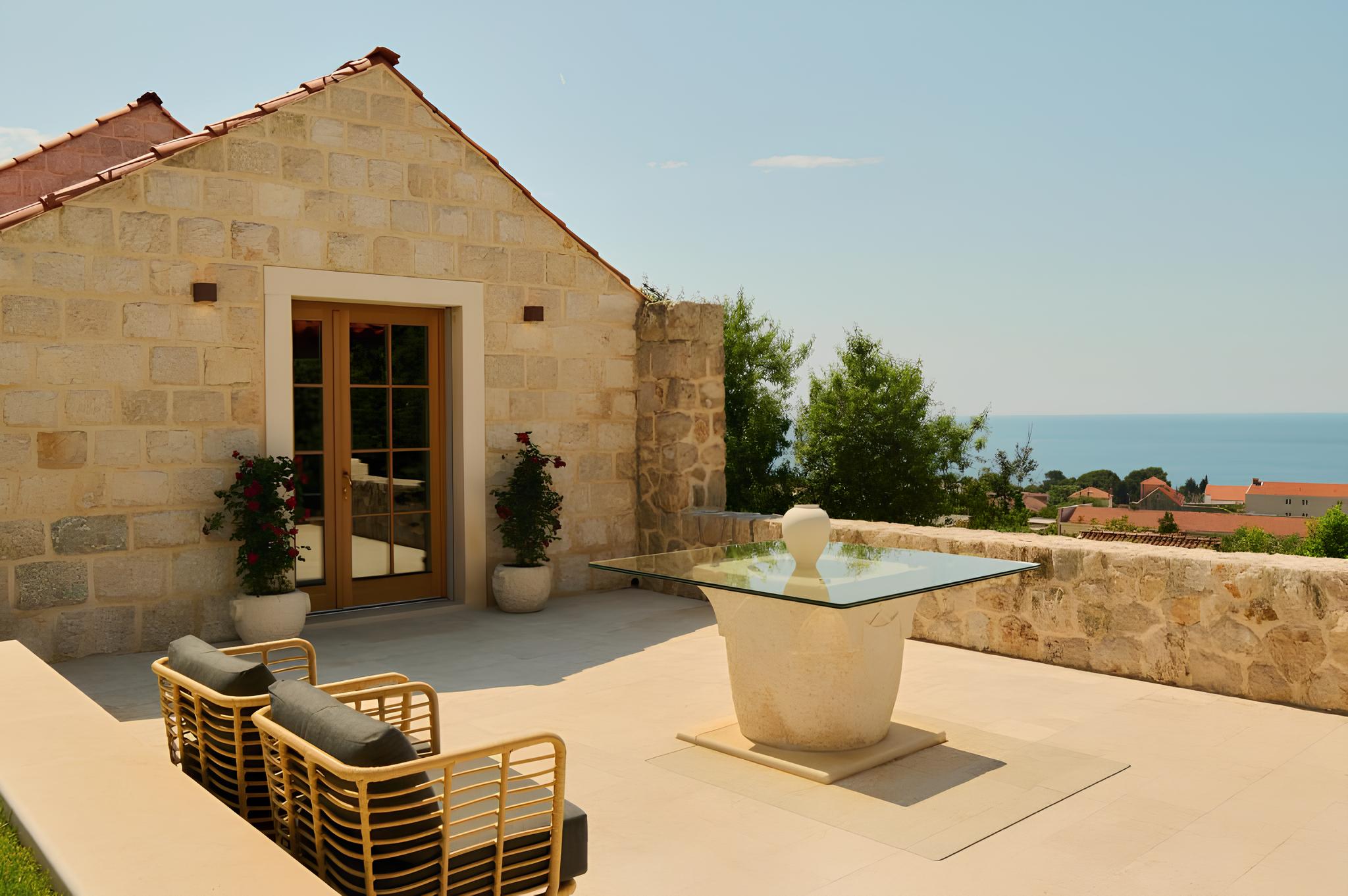
Palace Natali sits in the Dubrovnik-Neretva county just outside the strict cruise-traffic zone, in a restored stone building that uses the regional Dalmatian vocabulary of pale limestone, dark wood, and shaded inner courtyards. The property is small (under twenty rooms), the staff know the names of returning guests after one stay, and the position allows the right kind of arrival into the old town: by water taxi or short transfer, with the option to return to the property whenever the day in the city becomes too dense.
The kitchen serves regional Dalmatian cooking: crni rižot (the squid-ink risotto that is the southern Croatian signature), peka (slow-cooked lamb or octopus under a bell-shaped iron lid, ordered the day before), grilled fish from the morning markets in Gruz. The wine list leans heavily on the indigenous southern Dalmatian grapes, particularly Plavac Mali from the Pelješac peninsula across the bay.
What to do in the two days: the walls walk at eight in the morning of day one; the cable car to Mount Srđ for the late-afternoon view and dinner up at the Panorama restaurant on day one; the Pelješac peninsula by car or hired driver for the wineries (Dingač, Postup) on day two; or, for the alternative, a half-day by boat to Lokrum island, fifteen minutes off the old harbour, which is a forested nature reserve with a Benedictine monastery and a salt-water lake.
Best for: the opening two nights of the coastal trail, with the cultural anchor of the south and the right base for evening Dubrovnik.
Length of stay: two nights.
Memorable detail: the inner courtyard at ten in the evening, after dinner in the old town and the short transfer back, when the limestone of the walls is still warm and the staff bring out one last glass of prošek, the regional dessert wine.
Act II. Split: The Living Palace
Hotel Ambasador, Split (two nights)
Split is the second city of the Croatian coast and structurally the most interesting urban environment in Dalmatia. The historic centre is the Palace of Diocletian, the retirement compound built by the Roman emperor in the early fourth century. What makes Split unlike Dubrovnik, and unlike most preserved Roman sites in Europe, is that the palace is not a ruin: it is a working part of the modern city. Three thousand people still live inside the walls. The Roman peristyle is also the local piazza. The cellars are now coffee bars. The cathedral is the emperor's mausoleum.
This is the city's single most powerful experience. Walking through the iron gate of the palace at eight in the morning, when the locals are crossing the peristyle on their way to work, is unlike walking through any other Roman site. The continuity is real.
The catamaran arrives from Dubrovnik at the central Riva waterfront, which is also the city's main promenade. The position of the port inside the city is one of the practical pleasures of arriving in Split: there is no airport-to-centre transfer, just a short walk from the boat to the hotel.
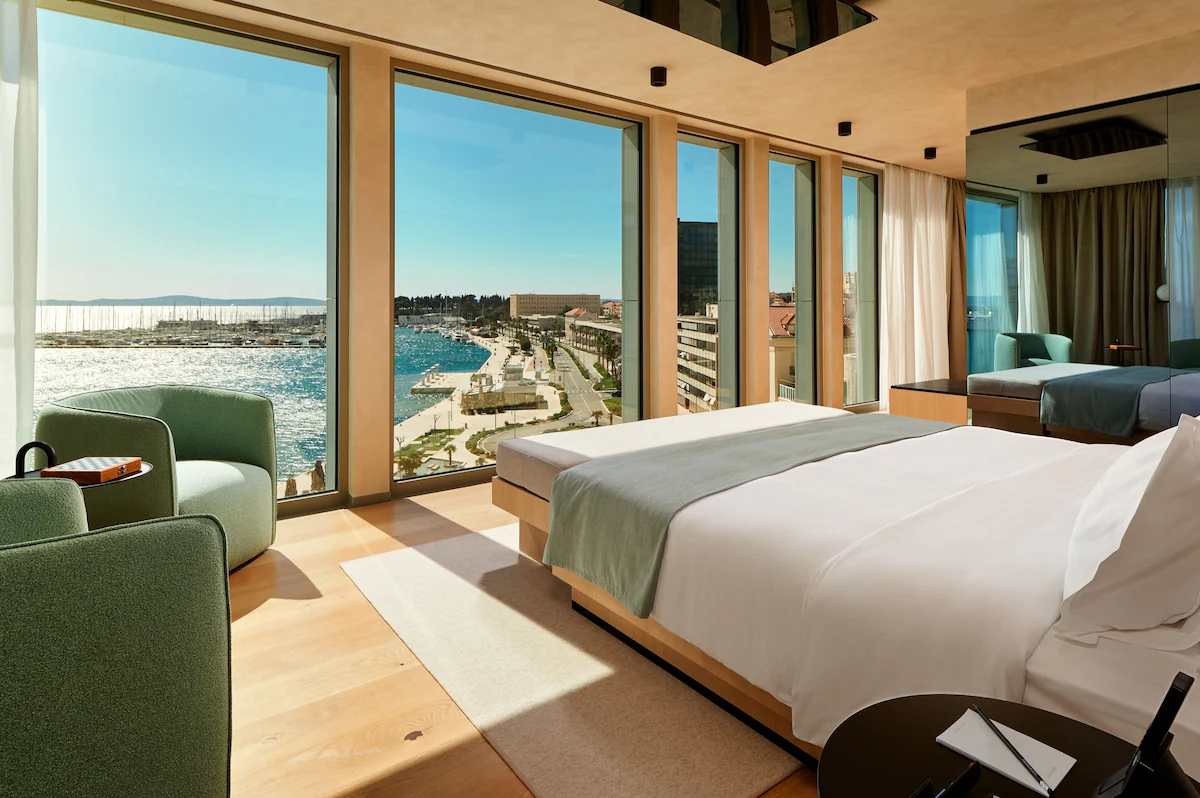
Hotel Ambasador sits on the Split-Dalmatia coast within walking range of the palace, in a contemporary property that handles the city base function: comfortable rooms, good breakfast, a position from which the historic centre is reachable on foot and the rest of central Dalmatia is reachable by boat. The hotel does not try to compete with the palace; it offers what the palace cannot, which is a quiet room at the end of the day.
The kitchen serves a coastal Dalmatian repertoire with strong emphasis on the morning fish market three streets away: brudet (the Dalmatian fish stew), gregada (the slow-cooked fish-and-potato dish from the islands), grilled orada (sea bream) with the local olive oil. The wines run heavily to the indigenous central Dalmatian whites: Pošip from Korčula, Debit from the mainland.
What to do in the two days: the palace walk at eight in the morning, with breakfast inside the walls at one of the small bakeries; the cathedral and Diocletian's mausoleum mid-morning; the small archaeological museum or the Mestrovic gallery in the afternoon of day one; a half-day to Trogir, the small medieval town twenty minutes west, on day two; or alternatively a boat day to the Blue Cave on Biševo island, four hours round trip from Split harbour.
Best for: the middle two nights of the coastal trail, with the most layered urban experience on the Croatian coast.
Length of stay: two nights.
Memorable detail: the peristyle at sunset, when the limestone is gold and the cathedral bells are working through the evening sequence, and the local teenagers are sitting on the steps where Diocletian's court once stood.
Act III. Hvar: The Slow Island
Maslina Resort, Stari Grad (Hvar island, three nights)
Hvar is the longest of the central Dalmatian islands, a thin sixty-eight-kilometre strip parallel to the mainland. The island has two reputations and they are not the same place.
The first reputation is Hvar Town, at the western end, which is the social capital of the island in summer: yachts, late-night clubs, designer beachfront restaurants. This is the Hvar that appears in international press. It is also the smaller part of the island.
The second Hvar is the rest of it: the inland plain (the Stari Grad Plain, a UNESCO World Heritage Site for its preserved Greek field divisions from the fourth century BC), the lavender hills around Velo Grablje, the olive groves that have been worked continuously for two thousand years, the small fishing harbours on the southern coast, and Stari Grad, the island's original capital, founded by Greek settlers from Paros in 384 BC. Stari Grad is older than Athens's Acropolis as a continuously inhabited settlement.
This second Hvar is the one to spend the closing three nights of the trail on. The pace is genuinely different. There are no nightclubs. The dinner crowd is on the harbour by nine and home by eleven. The roads inland are empty by mid-morning.
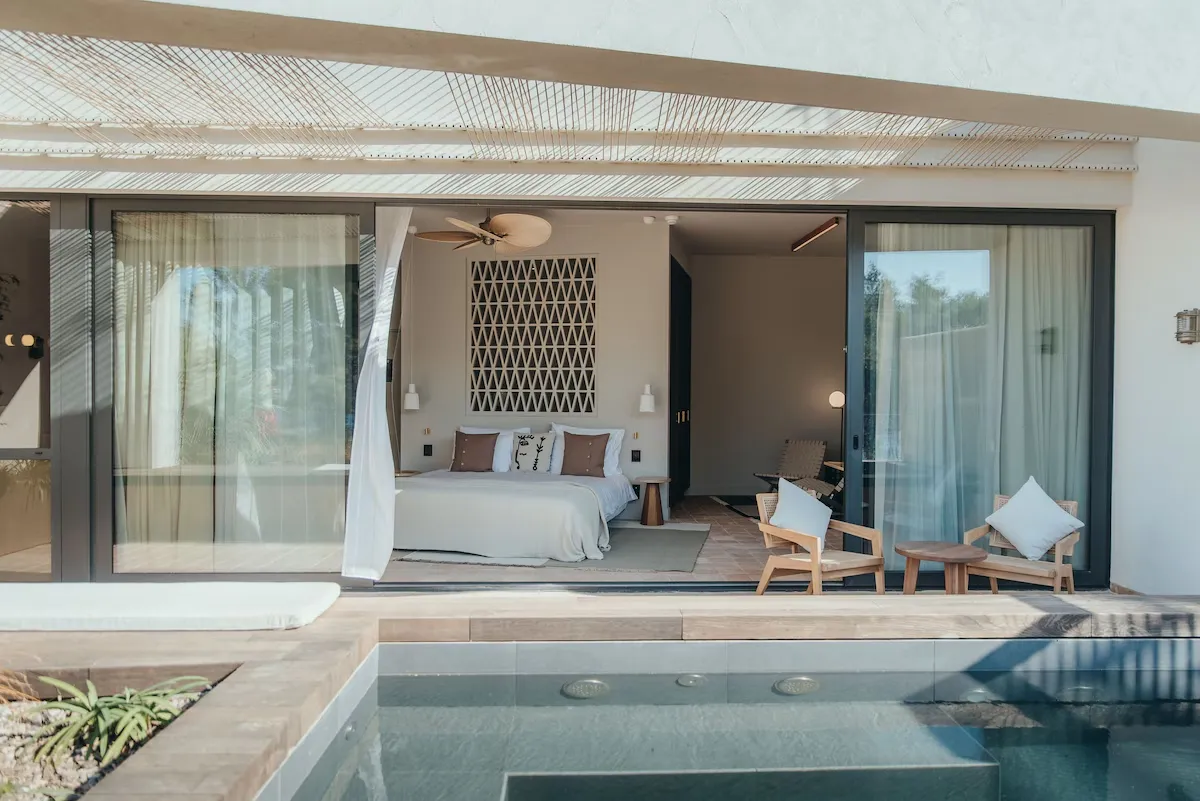
Maslina Resort sits just outside Stari Grad on the Maslinica bay, on a quiet pebble cove with a small private jetty. The property is built into the pine-and-olive coast with a contemporary Dalmatian vocabulary: pale stone, untreated timber, large terraces, and an interior palette that follows the colour of the surrounding olive groves. There are around fifty rooms and suites, organised across a low main building and a row of villas on the slope.
The kitchen is the property's strongest argument. The chef works with the island's producers directly: the olive oil is from a single grove visible from the terrace; the lamb is from the inland plain; the wine list is a long survey of the indigenous Hvar grapes (Pošip, Bogdanuša, Plavac Mali) with most bottles produced within ten kilometres of the kitchen. The breakfast is built around the local stone-fruit preserves, the goat's-milk cheese from the southern slopes, the morning bread from a bakery in Stari Grad.
The spa is small but seriously considered, with treatments that draw on the island's herb tradition: rosemary, lavender, sage, the local immortelle (smilje) that gives the strongest of the regional essential oils. The signature treatment is a long-form ritual that uses Maslinica olive oil from the property's own grove.
What to do in the three days: the Stari Grad Plain by bicycle or on foot at dawn of day one (the property arranges both); a half-day in Stari Grad town with lunch on the harbour; the lavender fields around Velo Grablje on day two, with a tasting at one of the small distilleries; a boat day to the Pakleni islands off Hvar Town on day three, or alternatively a slow morning on the property's own cove with the books from the small library.
Best for: the closing three nights of the coastal trail, on the slowest Adriatic the country offers, with the strongest food of the three stops.
Length of stay: three nights minimum, four if the schedule allows.
Memorable detail: the small jetty at sunset, when the bay light fades behind the pines and the chef sends out one last plate of grilled sardines marinated in the morning's first oil.
04The seven-night structure, at a glance
- Day 1: arrive Dubrovnik, transfer to Palace Natali. Evening in the old town.
- Day 2: walls walk at eight, Pelješac wineries in the afternoon.
- Day 3: catamaran to Split (morning, around four hours via Korčula or Mljet). Afternoon arrival at Hotel Ambasador.
- Day 4: palace walk, archaeological museum, evening on the Riva.
- Day 5: catamaran to Stari Grad on Hvar (morning, around two hours). Afternoon at Maslina.
- Day 6: Stari Grad Plain at dawn, lavender hills inland.
- Day 7: Pakleni islands by boat, dinner on the property.
- Day 8: catamaran Hvar to Split, fly out from Split airport in the late afternoon.
Three properties, three nights at the closing stop, two catamaran crossings, two short transfers. No rental car required.
05Clichés the trail corrects
"Croatia is the new Italy." The two countries face each other across the Adriatic but are not interchangeable. Croatian food is sparer and more focused on grilling. The architecture is Venetian-influenced but materially different (limestone rather than terracotta). The local conversation culture is more reserved than Italian. Different rather than transitional.
"Hvar is a party island." The western end (Hvar Town) is. The rest of the island, where this trail spends its closing nights, is one of the quietest places on the central Adriatic.
"You need a rental car to see Croatia." Not for this trail. The catamarans connect the three stops directly. A car between Dubrovnik and Split adds the Bosnia border crossing and several hours of motorway driving in exchange for a coastal road that is genuinely spectacular but tiring.
"Dubrovnik is ruined by tourism." Dubrovnik in August at midday is unpleasant. Dubrovnik in early June at eight in the morning is one of the great walled-city experiences in Europe. Timing solves the problem.
06Frequently asked questions
| Question | Answer |
|---|---|
| When is the best time to visit the Croatian coast? | The first week of June or the last week of September. Both windows offer warm sea, the historic centres are usable, the islands are open but not crowded, and prices have not yet hit summer peaks. |
| How long do visitors need on the Croatian coast? | A first trip should be at least seven nights to cover three stops meaningfully. The structure above uses two-two-three. Shorter trips force either a single base (which misses the variety) or constant movement (which misses the islands). |
| Do travellers need a car in Croatia? | Not for this trail. The catamarans connect the three stops on daily summer schedules. For a different itinerary inland (Plitvice lakes, Istria, the Zagreb-to-Dubrovnik overland route) a car becomes necessary. |
| Is the Croatian coast family-friendly? | Yes. The pebble beaches are easy with children, the small harbours are safe, and the boat travel becomes part of the trip. The three properties listed above all accommodate families. |
| What about Plitvice lakes? | Plitvice is in the interior, around halfway between Zagreb and Split. It is one of the country's iconic landscapes but requires a full day of inland driving in each direction from the coastal trail above. Better added as a separate inland leg, either before or after the coastal one. |
| What about Istria? | The peninsula in the far north of the country, with strong food traditions (truffle, olive oil, the Italian-influenced cuisine) and the Roman amphitheatre at Pula. Worth a separate three-night trip, not easy to combine with the southern coastal trail above without significant transit. |
| How does the Croatian coast compare to the Greek islands? | Croatia is more architecturally Venetian, less aggressively summer-built, and structurally closer to Italian coastal culture. The Greek islands are more atomised, more dependent on the ferry network, and more weighted toward beach culture. Different sea, different sky. |