Where to Stay in Tokyo in 2026: The Complete Guide to the City's Two Faces
Tokyo is not one city. It is at least two, held inside the same boundary lines. The first is residential, low-rise, almost rural in its rhythm, where dusk arrives as a quietening of one of the densest urban areas on earth. The second is the Tokyo of the lit towers, the skyline that Japanese cinema has spent fifty years interpreting and that has added another generation of architectural statements since 2020. This guide is built around that diptych. Two boutique hotels from the Top World Hotel network anchor it; everything else, from when to go and how to get there to what to eat and where to day-trip, sits around them.
01When to go to Tokyo
Tokyo has four meaningful windows. The choice between them is consequential.
Late March to mid-April is the cherry blossom season, the most photographed travel window in Japan and one of the most over-booked. The blooms last around ten days at any given location and move from south to north across the country; central Tokyo is typically in peak bloom in the last week of March and the first week of April. Hotel rates are at their absolute peak, restaurants are booked weeks ahead, and the parks (Ueno, Shinjuku Gyoen, the Imperial Palace moat) are crowded from morning until late evening. The blossoms are worth the trip. The conditions are not for everyone.
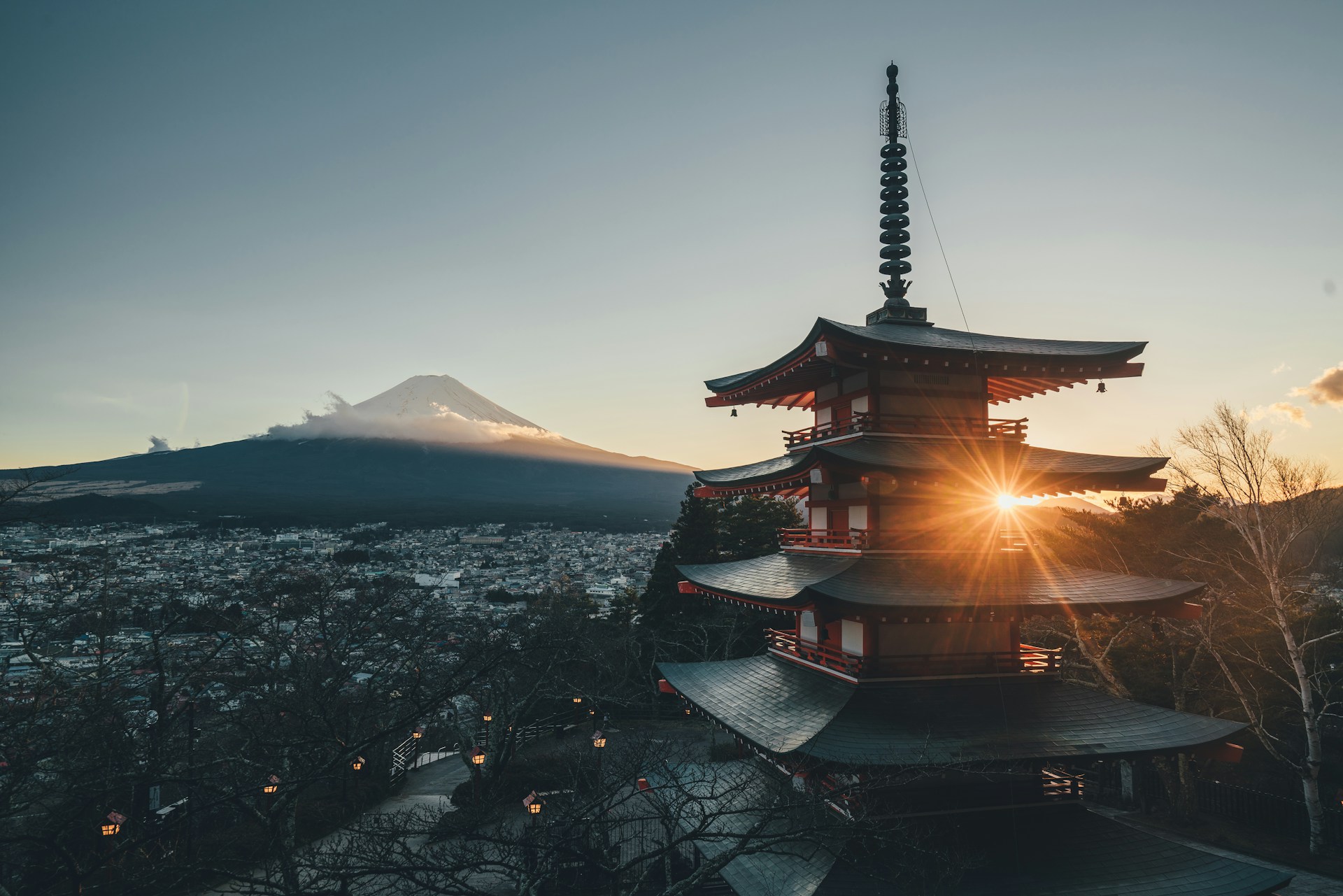
Late October to mid-November is the strongest single window of the year. The autumn colour begins inland and reaches central Tokyo through November; the weather is dry, the air is unusually clear (the post-typhoon atmosphere produces some of the year's best photographs of Mount Fuji from the upper floors of the central towers), and the city's restaurant culture is at its most active. International tourism is significantly lighter than in the cherry blossom window. For a first Tokyo trip, this is the optimal moment.
December and January are the city's quiet luxury window. The temperatures are cold (highs around eight to ten degrees, lows around freezing), but the light is the year's clearest and the residential neighbourhoods on the west side are at their most atmospheric. The new year period (the last days of December and the first three of January) is when many small restaurants close for the holiday; either book around it or use the closures to slow the trip down.
Late May through September is the difficult window. Late May through June is the rainy season (the tsuyu), with three to four weeks of grey weather. Late June through August produces the city's heat: temperatures regularly hit thirty-four to thirty-six degrees with humidity in the high seventies, which makes daytime walking arduous. September can be unstable because of typhoon season. None of these months are impossible, but they are the months experienced Tokyo travellers actively avoid.
Avoid: the Golden Week period in early May (the first week, a Japanese national holiday when domestic travel saturates every system), the Obon period in mid-August (similar pattern), and the year-end days from 29 December through 3 January (many smaller restaurants and shops are closed).
02How to get to Tokyo
Tokyo is served by two international airports. The choice between them shapes the first and last few hours of the trip.
Haneda (HND) sits on the bay south of central Tokyo. From Haneda to a central hotel is around twenty-five to forty minutes by taxi (around 7,000 to 9,000 yen depending on traffic) or thirty minutes by the Tokyo Monorail and a metro change. Haneda has substantially expanded its international long-haul programme over the last decade and is now the better arrival airport when bookable, particularly on flights arriving late at night.
Narita (NRT) is the older international hub, sixty kilometres east of Tokyo. From Narita to central Tokyo is roughly sixty to eighty minutes by the Narita Express train (around 3,000 yen, runs directly to Tokyo Station, Shinjuku and Shinagawa), or ninety to a hundred minutes by the Limousine Bus or a taxi (the latter costs around 25,000 yen and is rarely the right choice). Narita is fine if Haneda is unavailable; the train is the right transfer mode.
Open-jaw tickets (into Tokyo, out of Osaka or Fukuoka) are widely available and cost roughly the same as round-trip Tokyo. Travellers combining Tokyo with Kyoto, Hakone or further west should use the open-jaw rather than backtracking. The Shinkansen (the bullet train) from Tokyo Station to Kyoto is two hours and twenty minutes; to Osaka is two hours and forty-five.
The Japan Rail Pass, after its 2023 price increase, is no longer the obvious purchase it once was. For a trip that stays around Tokyo and makes one Shinkansen return to Kyoto, the pass usually costs more than buying individual tickets. For a trip that crosses the country (Tokyo to Hiroshima or Fukuoka and back), the pass remains worthwhile. Calculate before buying.
03How to move around Tokyo
Tokyo's public transport is one of the world's better travel experiences. Three principles cover most of what a first-time traveller needs to know.
The metro is the city's spine. Two networks run in parallel (Tokyo Metro, with nine lines, and the smaller Toei Subway), and both accept the same Suica or Pasmo IC card, which is loaded once and tapped at every gate. The Suica card on a smartphone (the digital version) is the cleanest set-up. Avoid buying paper tickets at every station; the time loss compounds.
JR lines connect the larger geography. The Yamanote line is the loop around central Tokyo, running through every district most international travellers will visit (Tokyo Station, Shinjuku, Shibuya, Harajuku, Ueno, Akihabara). The Chuo and Sobu lines run east-west across the city. The Odakyu line runs west-southwest into Setagaya and onward to Hakone. The Tokaido line runs south toward Yokohama and Kamakura.
Walk between adjacent stations. Tokyo's neighbourhoods are smaller than they look on the map. The distance between Roppongi and Azabu-Juban, between Shibuya and Harajuku, between Asakusa and Ueno, is in every case a fifteen-to-twenty-minute walk, and the walk is more interesting than the train. The city rewards pedestrians more than the official tourist material admits.
Taxis are clean, professional and surprisingly affordable for short hops in the central districts. The fare structure changed in 2017 to a low starting rate (around 500 yen for the first kilometre) and a meter that accumulates steadily afterward. For a short evening hop from a Roppongi restaurant back to the hotel, a taxi is often more pleasant than the metro. For longer cross-city distances, the train is faster.
Avoid driving. Driving in Tokyo is unnecessary and frustrating. Parking is expensive, the streets are narrow, and the public transport handles the journey in less time.
04Two Tokyos: the diptych at the heart of this guide
The most useful frame for thinking about where to stay in Tokyo is not the standard neighbourhood-by-neighbourhood breakdown that most guidebooks offer. The useful frame is the one the city itself proposes: the residential Tokyo and the architectural Tokyo, two registers that the city holds simultaneously and that the right traveller reads as a pair.
The two registers map cleanly onto two boutique hotels in the Top World Hotel network. What follows are the two portraits.
05Portrait One: the residential Tokyo
Yuen Bettei Daita, Setagaya
In a quiet residential street in Setagaya, a long way from the lit central districts that most international travellers picture when they think of Tokyo, a small road slopes gently down between low houses, a temple, a few small shops that still sell tofu and pickled vegetables from the same families that opened them in the 1970s. The trees along the road are the standard urban Japan mix: ginkgo, plum, a couple of older zelkovas whose canopies briefly meet across the asphalt.
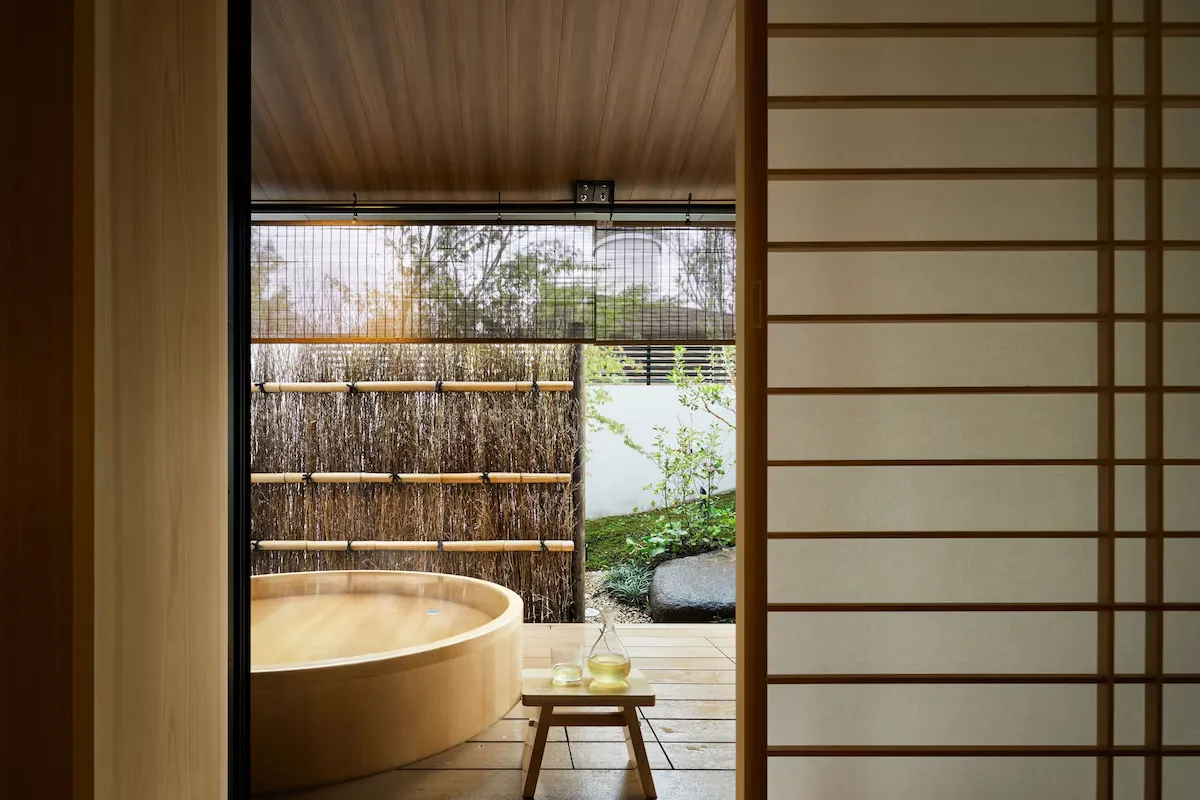
At the end of this road, behind a discreet entrance, sits Yuen Bettei Daita. The hotel is small, around twenty rooms organised around a central garden and the property's own onsen-style bath, drawn from a hot spring whose water is trucked nightly from Hakone. The architecture is contemporary but reads as if it has always been there: dark cedar, slate, paper screens, the long low rooflines of the Japanese residential vernacular. The interior follows the same restraint. Rooms have a tatami floor, a deep wooden bath, a low futon-style bed, and a window that opens onto either the garden or the residential street.
The neighbourhood is the second half of the proposition. From the property's door, a fifteen-minute walk leads to Shimokitazawa, the small-bar and second-hand bookstore neighbourhood that has been one of the city's intelligent corners for two decades. The opposite direction leads into the long quiet streets of Setagaya proper, with the old wooden houses that have survived because the postwar rebuilding never quite reached this far west. Twenty minutes by the Odakyu line and the traveller is in Shinjuku; thirty minutes and they are in central Tokyo. The point of staying here is to come back to the quiet.
The hotel's evening rhythm completes the portrait. Dinner is served at the property in a small dining room, a tasting of the regional Japanese repertoire built around vegetables, smaller portions of fish, and a discreet sake list. The bath is open until late and the property's design assumes the guest will use it twice on the day of arrival. The light in the rooms drops gradually toward eight in the evening. By ten the only sound from the street is the distant rumble of the Odakyu line, the residential commuter rail whose station is a quiet ten-minute walk away.
Best for: the first Tokyo trip when the traveller wants to read the city through its residential rhythm, returning travellers who already know the central districts, anyone for whom a hot bath at the end of the day is part of why they came to Japan.
Length of stay: three to five nights as part of a seven-to-ten-night Tokyo trip.
Memorable detail: the garden bath at six in the evening, when the cedar lining catches the warm light and the steam reflects off the paper screens above.
06Portrait Two: the architectural Tokyo
Janu Tokyo, Azabudai
The second Tokyo arrives at the airport in a different mood. The traveller takes the Narita Express toward Tokyo Station, or the Limousine Bus from Haneda toward Roppongi, and watches the skyline rise. The shape of the city changes in this approach. Setagaya is invisible from this angle. What is visible is the new central Tokyo: the towers around Azabudai, the redevelopment of the Toranomon district, the long curves of the new bridges over the Sumida, the architectural statements the city has accumulated since 2020.
At the heart of this second Tokyo sits Janu Tokyo, the property that has, since its opening, become one of the reference points for the contemporary Tokyo luxury stay. The hotel sits inside the Azabudai Hills development, a multi-tower complex by Heatherwick Studio and Pelli Clarke & Partners that has redefined the central Tokyo skyline. The architecture is bold and assured. The interiors carry the same intention.
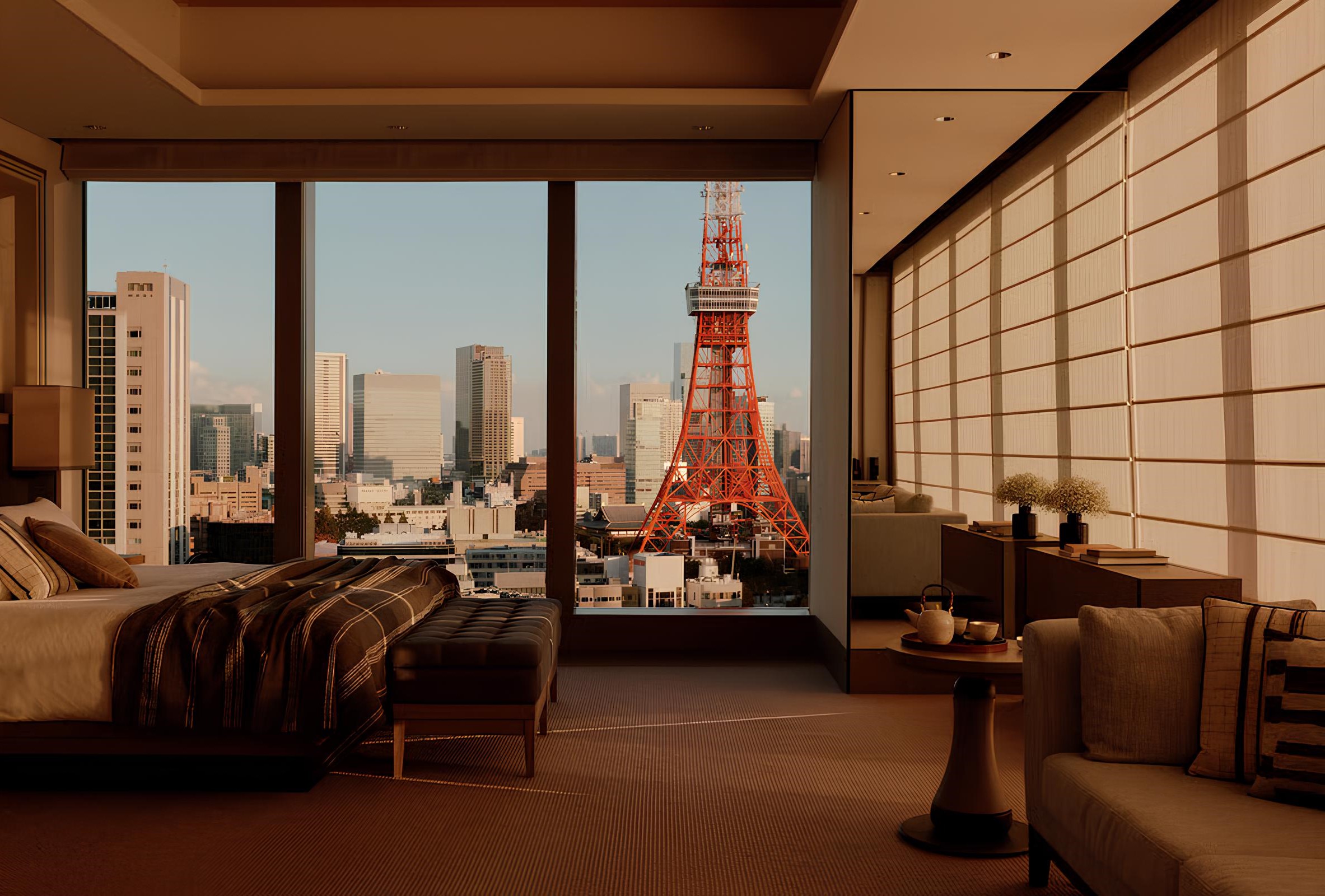
The proposition of Janu is different from Yuen Bettei's at almost every level. The rooms are large by Tokyo standards, with city views that drop directly into the heart of the new central district. The wellness floor is one of the most ambitious in the city: a four-thousand-square-metre spa across multiple floors, two pools, a long fitness floor, a hot-and-cold plunge sequence, and a treatment menu that takes the contemporary Japanese wellness tradition seriously without slipping into ryokan pastiche. The kitchens (the property runs several) cover a range from formal Japanese to contemporary European, all at a level that competes with the best Tokyo standalone restaurants.
The district around the hotel is the second half of the proposition. The walk from Janu passes through the Azabudai gardens, around the Mori-Pelli tower, into the streets of Roppongi and the museum corridor that runs from the National Art Center toward the Mori Art Museum and the 21_21 Design Sight. The evening, here, is the one of the lit towers, the rooftop bars, the late dinners in the small contemporary kitchens that the central districts have produced since 2020.
Best for: second or third Tokyo trips when the city is no longer new and the architectural Tokyo becomes the more interesting register, family trips that want the resort-style wellness operation, business travel that needs a serious work-and-life-balance setting.
Length of stay: three to four nights, often as the second leg of a longer Tokyo trip that begins residential.
Memorable detail: the upper-floor view at the moment dusk turns the city from pale grey to lit pink, with the geometry of Azabudai Hills picking out the skyline against the soft horizon.
07The shared dusk
The instructive moment is dusk. At Yuen Bettei in Setagaya, dusk arrives as the trees outside the window darken first and the rooms hold the residential warmth a little longer; the street lamp at the end of the lane comes on around half past five in winter, half past seven in summer, and the building inside the garden becomes, briefly, the most luminous object on the street. The bath is at its best in this hour, with the lights low and the steam rising into the cedar ceiling.
At Janu in Azabudai, the same dusk arrives differently. The towers around the property begin to register against the sky, the lit edges of the architecture pick out the geometry of the district, and the view from the room performs a gradual transformation from the pale flat city of the afternoon to the lit, layered city of the evening. The bar on the upper floor at this hour is the city's reading of itself.
Two dusks. One city. The point of the diptych is that both readings are accurate. Tokyo holds the residential calm and the architectural drama at the same time, on the same evening, two underground stops apart.
08What to eat in Tokyo
Tokyo has more restaurants with international stars than any other city in the world. The official statistic, repeated in every guide, is true and misleading. The interesting Tokyo food story is not the formal kaiseki at the top; it is the depth of the second and third tiers, the small specialist kitchens that run on one product done at a level no other city sustains.
Sushi. The Tokyo sushi tradition splits into two registers. The serious omakase bars, twelve or fewer seats, single sitting, chef-led: the experience that costs forty thousand to a hundred thousand yen per person and is the city's signature meal. These require booking through the hotel concierge, often months in advance. The neighbourhood sushi counter, the standing sushi bar at Tsukiji or the small bar in Ebisu: the same product at a tenth of the price and a different (but not inferior) experience. Do both at least once on the trip.
Soba and udon. The buckwheat and wheat-noodle tradition is the working Tokyo lunch. The small soba shops with the cold soba and the dipping sauce, or the standing-counter tachigui for a quick midday bowl, are the city at its most efficient and most regional. Soba is at its best in autumn, when the new harvest shinsoba arrives in late October.
Ramen. Tokyo has, by some estimates, around five thousand ramen shops. The variety covers tonkotsu, shoyu, miso, shio, and the specialist regional styles imported into the city. The serious ramen bowl in 2026 costs roughly 1,500 yen at a top-tier shop. For a first Tokyo ramen, the small specialist in Yoyogi-Uehara is a defensible default; for a deeper exploration, ask the hotel concierge for the current top three in the neighbourhood.
Izakaya. The Japanese pub, where the food is small plates and the drink is beer, sake or shochu, is one of the city's essential experiences. The grilled chicken (yakitori) bars under the railway arches in Yurakucho and Shimbashi are the most documented version; the small izakaya in residential neighbourhoods (Setagaya, Yoyogi, Nakameguro) are the more pleasant.
Kaiseki. The multi-course seasonal Japanese tradition, served in formal restaurants with a single sitting per evening. A serious kaiseki dinner in Tokyo runs from forty thousand to over a hundred thousand yen per person, sits on a months-ahead booking, and is one of the world's serious dining experiences. Reserve through the hotel.
Coffee. Tokyo is, alongside Melbourne and Oslo, one of the most serious coffee cities in the world. The small specialist shops (Yanaka, Kichijoji, Shimokitazawa, Daikanyama) are worth the trip for the coffee culture alone. The morning hour at one of these shops is the city's most underrated experience.
09What to do in Tokyo
An honest short list, weighted by what actually repays the time spent.
Walk the residential west. Setagaya, Yoyogi-Uehara, Yanaka. The streets of older Tokyo that survived the postwar reconstruction. Half a day at least, ideally an early morning.
The museum corridor of Roppongi. The National Art Center, the Mori Art Museum, and 21_21 Design Sight are within a fifteen-minute walk of each other. A serious half-day visits the current exhibitions at all three. The Mori observation deck is the better Tokyo skyline view than the Tokyo Tower or Skytree.
The Meiji Shrine and Yoyogi Park. The shrine itself is the city's largest and quietest religious space; the surrounding park is the central Tokyo green lung. Go at seven in the morning when the wedding processions and the early shrine maintenance produce the most photogenic atmosphere.
The fish market at Toyosu. The successor to Tsukiji. The tuna auction (around five in the morning, booking required) is for the committed; the visitor galleries during normal hours and the surrounding sushi breakfast are the easier version.
Asakusa and the Senso-ji temple. The most-visited Tokyo cultural site for a reason. Go at six in the morning or after nine in the evening to avoid the daytime crowd; the temple lit at night is unlike anything else.
The Imperial East Garden. The accessible part of the Imperial Palace grounds, with the moat, the old guardhouses, and the gardens that change month by month. A quiet hour.
Shibuya, briefly. The famous scramble crossing is worth seeing once, at night, from the upper-floor window of one of the surrounding buildings (Magnet by Shibuya109 has the standard angle). Stay no longer; the area is not the city's interesting part.
10Day trips from Tokyo
The city's location makes three day trips genuinely workable, with one onward-stay option worth adding.
Hakone is the standard Tokyo escape: hot springs, the foothills of Mount Fuji, the boat across Lake Ashi. Reachable in around ninety minutes from Shinjuku on the Odakyu Romance Car. Workable as a day trip but better as a one-night stay at a proper ryokan; the value of Hakone is in the evening bath, not the daytime sightseeing. From Yuen Bettei in Setagaya, the Odakyu line provides the direct connection.
Kamakura is the small coastal town an hour southwest of Tokyo by the JR Yokosuka line. The Great Buddha at Kotoku-in, the bamboo grove at Hokoku-ji, the Hase-dera complex with the sea view, and the small surf-and-coffee streets near the beach. A clean day trip; lunch at one of the small restaurants near the Tsurugaoka shrine is the best Kamakura meal.
Nikko is further (two hours by train) and bigger: the seventeenth-century Toshogu shrine complex, the lakes and waterfalls in the surrounding national park, the older temples that ring the central site. Workable as a long day trip from Tokyo (six in the morning departure) but more naturally a one-night stay if the schedule permits.
Kyoto is two hours and twenty minutes by Shinkansen and is not a day trip; it is the natural second leg of a Japan trip. A second-trip traveller can do Tokyo for five nights and Kyoto for three; a first-trip traveller is better served by spending the whole week in Tokyo and visiting Kyoto on a return.
11Clichés worth correcting
"Tokyo is too big to figure out." Tokyo is large in population, but the central area that interests most travellers is roughly the Yamanote loop, a circle around twelve kilometres in diameter, plus the western residential districts. That geography is no bigger than central London. The Tokyo metro and the JR network handle the rest. The city rewards the traveller who treats it like a small set of neighbourhoods strung along train lines, not like a single mega-city.
"You need three days for Tokyo." Three days is enough only to skim the surface. The honest minimum for a first Tokyo trip is five nights, and seven to ten is the right number. The properties recommended above both reward longer stays.
"Shibuya is the centre of Tokyo." Shibuya is the most photographed Tokyo neighbourhood but not the most interesting one. The central Tokyo of contemporary cultural and architectural life sits east of Shibuya, around Roppongi and the new Azabudai district. The residential Tokyo sits west of Shibuya, in Setagaya. Use Shibuya as a transit hub, not a base.
"Japan is expensive." The high-end of Japan is expensive, in line with London or New York. The middle and lower tiers of Tokyo, including some of the best food experiences, are significantly more affordable than equivalent meals in any other major city. A serious ramen in Tokyo costs 1,500 yen. The same quality of bowl in London or Paris would be three times the price.
"You need a JR Pass." Not always. The 2023 price increase made the pass uneconomic for most Tokyo-centred trips. Calculate the individual ticket cost before buying the pass.
"Tokyo is unfriendly." Tokyo is reserved, which is not the same thing. Service in Japanese hotels, restaurants and shops is among the most attentive in the world. The reserve is a function of the cultural register, not a sign of indifference.
12A suggested seven-night structure
The honest seven-night first-time Tokyo trip looks roughly like this.
- Day 1: arrive Haneda, transfer to Yuen Bettei in Setagaya, light dinner at the hotel, early evening bath, early night.
- Day 2: walk through Setagaya in the morning, lunch at a Shimokitazawa coffee-and-pastry spot, afternoon in the Meiji Shrine and Yoyogi Park, dinner at a small izakaya in the neighbourhood.
- Day 3: morning visit to the Toyosu fish market and a sushi breakfast nearby, midday in Asakusa for Senso-ji, evening back in the residential west for dinner.
- Day 4: transfer to Janu Tokyo in Azabudai (a short cab ride or one metro change), afternoon in the Roppongi museum corridor, evening dinner in one of the contemporary Azabudai or Hiroo kitchens.
- Day 5: full day in central Tokyo (Imperial East Garden, the Marunouchi business district, Ginza for lunch and a small shop), evening rooftop drink at the hotel.
- Day 6: day trip to Kamakura, returning to Janu in the evening for a final dinner in the central district.
- Day 7: half-day for any remaining city walk, late afternoon transfer to Haneda or onward train to Kyoto.
For ten nights, add two more residential nights at the start (deeper exploration of Setagaya, Shimokitazawa, Yanaka) and one more architectural night at the end (a serious dinner programme through the contemporary Tokyo kitchens). For fourteen nights, fold in a Hakone one-night onsen stop between the two Tokyo halves.
13Frequently asked questions
| Question | Answer |
|---|---|
| Where should I stay in Tokyo for a first trip? | For a first Tokyo trip, the residential western neighbourhoods (Setagaya, Shimokitazawa, parts of Meguro) are often the more rewarding base. The traveller reads the city through the way it actually works for residents, with the central architectural districts as evening destinations rather than the constant backdrop. Yuen Bettei Daita is the network's reference property in this register, with Janu Tokyo in Azabudai as the contemporary counterpoint for the second half of a longer trip. |
| What is the best month to visit Tokyo? | Late October to mid-November is the single strongest window of the year: dry weather, clear air, autumn colour, and significantly lighter tourism than the cherry blossom season. Late March to mid-April is the cherry blossom window, the most photographed but also the most crowded and expensive. January is the city's quiet luxury moment. |
| How many days do I need in Tokyo? | Seven nights is the realistic minimum for a first Tokyo trip. Ten is the proper number, allowing three nights in the residential west, four in the central district, and two day trips. Three to four nights is enough only to scratch the surface; the city's depth requires time the standard short city break does not allow. |
| How do I get from Narita to central Tokyo? | The Narita Express train is the cleanest option: around sixty minutes to Tokyo Station or Shinjuku, around 3,000 yen, runs every thirty minutes. The Limousine Bus is slower and slightly cheaper. Taxis from Narita are not recommended; the fare is around 25,000 yen and the journey is rarely faster than the train. |
| What are the best day trips from Tokyo? | Hakone for hot springs and Mount Fuji (ninety minutes by Odakyu line), Kamakura for the coast and the Great Buddha (an hour by JR), and Nikko for the Toshogu shrine and the national park (two hours by train). Hakone is best as a one-night onsen stay rather than a pure day trip. Kyoto is a second leg of a Japan trip, not a day trip. |
| How much does a luxury Tokyo trip cost? | A seven-night first-time Tokyo trip with stays at the two network properties, flights from Europe, all transfers and a serious dining programme runs in the range of eight thousand to fifteen thousand euros per person, depending on the season and the dining-up choices. The cherry blossom and high autumn windows push the upper end; January and February push the lower. |
| How does Tokyo compare to Kyoto? | Tokyo is the contemporary, residential and architectural city; Kyoto is the traditional, cultural and ritual city. The two together produce the proper Japan trip. A first Japan trip can do Tokyo only (seven to ten nights) and save Kyoto for a return. A second Japan trip should combine them with the open-jaw flight and the Shinkansen between. |