Inside the Riads of Marrakech: A Guide to the City's Courtyard Houses
In a city built for noise, the riad is an architecture of quiet. To step through its low door is to leave Marrakech and find it again, turned inward, arranged around a single square of sky.
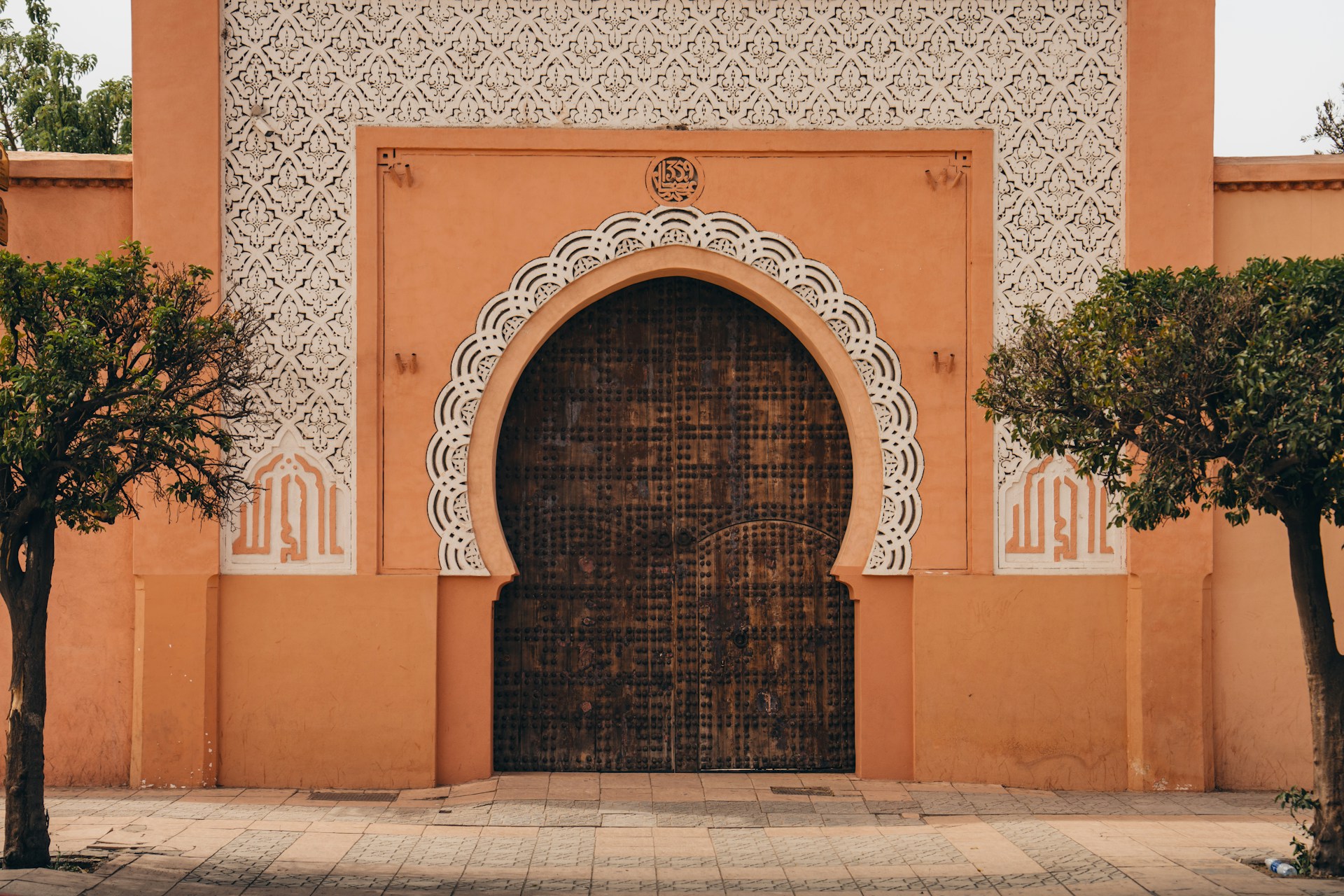
Most travelers meet Marrakech as a wall. The medina shows the street a long, unbroken face of pink-brown pisé, pierced only by studded doors and the occasional iron grille. There are few windows, and the ones that exist are small and set high. A first-time visitor reads this as secrecy. It is closer to the opposite. The riad turns its back on the street not to hide, but because everything it cares about, the light, the water, the garden, the family, has been moved to the center of the house. The blank wall is a promise. Behind it, the city keeps its best room.
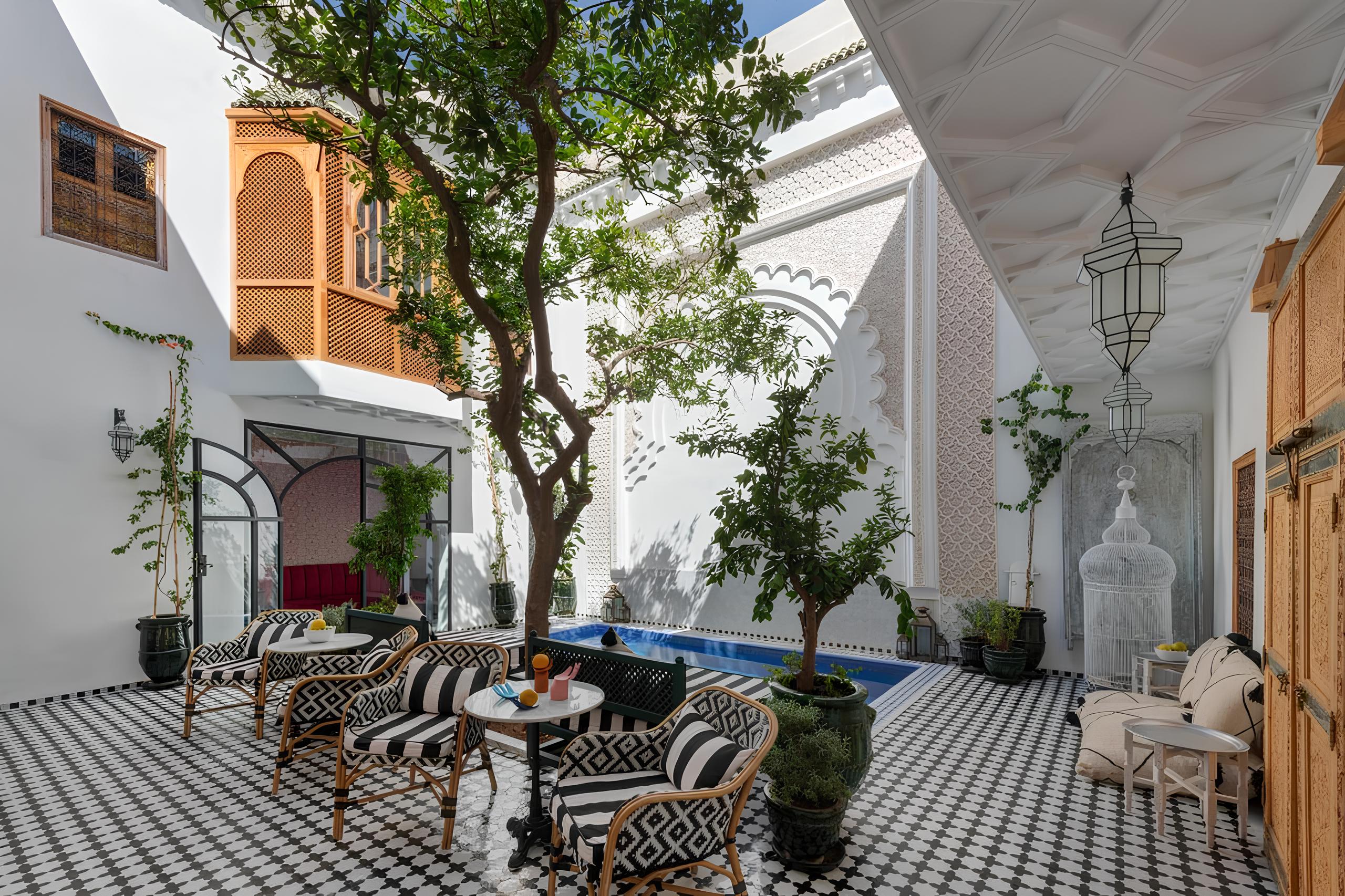
The word itself explains the design. Riad comes from the Arabic for garden, and the classic riad is a house wrapped around one. Rooms rise on two or three floors around an open courtyard, usually with a fountain or a small pool at its heart and four planting beds set in a cross, an echo of the Persian chahar bagh and, further back, of the garden as an image of paradise. The plan is almost monastic in its logic. The outside is given nothing. The inside is given everything.
A house built around the sky
The courtyard does the work that windows do elsewhere. Because the rooms open onto it rather than onto the street, the riad solves the two oldest problems of building in a hot, crowded place at once. It stays private, since no neighbor and no passer-by can see in. And it stays cool, because the tall shaded shaft of the courtyard pulls warm air up and out while the fountain and the planting hold a little damp in the dry afternoon. Long before air conditioning, the riad was a climate machine dressed as a poem.
Materials carry the same intelligence. Floors and lower walls are often finished in tadelakt, a polished lime plaster sealed with black soap and burnished with a stone until it turns waterproof and faintly luminous, soft as skin to the eye. Above it run zellij, the hand-cut geometric tilework whose star patterns repeat without ever quite resolving, and gebs, carved plaster cut into lace while still wet. None of it depicts a face or a figure. The decoration is mathematics made tender, pattern standing in for image, which is its own quiet lesson in how this culture chose to look at beauty.
Then there is the roof. The riad's fourth great room has no ceiling but the sky. The terrace is where the household goes at dusk, when the call to prayer crosses the city from a dozen directions at once and the Atlas Mountains, snow-topped well into spring, draw a hard line on the southern horizon. A traveler who spends one evening on a riad rooftop with mint tea cooling in the glass understands the building better than any floor plan could explain it.
The riad is not a small hotel with Moroccan decoration. It is a way of living that hotels later learned to borrow.
From family house to boutique stay
For centuries the riad was simply how the merchant and artisan classes of Marrakech lived, generations stacked around the same courtyard, the ground floor for receiving guests and the upper floors for the family. Through the twentieth century many fell into disrepair as families left the medina for modern villas in the new town. What saved them was an unlikely second life. From the 1990s onward, a wave of restorers, many of them foreign, began buying crumbling courtyard houses and bringing them back, room by hand-finished room, often as small guesthouses of five to ten keys.
That history matters to anyone choosing where to sleep. A riad is, almost by definition, a boutique experience. It is intimate by construction, since the courtyard plan cannot scale, and it is personal by tradition, since the form grew out of a private home. Breakfast tends to arrive on the terrace. The staff often number more than the rooms. The trade, compared with a large resort outside the walls, is space and predictability for atmosphere and place. Inside the medina there is rarely a swimming pool worth the name and almost never a gym. What there is instead is the thing that brought the traveler to Marrakech in the first place.
Among the courtyard houses that have made this transition with care, Riad Botanica sits firmly in the green tradition the name promises, a medina house where planting and water are treated as the main event rather than the backdrop. It is the kind of address that rewards travelers who came for the idea of the riad and not merely for a bed in the old city.
What the courtyard teaches the day
Staying in a riad changes the shape of time. A resort organizes the day around its facilities. A riad organizes it around light. Morning belongs to the courtyard, cool and blue-shadowed, the best hour for breakfast and for the slow second coffee no one hurries. The middle of the day, when the medina outside turns fierce, is when the thick walls earn their keep and the house asks to be used as it was meant to be, for shade and stillness and the kind of reading that holidays are supposed to allow. Late afternoon moves upward to the terrace. Evening returns to the courtyard, lit now by lanterns, the fountain louder in the dark.
This rhythm suits some travelers and not others, and honesty serves better than enthusiasm here. A riad is a poor choice for anyone who wants to step out of the lobby into a taxi and a tour, or who needs a large room, a fitness suite and a buffet. The lanes of the medina are narrow, often unmarked, and cars cannot reach most riad doors, so arrival usually ends with a short walk and a porter with a cart. For the traveler who finds that charming rather than inconvenient, the reward is total. The house at Riad Nyla is one of those small medina addresses where the scale is the point, a handful of rooms gathered around the courtyard so that the building never stops feeling like a home that happens to take guests.
Inside the walls and beyond them
The geography of a Marrakech stay divides cleanly, and it is worth understanding before booking. The medina, the walled old city, is where the true riads stand, within a few minutes' walk of the souks and of Jemaa el-Fnaa, the great square that fills each evening with food stalls, musicians and storytellers. To stay here is to stay inside the experience, with all that implies, sound, closeness, the constant low theatre of the streets.
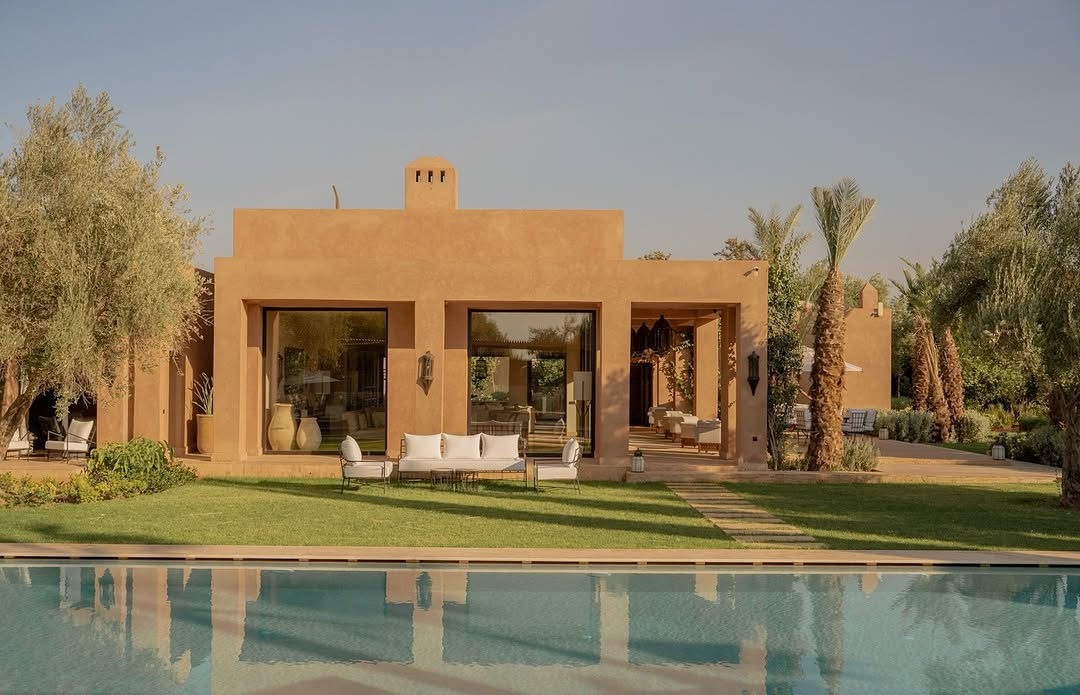
Outside the walls, two other Marrakeches open up. To the west and south sit the Palmeraie and the road toward the Atlas, where larger garden estates and design-led country houses trade the density of the medina for space, pools and a different, calmer luxury. A property such as La Plantation belongs to this second Marrakech, the one of olive groves and long horizons rather than tight lanes, and it answers a real question for travelers who love the city by day but want room to breathe by night.
The choice between the two is not about quality. It is about which version of the place a traveler wants to wake up inside. Many who know Marrakech well split the difference across a single trip, two or three nights in a medina riad for the immersion, then two more in a garden estate to recover, the city absorbed in close-up and then admired from a distance.
How to read a riad before you book
Not every property that calls itself a riad is one, and the word has loosened as it has sold. A genuine riad is built around an internal courtyard or garden, has its rooms facing inward, and almost always carries the marks of medina craft, tadelakt, zellij, carved cedar, a usable terrace. A few practical signals separate the real thing from a renovation that merely borrows the name.
- The courtyard is the plan, not a feature. In a true riad every room relates to the central space. If photographs show only bedrooms and a lounge with no working courtyard at their core, the house is something else.
- The terrace is usable. A medina rooftop with shade, seating and a view of the Koutoubia minaret or the Atlas is part of what the building is for. A locked or token roof is a missed half of the house.
- The scale stays small. Most restored riads hold between five and twelve rooms. A property advertising forty keys inside the medina has almost certainly knocked several houses together and lost the intimacy in the process.
- Arrival is on foot. If a car can pull up to the door inside the old city, the address is probably on the medina's edge rather than its heart, which some travelers will prefer and others will not.
Design-forward houses have stretched these conventions in interesting ways without breaking them. Pure House Marrakech reads the riad through a cleaner, more contemporary lens, proof that the courtyard logic survives translation into a modern aesthetic, while a more classical address such as Riad Tajania keeps faith with the traditional vocabulary of carved plaster and lanternlight. Both are riads. They simply answer the same plan in different centuries.
When to go
Marrakech has two clear seasons for a riad stay. Spring, from March to May, and autumn, from late September to November, are the gentle windows, with warm days, cool evenings that the courtyard handles beautifully, and the Atlas often still white to the south. Winter is mild by day and genuinely cold at night, when a riad's open plan turns brisk and a room with a working fireplace becomes worth seeking out. High summer, from June to August, is severe, with daytime heat that pushes well past comfort, which is precisely when the riad's old cooling logic, and the discipline of staying inside through the middle of the day, prove they were never decoration.
Frequently asked questions
| Question | Answer |
|---|---|
| What exactly is a riad? | A riad is a traditional Moroccan house built around an internal courtyard or garden, with its rooms facing inward and a rooftop terrace above. In Marrakech, most riads stand inside the walled medina and have been restored into small boutique guesthouses of roughly five to twelve rooms. |
| Is it better to stay in a riad or a hotel in Marrakech? | It depends on what I want from the trip. A riad gives intimacy, craftsmanship and a location in the heart of the old city, but rarely a pool, gym or large rooms. A resort outside the walls offers space and facilities but less immersion. Many travelers do both across one stay, a few nights in a medina riad and a few in a garden estate. |
| Are riads in the medina noisy? | Less than expected. Because the rooms face an internal courtyard rather than the street, the thick walls and inward plan keep most of the medina's sound outside. Rooms nearest the courtyard can carry some echo in the evening, so a room set back from the central space is the quieter choice for light sleepers. |
| How do I reach a riad with luggage? | Most riad doors sit on lanes too narrow for cars, so a transfer usually drops travelers at the nearest vehicle point and a porter meets them with a cart for the final short walk. Arranging an arrival pickup with the riad in advance removes the only real friction of a medina stay. |
| Do riads have swimming pools? | Rarely a full one. Space inside the medina is too tight, so a riad pool, when it exists, tends to be a small plunge pool in the courtyard for cooling off rather than swimming. Travelers who want a proper pool usually choose a garden estate in the Palmeraie or on the road toward the Atlas. |
| When is the best time of year to stay in a riad? | Spring, from March to May, and autumn, from late September to November, offer the most comfortable balance of warm days and cool evenings. Winter is mild by day but cold at night, so a room with a fireplace helps. High summer is very hot, which is when the riad's natural cooling and the habit of resting indoors at midday matter most. |
| How many nights should I spend in Marrakech? | Three to four nights suit most first visits, enough to settle into the rhythm of a riad, explore the souks and Jemaa el-Fnaa, and take one day trip toward the Atlas or the Agafay desert. Travelers who want both the medina and a garden estate should add two nights to do each properly. |
| Are riads suitable for families? | Some are, though the form has limits. Open courtyards, plunge pools and steep tiled staircases ask for supervision with young children, and the small scale means connecting family rooms are not always available. Larger riads and garden estates outside the walls tend to suit families better than the smallest medina houses. |
To stay in a riad is to accept the city's own arrangement of priorities, the wall to the street, the garden to the heart, the sky kept for last. Marrakech does not hide its beauty behind those doors. It simply asks the traveler to come inside to find it.