Three Atolls, Three Maldives: Where to Disappear When the Crowds Have Left
A close look at three resorts in three different Maldivian atolls (Amilla in Baa, Alila Kothaifaru in Raa, Huvafen Fushi in North Malé) and the contrarian case for travelling here in May, June and September instead of February.
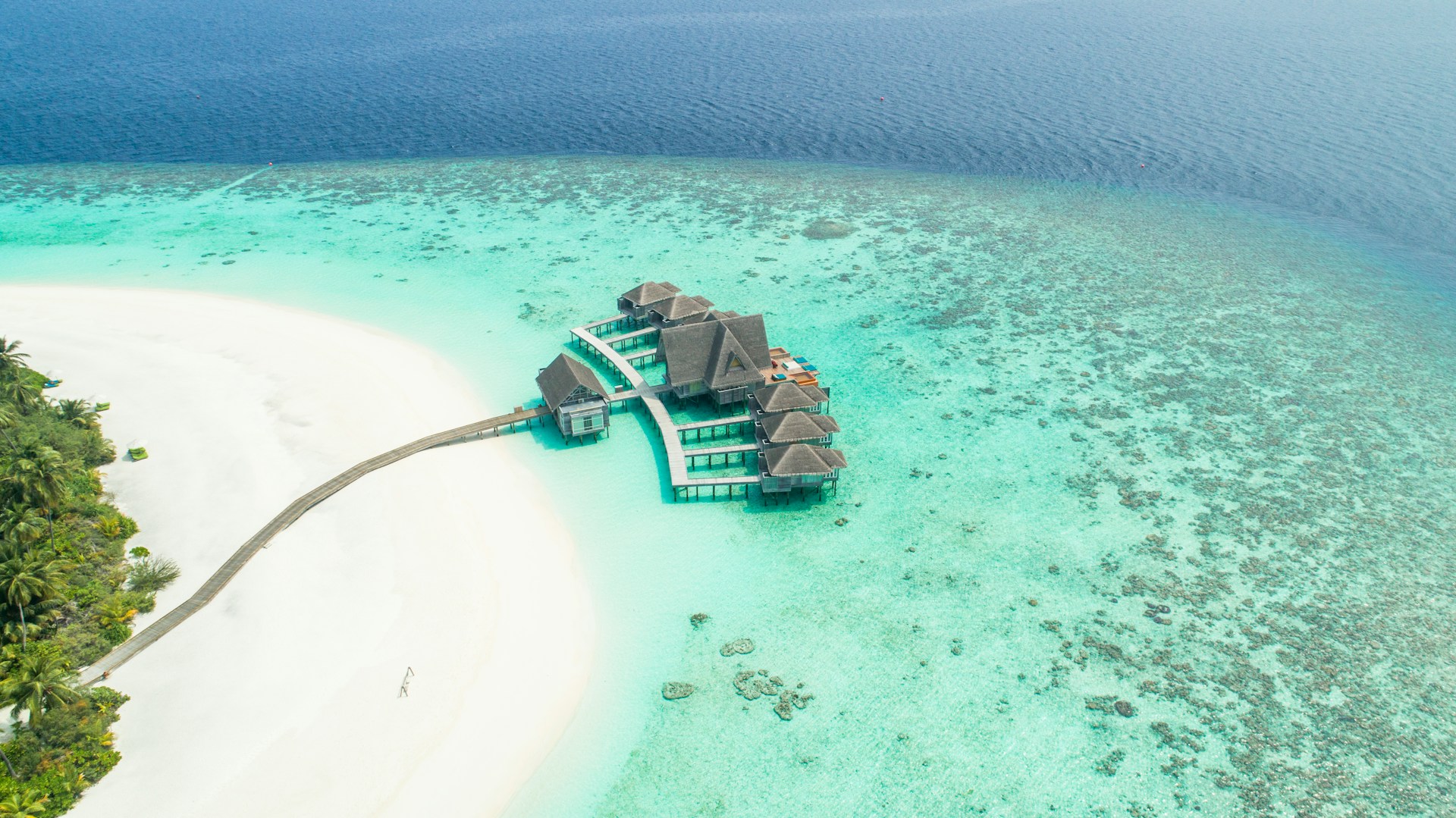
The first thing to know about the Maldives is that the country you read about in glossy magazines is not, geographically, a single place. It is twenty-six atolls spread across roughly nine hundred kilometres of the Indian Ocean. The difference between staying on one atoll and staying on another is more meaningful than most travellers realise before they go. The reef is not the same. The light is not the same. The flight from Velana International Airport (by domestic plane and then speedboat, or by seaplane, or by speedboat alone) is not the same. And the resort, which is what the brochures actually photograph, sits inside this geography in ways that change the entire shape of the trip.
The second thing to know is that the timing, almost as much as the atoll, decides what kind of week you are going to have. The Maldives has two seasons. The dry, almost windless iruvai runs roughly from December through April. This is the period in which 80 percent of high-end travel arrives, prices peak, and the smaller, more interesting resorts are largely fully booked by October of the year before. The wet hulhangu, running roughly May through November, brings shorter periods of rain, slightly choppier seas in some atolls, and lower prices.
Here is the contrarian truth that experienced Maldives travellers have known for years. The early hulhangu, May, June and September, is for many resorts almost as good as iruvai. Rainfall is intermittent rather than constant. Visibility on the reef is still excellent, especially in May and June. The light, after a brief cloud, is often more dramatic than the bleached sky of February. And the islands are dramatically less crowded.
This article looks at three resorts on three different atolls. Three of the most interesting in the Maldives in 2026, three styles, three price points, three quite different experiences of what the country can be. They share, importantly, a lower-crowd window in the months around now. Each one is, in its own way, a strong answer to the question that frames every Maldives trip: what kind of disappearance are you actually looking for?
Why early hulhangu is the secret of the people who go often
Most travellers who fall in love with the Maldives go more than once. After the second visit, an interesting pattern emerges in their booking behaviour. They stop going in February. They start going in May, late June, or early September. They are not paying significantly less, but they are getting back something more important: empty beaches, available reef guides, an island that is not at full occupancy.
The myth that May is “the rainy season” is, technically, true. May does sit at the edge of the south-west monsoon. But “monsoon” in the Maldivian context is not the wall of water that travellers from temperate climates imagine. It is, more often, a heavy thirty-minute shower in the afternoon followed by a clear evening. Average rainfall in May is roughly 220 millimetres across roughly fourteen rain days. Translated: more than half the days have no significant rain. The water temperature stays a constant 27 to 29 °C. The reef is alive. The plankton blooms in some atolls (Baa Atoll most famously) bring manta rays and whale sharks in numbers that the dry season does not.
What you trade is two things. The chance of one fully grey day per week. And slightly higher humidity. What you gain is dramatically lower occupancy at the more interesting resorts, the chance to negotiate quietly for villa upgrades, and access to spa and dining slots that in February require booking weeks in advance.
The three resorts that follow each handle this trade-off differently. They are also, deliberately, in three completely different parts of the country.
Amilla Maldives: Baa Atoll, the UNESCO biosphere reserve
Baa Atoll is the only place in the Maldives, and one of relatively few in the world, designated as a UNESCO Biosphere Reserve. The status is ecological, not symbolic. The waters around Baa contain Hanifaru Bay, the most important manta ray feeding ground in the country. The protections placed on the atoll over the last decade have meaningfully improved its reefs while the broader Indian Ocean has struggled. Amilla Maldives sits inside this protected area, on Finolhas Island.
The resort feels different from the moment of the seaplane approach. The lagoon, in good light, holds four distinct colours of blue. The island is dense with vegetation in a way that many newer Maldivian resorts are not: palms, pandanus, screw pine, and a generation of indigenous trees that the property has chosen to preserve rather than clear. The villas, scattered across the island and in two strips of overwater pavilions, are organised more like a residential community than a hotel.
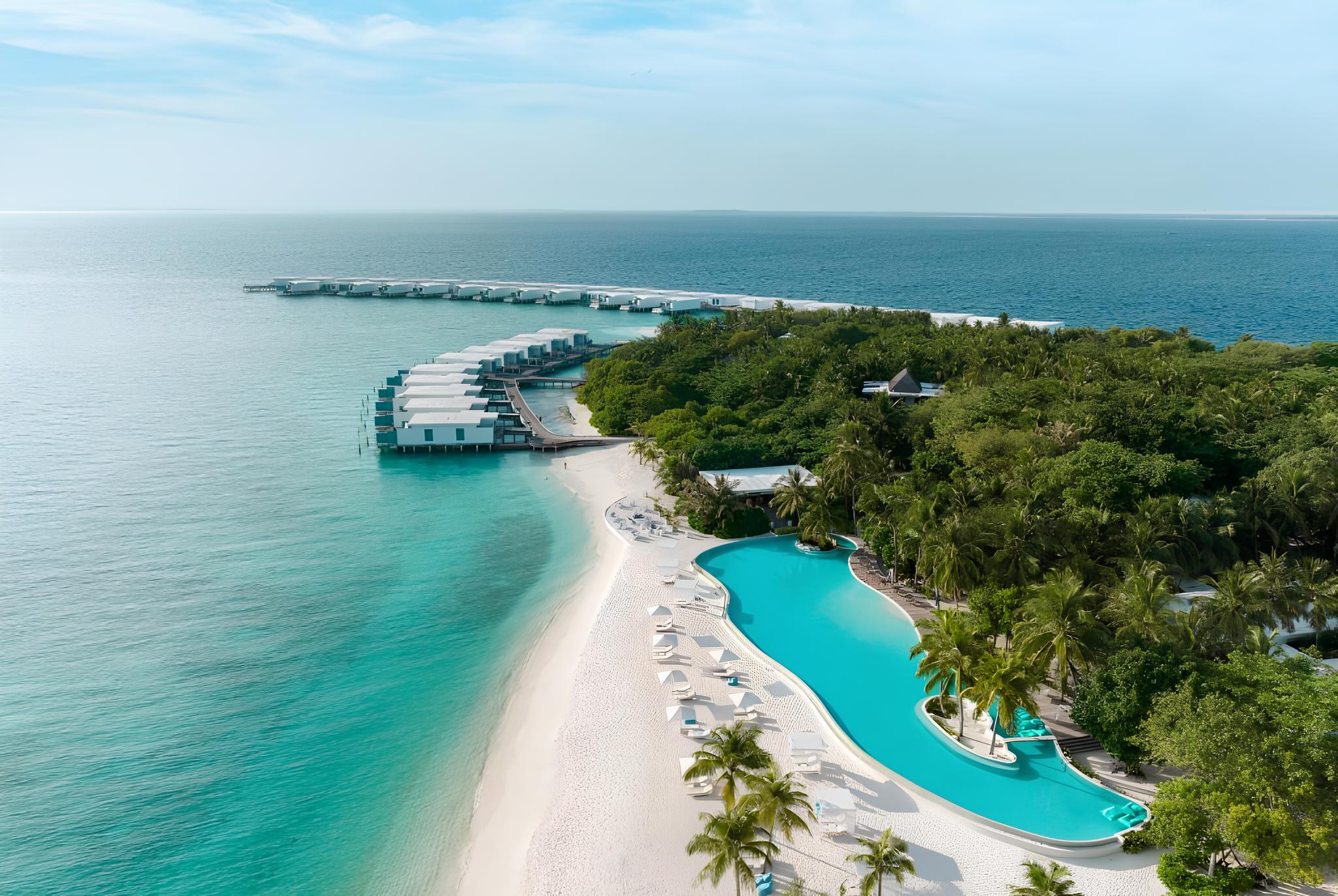
The family-friendly dimension of Amilla is one of the most quietly serious in the Maldives. Many resorts offer kids’ clubs as a bolted-on amenity. Amilla treats family as a design programme. There is a substantial children’s villa with its own activities, a teen lounge separated by enough distance from the adult areas that neither group disturbs the other, and a roster of marine biologists who run guided snorkelling for children alongside the standard adult programmes. For parents who want a luxury Maldives experience and a serious environmental education for their kids in the same week, it is the strongest option in the country in 2026.
The dining is wider than any single restaurant. The line-up (including Koi, Barolo, Joe’s Pizza, Sunset Bar and others) gives the property a sort of village feel. You eat differently each night. The Javvu Spa sits in dense vegetation, organised more around quiet pavilions than the resort spa template you may know.
What separates Amilla from a generic family-friendly luxury resort is its commitment to sustainability as a working practice rather than a brochure adjective. The desalinated water comes from a closed-loop system that recycles aggressively. The agricultural plot grows a meaningful part of the kitchen’s herbs and salads on island. The reef monitoring programme runs continuously and publishes its data. None of these are unusual claims at the brochure level. The difference at Amilla is that you are shown the operations if you ask, and the answers are specific.
At a glance: - Atoll: Baa (UNESCO Biosphere Reserve) - Transfer from Malé: about 30 minute seaplane - Style: Family-friendly, sustainability-led, Indian Ocean villa village - Price range: From around €1,285 per night - Best for: Families, marine-life travellers, manta ray and whale shark season (May to September is the peak window in Hanifaru Bay) - Memorable detail: The on-island marine biologists, who turn a snorkel session into a working ecology lesson.
Alila Kothaifaru Maldives: Raa Atoll, design over decoration
Forty-five minutes from Malé by seaplane, in the relatively quiet Raa Atoll, sits one of the most architecturally precise resorts opened in the Maldives in the last few years. Alila Kothaifaru has 80 villas in total, 44 beach villas and 36 water villas, every single one with a private pool. They are distributed across an island that the design team treated as a single piece of land to be choreographed rather than carved up.
The architecture is the point. Where many Maldivian resorts default to a thatched-roof, tropical-pavilion vocabulary, Alila Kothaifaru works with a more contemporary language: clean horizontal volumes, deep overhangs, materials that age with the climate (timber, stone, woven natural fibres) instead of fighting it. The result, on the ground, is a property that feels less like a Maldivian cliché and more like a coastal design retreat that happens to be in the Maldives.
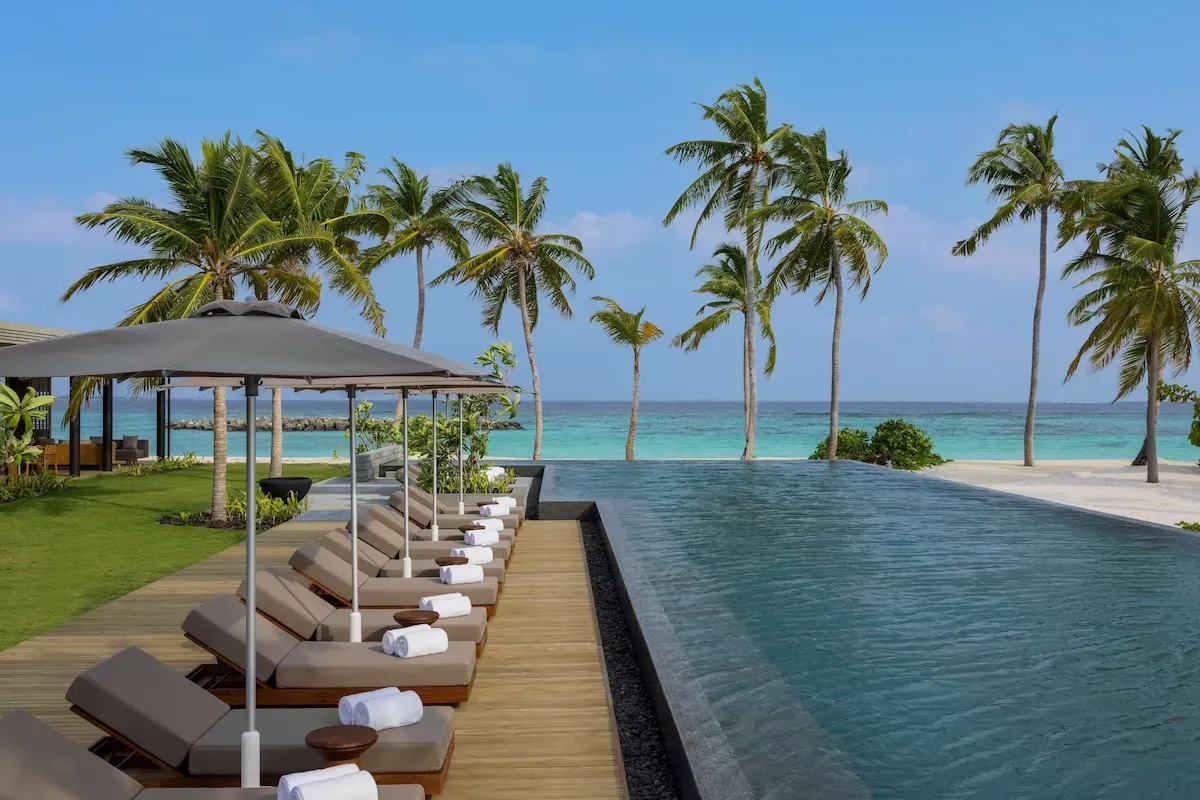
The dining programme is unusually wide for a resort of this size. Five restaurants and bars, each with its own kitchen team. Seasalt is the beachfront flagship, contemporary international with a strong Indian Ocean accent. Umami is a Japanese kitchen with sashimi flown in twice weekly and a more inventive omakase served at a counter overlooking the water. Yakitori Bar is exactly what it says, and exactly the late-night option a serious Maldivian resort needs. Mirus Bar does cocktails at a level you would expect in a major capital city. Pibati is the more casual, all-day café, exactly the place you want for breakfast on day three when you have settled into the rhythm.
The spa, the Mara Spa, is built around indigenous Maldivian healing traditions translated into a contemporary register. The wellness programme (yoga, breath work, longer-form retreat options) runs continuously and is staffed at a level that lets you book a session at almost any moment.
What makes Kothaifaru particularly interesting in early hulhangu is its isolation. Raa Atoll is far enough from the heavily trafficked North Malé corridor that on a quiet week you genuinely feel that you have the lagoon to yourselves. The 45-minute seaplane flight in is one of the most beautiful approaches in the country.
At a glance: - Atoll: Raa - Transfer from Malé: about 45 minute seaplane - Style: Contemporary design-led private-pool resort, all 80 villas with private pools - Price range: From around €1,820 per night - Best for: Travellers who care about architecture and food at equal weight, couples, and groups of friends taking 3 to 4 villas together - Memorable detail: The five-restaurant programme, wider and better than the size of the resort would suggest
Huvafen Fushi: North Malé, the icon and its underwater spa
Huvafen Fushi, on North Malé Atoll, ranks as a piece of Maldives history. It opened in 2004, almost immediately built a global reputation, and was the first resort in the country to install a fully underwater spa. A structure that sits below sea level, with treatment rooms looking out into the reef, that has been imitated many times since but rarely matched.
What makes Huvafen different two decades later is that the property has continued to evolve rather than rest on the fame. The villas, across both beach and overwater categories, have been refurbished in waves. Each refurbishment has pushed further into a sleek, modern, almost minimalist register. The interiors today are some of the most contemporary in the country, with private plunge pools, indoor-outdoor bathrooms and curated art that has rotated through several editions.
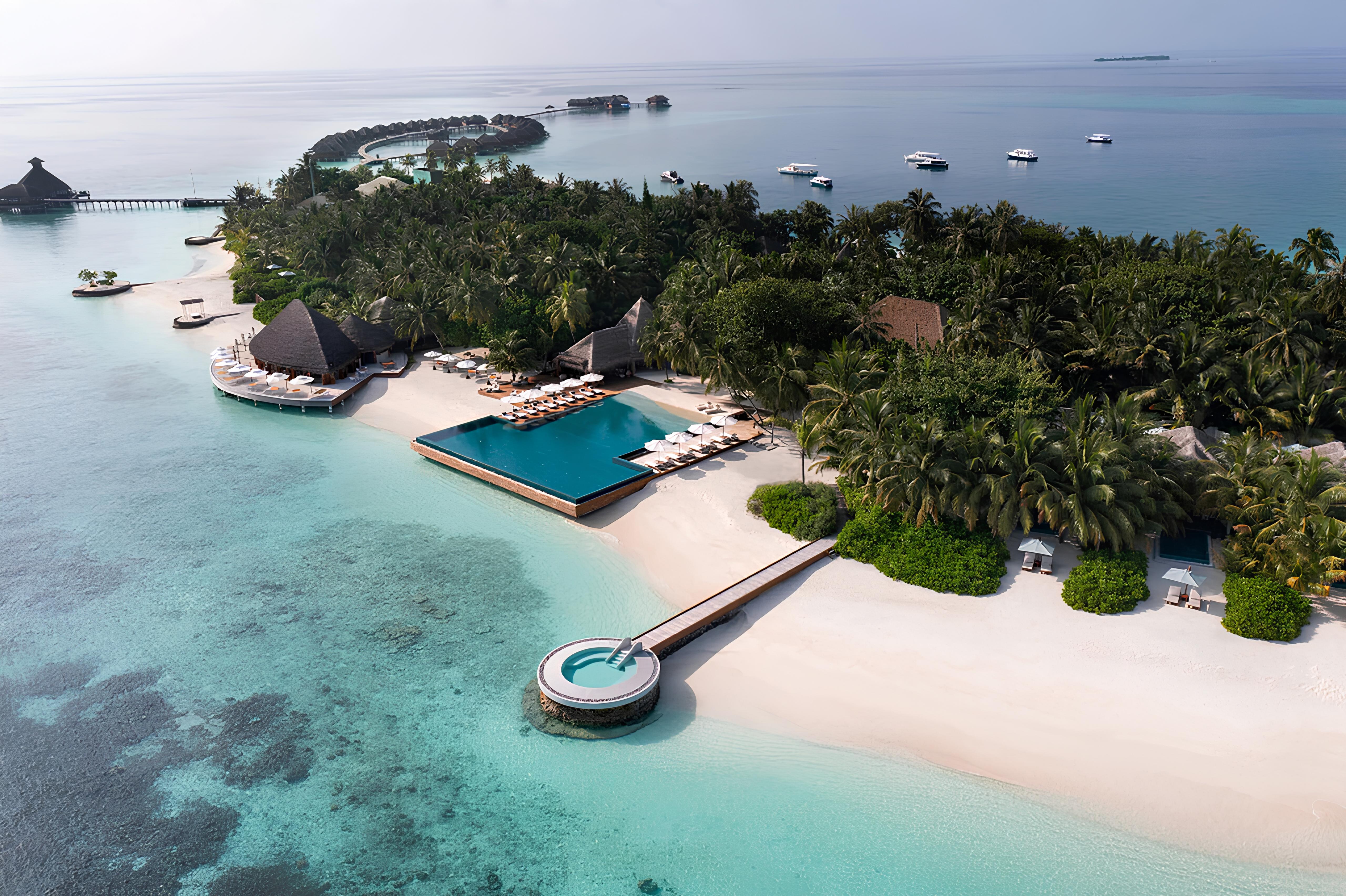
The dining range is extensive across four restaurants. Celsius is the Mediterranean-leaning seafood-focused flagship, and one of the most reliable upper-echelon dinners in the Maldives. Fogliani’s is the Italian, with house-made pasta that is genuinely good rather than tropical-Italian-good. Raw, as the name suggests, is the sashimi and crudo programme, with a Japanese-Peruvian (Nikkei) intersection that the chef does not overplay. Salt is the all-day pavilion. UMBar, with its infinity pool, is the cocktail-and-sunset hub.
The Lime Spa, both above and below the water, remains the property’s signature. The underwater treatment rooms still surprise. The light coming through the reef into the rooms changes through the day in a way that becomes itself a part of the treatment. The staff around it, after twenty years of practice, are as polished as any spa team in the country.
What makes Huvafen the right choice in early hulhangu is something practical: the 30-minute speedboat transfer from Malé. Where Amilla and Alila Kothaifaru both involve seaplanes, which are weather-sensitive in monsoon season and occasionally delayed for an hour, Huvafen can be reached almost regardless of weather. For travellers who want maximum reliability of arrival in shoulder season, this matters.
At a glance: - Atoll: North Malé - Transfer from Malé: about 30 minute speedboat - Style: Contemporary luxury icon, design-forward, the original underwater spa - Price range: From around €1,547 per night - Best for: Travellers wanting an iconic, design-led Maldives experience with the easiest transfer logistics - Memorable detail: The light moving through the reef into the underwater spa rooms across a single afternoon.
Beach villa or overwater villa: the question everyone asks
Almost every Maldives traveller asks this once. The honest answer is that it depends on three things: how much you swim, how much you sleep, and what time of day you most enjoy.
Beach villas give you a private patch of sand, direct walk-in access to the reef and lagoon, and (a detail surprisingly often missed) significantly better night-time silence. Sound carries on overwater pavilions. The lapping of water under the floor is, after the first night, slightly less romantic than the brochure suggests.
Overwater villas give you the iconic sunrise view straight from bed, the glass-floor-panel novelty in some properties, and a slightly cooler air movement during the day. They are the brochure shot for a reason.
A practical recommendation, especially in early hulhangu: start beach, end overwater. A first-time Maldives traveller staying seven nights does well to spend the first three nights in a beach villa (you settle, you swim from your steps, you sleep deeply) and the final four in an overwater villa (the morning light, the lagoon view, the photograph for the journey home).
When to go: the case for May, June and September restated
May and early June are, for all three resorts, an exceptionally good window. The reef is alive, the manta rays at Hanifaru Bay (Baa) are active, the resorts run at significantly lower occupancy than February, and the light, when it breaks through cloud, is often more cinematic than the bleached blue sky of dry season.
Late September and October are the second window. The very end of monsoon. Slightly more rain than May to June, but with the trade-off of dramatically lower prices in some categories.
February remains the postcard. If you want zero rain, full occupancy, and to pay full rate, February is your month. For anything else, the early hulhangu is more interesting.
Frequently asked questions
| When is the rainy season in the Maldives, really? | The official wet season runs roughly from May to November. In practice, the country sees brief afternoon showers, usually under thirty minutes, interspersed with long sunny periods. Average rainfall in May is around 220 mm across roughly fourteen rain days, which means that more than half the days have no significant rain. Visibility on the reef stays excellent through June. |
| Which Maldives resort is best for families? | Amilla Maldives in Baa Atoll. Of the three resorts in this article, it is the most thoughtfully designed for families, with a serious children’s programme led by marine biologists, separate adult and family zones that reduce friction, and a UNESCO Biosphere Reserve outside the door. |
| Which Maldives resort has the best underwater spa? | Huvafen Fushi. It was the first to build one in the country, in 2004, and it is still considered the benchmark. |
| How much does a Maldivian seaplane transfer cost? | Roughly $300 to $400 each way per adult, depending on atoll. Speedboat transfers, available for resorts in North Malé Atoll like Huvafen Fushi, are significantly cheaper at around $150 each way and are not weather-sensitive. |
| Should I choose a beach villa or an overwater villa? | For a first Maldives trip of one week, the strongest combination is to split your stay: three nights in a beach villa first (better for sleeping, easier reef access) and four nights in an overwater villa second (better light at sunrise, the iconic Maldivian view). For longer stays, alternate as the architecture of the property allows. |
| What is the difference between Baa, Raa and North Malé atolls? | North Malé is the closest atoll to the airport (about 30 min speedboat), most accessible, and the location of the most iconic resorts. Baa is two hours further out by speed but a 30-minute seaplane, and is a UNESCO Biosphere Reserve with the country’s best manta ray populations. Raa is even further north and quieter still, with fewer resorts, longer transfers, and more isolation. The right atoll depends on the kind of disappearance you are looking for. |