Royal Pearl Island, Chios: A Forty-Eight-Suite Hotel Rewriting Luxury in the Eastern Aegean
Chios is the Greek island most travellers cannot place on a map. Fifth largest by surface, closer to Izmir than to Athens, ignored by the cruise circuit, and the only place on earth where mastic trees release their resinous tears. On a slip of coastline two minutes from Chios Town Beach, a forty-eight-suite property has spent the past several seasons quietly defining what luxury hospitality on the island can be. This is a complete profile of one of the most interesting hotels currently operating in the Aegean.
For most international travellers, the Greek-island map begins and ends with Santorini, Mykonos, Crete and Corfu. The cruise itineraries reinforce it. The Instagram algorithm reinforces it. Most flights into Athens connect onward to those four destinations, almost never to the strip of runway above Karfas Bay, on an island fifty kilometres off the Turkish coast that produces a resin grown nowhere else and has resisted, with quiet stubbornness, every wave of mass-tourism development that has reshaped its more famous neighbours.
That island is Chios. For a particular kind of traveller, the kind who reads ferry timetables for pleasure and considers the absence of a Four Seasons a recommendation rather than a deficiency, Chios has been the open secret of the eastern Aegean for years. What has changed in the past three seasons is the arrival of a hotel that is finally good enough to merit the journey on its own terms.
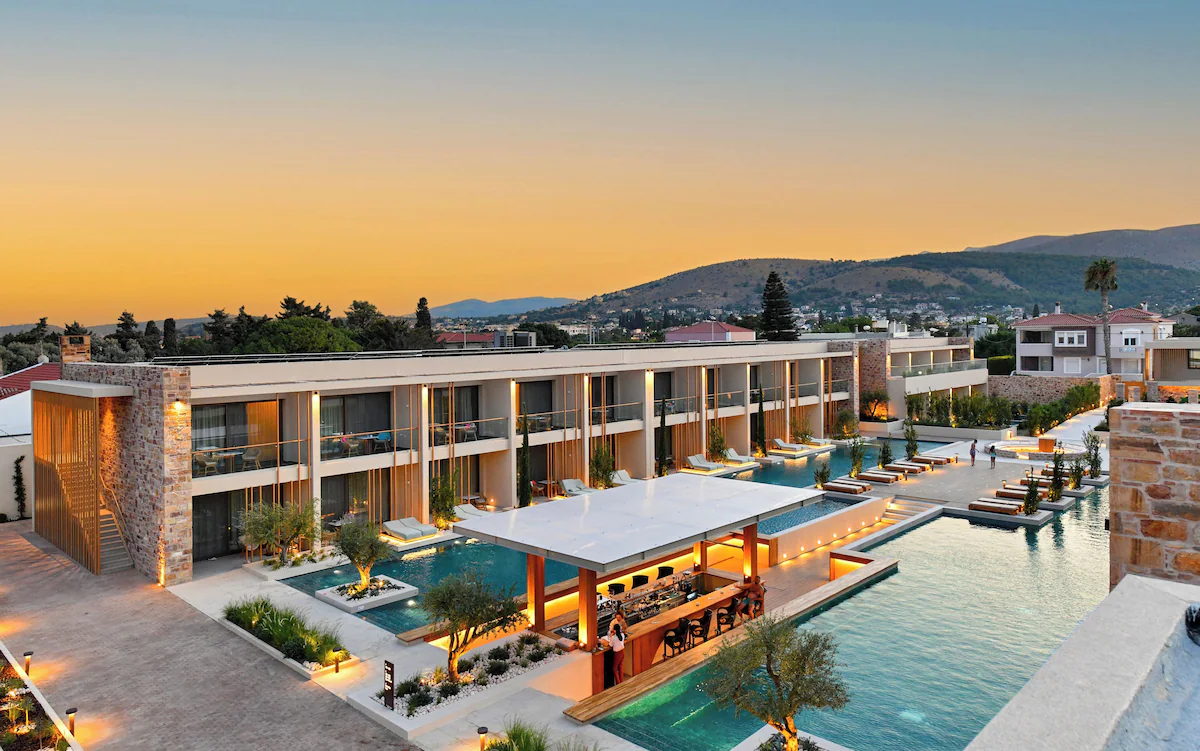
The property is called Royal Pearl Island. It sits on a short stretch of coastline two minutes from Chios Town Beach, forty minutes by air from Athens, and one and a half kilometres from the island’s tiny airport. It has forty-eight suites. It is built around what may be the most architecturally serious swimming pool in the Aegean. It approaches the island the way Chios deserves to be approached: with restraint, with patience, and with a refusal to import the visual vocabulary of Mykonos and impose it on a place that has nothing in common with Mykonos.
What follows is a complete profile. The setting, the rooms, the pool, the table, the spa, the island around it, and the answer to the only question that ultimately matters about a hotel: is it worth the flight.
01The Setting: a hotel in the town, not above it
The location matters more than it usually does in resort hospitality. Most Aegean luxury hotels are sited on remote headlands, accessed by switchback roads, isolated from the towns they nominally belong to. Royal Pearl Island is in town. The Byzantine castle is a fifteen-minute walk. The fish market is closer. The waterfront tavernas where Chiotes eat dinner on summer Tuesdays are a few hundred metres in either direction. A guest leaving the hotel at seven in the evening is in the centre of an active Greek port town inside ten minutes.
This proximity is deliberate. The island’s draw is not the curated beach-club seclusion that defines Mykonos and Paros. It is the texture of an ordinary Greek place that has not been retrofitted for tourism. Royal Pearl Island places its guests inside that texture rather than at a polite distance from it. Suites face the property’s gardens and pool, not the road. The town is available but not unavoidable. The choice belongs to the guest.
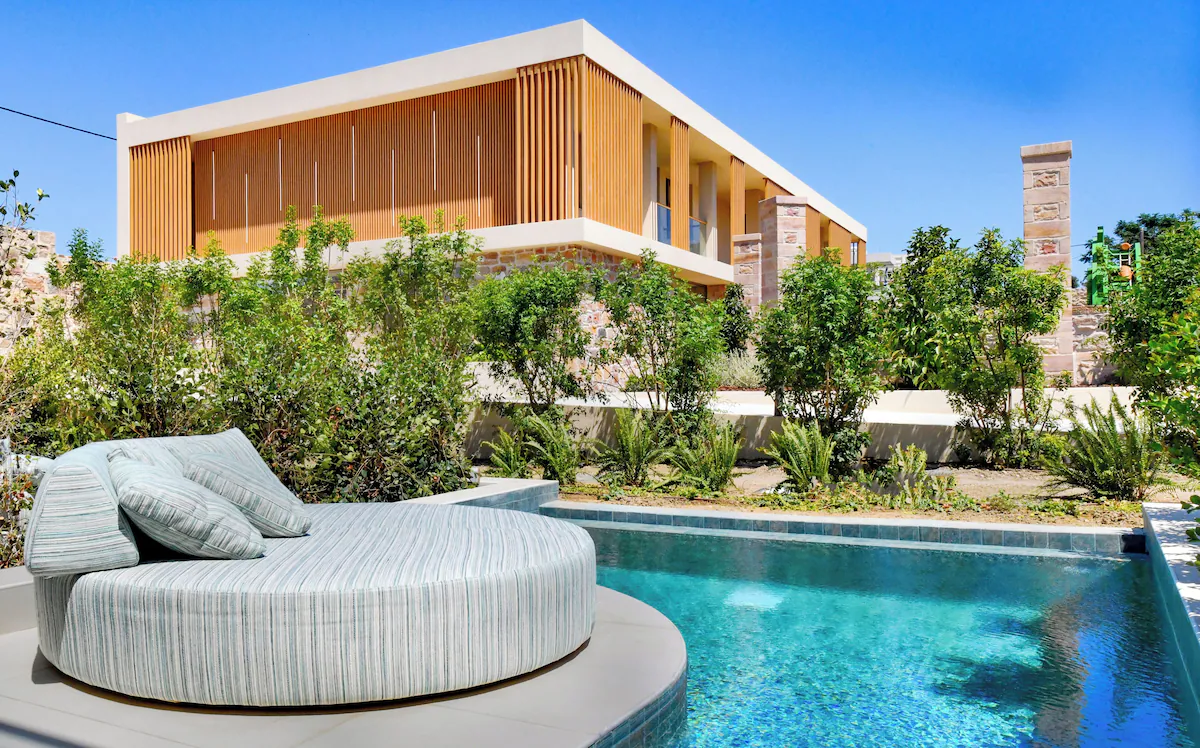
The building itself reads as a quiet response to the local vernacular. White stucco walls, low horizontal lines, stone underfoot in the public areas, timber accents that pick up the tone of the cedar trees growing along this stretch of coast. The reference points are obvious to a guest who pays attention: the mastic villages thirty kilometres south, the Genoese towers of Mesta and Olympi, the Cycladic instinct for whitewash and shadow. None of it is theatrical. The architecture does not announce itself. It recedes.
02The Suites: a forty-eight-room inventory done correctly
There are forty-eight suites in total, organised into four categories. The taxonomy is straightforward.
The Pool View Suite, at forty-five square metres, is the smallest category in the inventory and the easiest to book. Sightlines onto the central pool, ground or first floor. It is suited to couples on shorter stays of three to five nights who plan to spend most of their time outside the room.
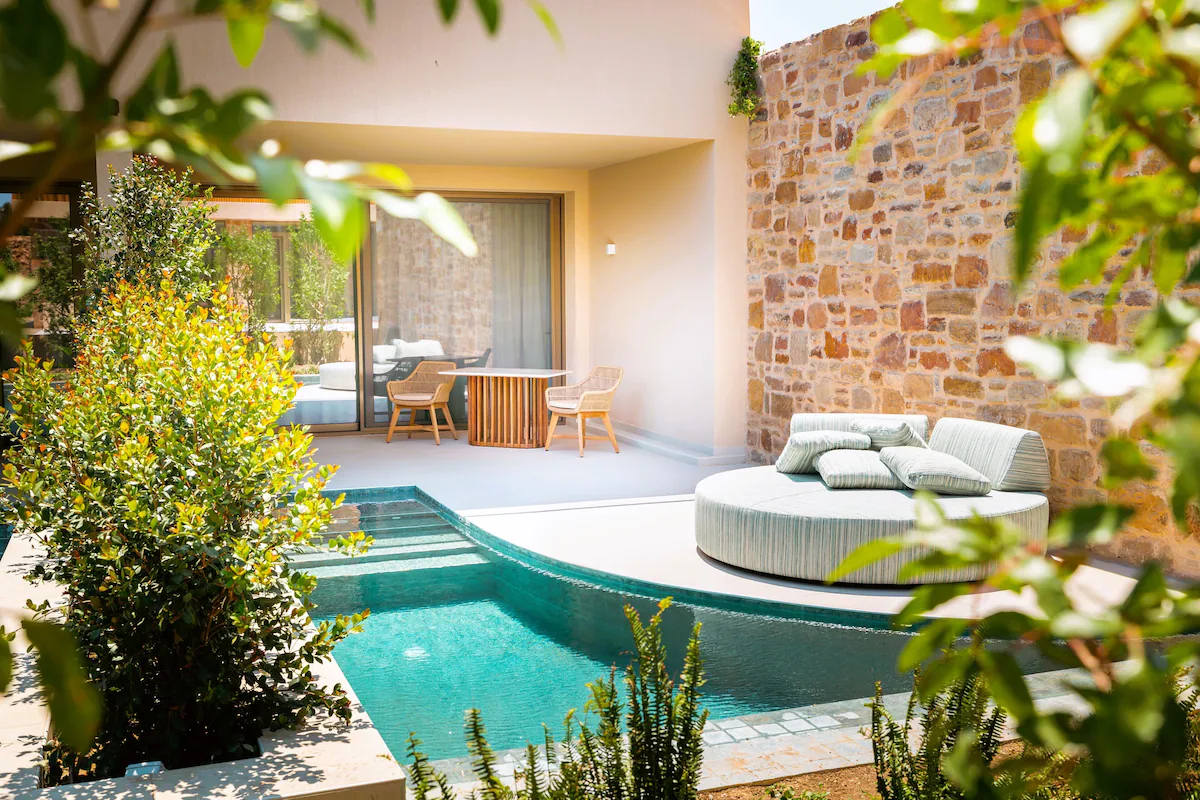
The Swim-up Suite, forty-five square metres indoors plus a twelve-square-metre private terrace, opens directly onto the swim channel. A guest steps from the suite into shoulder-deep water. The configuration is the central architectural conceit of the property and the most-photographed amenity in the inventory. Worth noting: the swim-up suites are loud when the pool is busy, which on a fully booked August week it always is. Couples who value silence over novelty should consider the alternatives.
The Jacuzzi Suite, forty-five plus twelve square metres, adds a private hot tub on a terrace screened from neighbours by hedges and timber slats. A reasonable middle ground for guests who want outdoor water without the social geometry of the shared pool.
The Private Pool Suite is the top of the inventory. Forty-five plus twelve square metres, private plunge pool on the terrace, the most generous privacy footprint on the property. This is where the hotel’s repeat guests stay.
Inside, the suites read as restrained rather than minimalist. Local stone on one wall, timber wardrobes, linen rather than synthetic textiles, low-glare lighting, blackout curtains that actually black out. Bathrooms in dark marble with rainfall showers and Greek-made amenity products that quietly avoid the global hotel-brand toiletry rotation. Air conditioning works. Wi-Fi is fast. The room safe accommodates a fifteen-inch laptop. These are the small operational details that a guest stops noticing only when they are done correctly.
03The Pool: the architectural centre of the property
An Olympic-length swim-up pool is an unusual amenity on a forty-eight-suite property, and Royal Pearl Island’s central channel deserves its own section. It runs through the entire courtyard, threads between suite terraces, widens in the middle to accommodate underwater loungers, and terminates at a swim-up bar where a guest can order a cold coffee or a glass of Chian assyrtiko without leaving the water.
The pool is shallow at the swim-up suite end and deepens toward the centre. Temperature-controlled, salt rather than chlorine, and on a windless evening it reflects the sky in a way that explains why the property’s photography is dominated by it.
The proportion is what matters. Most fifty-suite resorts allocate a pool that fits the photograph and not much more. This one fits the use. Three guests can swim laps without crossing paths. The underwater seating accommodates fifteen people without anyone feeling crowded. The result is a public space that earns the description “central” rather than “decorative”.
04The Table: Mastihi Restaurant and the Chian kitchen
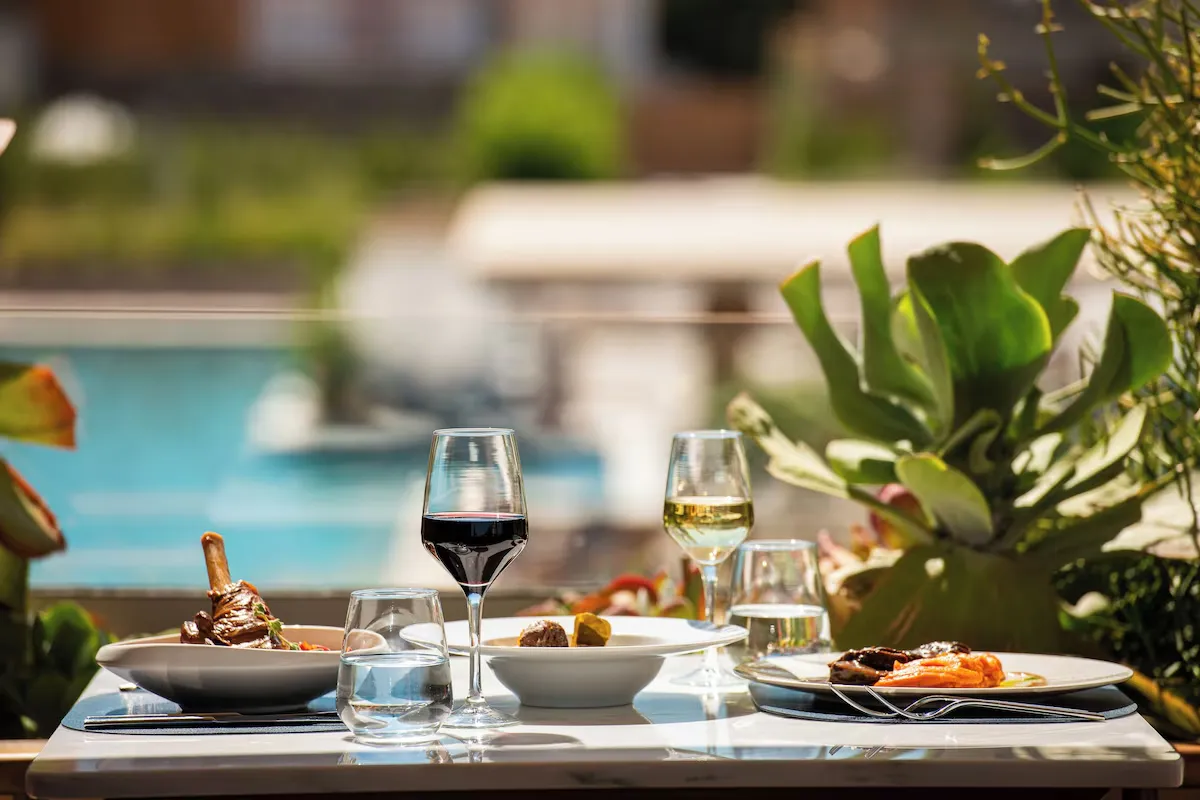
Mastihi is the on-site restaurant, named for the mastic resin that Chios alone produces. The kitchen runs a Mediterranean menu with deliberate Chian inflection. The mastic gets used, without the heaviness that characterises tourist-facing applications on the island. It appears in a mastic-glazed octopus, in a frozen mastic dessert that is the signature finish, occasionally in the bread. The fish is from the local market that morning. The produce comes from the property’s contracted growers in the central plain of the island, the same vegetable plots that supply the better tavernas in town.
The wine list is short and confident: Chian and Aegean whites with a focus on assyrtiko, agiorgitiko-driven reds from the mainland, a handful of producers from Lemnos and Limnos Black for guests who want to drink across the eastern Aegean rather than the standard Santorini lineup. The bar program at the Nautical Bar leans toward classical preparations executed precisely, with a small selection of cocktails built around mastic, citrus, and Greek aromatic spirits.
A private dining room, The Magganos, accommodates groups of up to forty and operates as the venue for set menus, family celebrations, and the occasional small private event. The chef’s tasting menu in this room is more ambitious than what reaches the main dining room and is worth booking on the night a guest wants to give the kitchen latitude.
05The Spa: a hotel spa that takes itself seriously
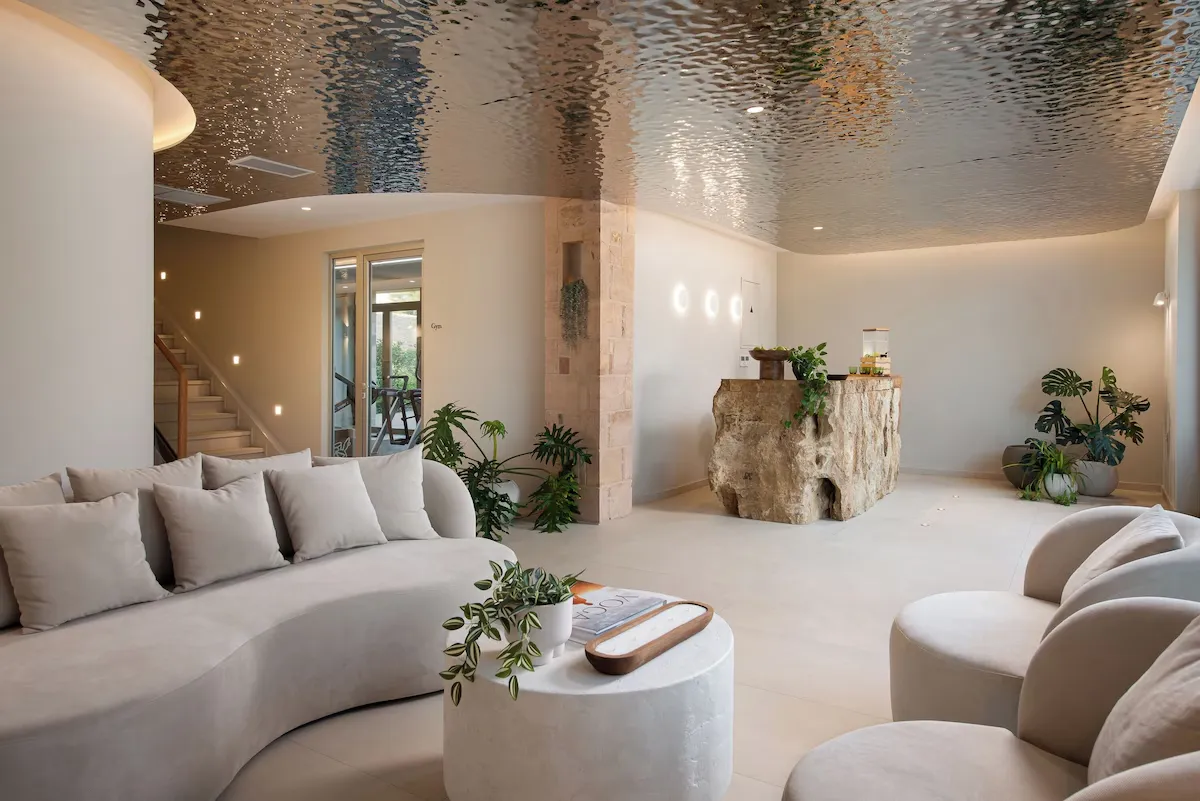
Wellness Hub & Spa is the official title. Treatments are bookable through the concierge and follow a tailored consultation rather than a fixed menu. The treatment rooms are small, calm, lit indirectly, and use products that hold up to scrutiny: mastic-derived skincare from a producer in Chios Town, Greek olive-oil-based therapy oils, no perfume-loaded chain-brand intrusions.
The wellness floor includes a sauna, a hot tub, and a small relaxation area with views onto the gardens. There is no aggressive marketing of “transformative” experiences, no thirty-step protocol with a six-figure asking price. The room rate includes morning yoga on the terrace in the summer months. Guests who want a deeper engagement with the wellness program can book a multi-day plan that integrates treatments, dietary guidance, and a walking program on the island’s southern coast.
It is not a destination spa. It is a hotel spa that takes itself seriously, which is the right register for a property of this size.
06The Island Around It: why the location is the amenity
A guest at Royal Pearl Island is, geographically, in one of the most underrated cultural landscapes in the eastern Aegean. The hotel’s concierge organises tailor-made itineraries that go beyond the standard rotation, and five excursions in particular define the difference between a guest who spends a week on Chios as if it were Mykonos and a guest who actually understands what the island offers.
The mastic villages (the Mastichochoria) are a thirty-five-minute drive south through olive groves and the dry hills that grow nothing but lentisk trees and the resin they produce. Mesta is the masterpiece: a fortified medieval village whose outer walls form a continuous defensive ring, built by the Genoese in the fourteenth century and still inhabited. Pyrgi is the painted village, its facades covered in xysta, a geometric black-and-white plaster technique that exists nowhere else in the Mediterranean. Olympi, smaller and quieter than either, is the village a guest visits in the late afternoon when the day-trip coaches have left and the residents are sitting outside their doors.
The Nea Moni monastery, a UNESCO World Heritage site, sits in the centre of the island in a pine forest at eight hundred metres of elevation. The eleventh-century mosaics are among the most important Byzantine works in Greece. The drive up from Chios Town takes forty minutes and the road becomes spectacular in the final ten kilometres. The monastery itself is small, the church compact, the experience contemplative rather than monumental. A guest can be there by nine in the morning and back at the hotel for lunch.
Mavra Volia, the famous black-pebble beach near the village of Emporio, is formed by volcanic activity. The water is clear, the pebbles heat to a remarkable temperature by the August sun, and the cove faces a sea darker than any other on the island. Karfas, closer to the hotel and the more conventional beach choice, is sandy, gently shelving, organised with sunbeds and a row of tavernas at the back. Komi, on the south coast, is the long-sand option that absorbs the most visitors without ever feeling crowded.
A mastic farm visit in the southern part of the island, organised in cooperation with a small producer, lets guests see the cultivation, the tear-resin harvest, and the artisanal processing. A half-day sailing on a wooden caique to the uninhabited islets off the eastern coast departs from the marina a few minutes from the hotel; the captain is local, the lunch on board is fish caught that morning. None of these experiences is bookable through the hotel website. They emerge from a conversation at check-in.
07Who It Is For: three traveller profiles, one type of trip
Royal Pearl Island works for three kinds of guests.
The first is the experienced Greek-islands traveller who has worked through Santorini, Mykonos and Paros and is looking for the next register. The arithmetic of crowding on the headline islands has shifted in the past three seasons. A high-season week on Mykonos now requires a different kind of patience than it did a decade ago. Chios offers the inverse problem: the difficulty is not avoiding crowds but finding them.
The second is the cultural traveller. The mastic villages, the Byzantine monastery, the maritime museum in Chios Town, the medieval Genoese castle and the Ottoman bath complex inside it. The island rewards a guest who reads before arriving and who plans for at least one half-day inland for every two beach days.
The third is the longer-stay guest: six to ten nights, sometimes more. The hotel’s pace and the island’s pace both reward this. A three-night visit is enough for the pool and the spa and dinner at Mastihi twice. A week starts to make sense of the rest.
What Royal Pearl Island is not is a hotel for guests who want a beach-club scene, a DJ residency, or the high-tempo social geometry of the cosmopolitan Cycladic resorts. The pool is a place to swim, not a place to be seen swimming. The bar closes at a civilised hour. The clientele skews European, often Greek and Italian, with a quieter Northern European contingent in May and September.
08The Practical: rates, season, how to book
A forty-minute domestic flight from Athens International brings guests to Chios airport on multiple daily services, operated by Aegean Airlines and Sky Express. The transfer from the airport to the hotel takes seven minutes by car and the property arranges it on request. A ferry from Piraeus is available for guests who prefer to arrive by sea, eight hours overnight, with private cabins available on the better-equipped vessels.
The hotel operates from April to late October. Peak season runs from late July through the third week of August. June and September are the quietest months with the best weather, the prettiest light, and the lowest rates. Anyone planning a first visit to Chios should avoid July and August.
Check-in is at three, check-out at eleven, and the property accommodates flexibility on both ends when the calendar allows. Pets are welcome with a forty-euro nightly fee. The hotel is accessible for guests with mobility issues, with adapted suites available on request. Children are welcome at all ages; extra beds are thirty-five euros for guests aged three to eleven, seventy-five for older guests, and cots for infants are complimentary. The atmosphere on the property is calm rather than exuberantly child-oriented, which suits families who travel quietly more than families who travel loudly.
Rates begin around 450€ per suite per night in shoulder season, with the Private Pool category reaching considerably higher in August.
Why this hotel matters now
Royal Pearl Island is not the most expensive hotel in Greece, the most architecturally ambitious, or the one with the most heavily marketed wellness program. It is something more useful and considerably rarer: a hotel that fits its place. The forty-eight-suite scale is correct for the island. The architectural restraint is correct for the vernacular. The pool, the table, the spa, and the excursions program all read as decisions made by people who understood that the appeal of Chios is its texture, not its glamour, and that a hotel here has to honour that or it has no reason to exist.
The eastern Aegean is the part of Greece that the global luxury industry has not yet found. By the time it does, the experience of Chios will have changed. The window for visiting before the rest of the market arrives is, by the most generous estimate, two or three more summers.
For a guest planning the kind of Greek-island trip that values cultural depth over social spectacle, this is currently one of the few addresses worth the flight to a destination that is not yet on the standard luxury circuit. Royal Pearl Island offers what the eastern Aegean offered before the global luxury industry arrived: quiet, water, a good table, a place to sleep with the windows open, and an island outside the door that has been doing this for eight thousand years and has no intention of changing for anyone.
Frequently asked questions
| Is Chios worth visiting compared to Santorini or Mykonos? | For a particular kind of traveller, yes. Chios is significantly less crowded, has a deeper cultural offer (UNESCO Byzantine monastery, fortified medieval villages, the only mastic production in the world), and is considerably less expensive. It does not have the headline beaches or nightlife of the Cyclades. It is a better choice for cultural travellers, longer stays, and shoulder-season trips. |
| How many days should a first-time visitor spend at Royal Pearl Island? | A minimum of five nights, ideally seven. Three nights is enough to enjoy the property but not to understand the island. A week allows one half-day excursion every other day, time at the pool and spa, and at least one full day exploring the south of the island and the mastic villages. |
| When is the best time of year to visit? | June and September are the best months: warm but not hot, light at its most beautiful, hotel and beaches at their quietest, and the mastic villages without the day-trip coaches. May is excellent for cultural travel but the sea is still cool. July and August are the high season with the highest rates and the most heat. Avoid August where possible. |
| Is the hotel suitable for families with young children? | Children are welcome but the atmosphere is calm rather than family-oriented. Royal Pearl Island works well for families who travel quietly. It is not the best fit for families seeking organised kids’ programmes or a high-energy resort environment. |
| How does Royal Pearl Island compare to the top luxury hotels on Santorini or Mykonos? | Different proposition. The top Santorini and Mykonos hotels are clifftop or beachfront with a tighter focus on architecture-as-amenity and a higher-tempo social scene. Royal Pearl Island is a quieter, more culturally embedded experience at a comparable price point with significantly less crowding. The choice depends on what the guest is travelling for. |