A Day at Maloba: Twenty Thousand Hectares of Silence Near Kimberley
A single day on a private reserve of twenty thousand hectares is enough to reset a person's sense of scale. This is one such day near Kimberley, from the moment the plains first go quiet to the last log settling in the fire.
Arrival, and the size of the quiet
The road to the reserve gives the first lesson. Kimberley falls away, then the last farm fences, then the tarmac itself, and the land begins to open in a way that feels almost physical, as though a hand were pressing gently on the chest. By the time the gate of Maloba Private Game Reserve closes behind the vehicle, the numbers on the brochure have turned into something a body can feel. Twenty thousand hectares is not a statistic out here. It is the reason the horizon sits so far away, and the reason nothing on it has been built by anyone.
The first thing a new arrival notices is not a sight but an absence. The engine cuts by the main lodge and the silence arrives all at once, complete, the kind that city ears mistake at first for a fault in their own hearing. Then it resolves into detail: wind combing the dry grass, an insect somewhere close, a bird calling a long way off and no answer coming back. Space this size has a sound, and the sound is almost nothing. A cool cloth, a cold drink and the low voice of a host fill the pause, and the day's real business, which is to slow down, has already begun without anyone deciding it.
The plains here run gold rather than green for much of the year, a dry, tawny grassland that shifts colour by the hour. At midday it bleaches pale. Late in the afternoon it turns the deep amber that gives the featured photographs their warmth. A guest standing on the terrace for the first time tends to go quiet, turning slowly through a full circle, checking and rechecking that the emptiness really does continue all the way round.
First light and the morning drive
Morning begins in the dark, and on a reserve this is not a hardship but a gift. A soft knock, coffee carried out to the terrace in the cold blue before dawn, and the plains still holding the night's chill. The Free State can be sharp at first light even when the days run warm, and the guides know it, so blankets wait folded on the open vehicle and a flask of something hot rides along.
The drive out is when the size of the land turns from feeling into fact. There is no queue of vehicles, no radio chatter competing for the same lion, because there is no one else. The tracks belong to the reserve alone. A guide reads the ground the way others read a page: a fresh print pressed into the dust overnight, a bent stem, a smell on the air that means something passed this way not long ago. The pleasure is in the looking, not only in the finding. A herd of springbok lifts its heads in unison. A distant shape resolves, through the binoculars, into a family of animals going about a morning that has nothing to do with the watchers at all.
On a reserve this size the animals are not an exhibit. The guests are the visitors, and the land makes that clear in its own quiet way.
By the time the sun clears the grass and the cold burns off, the vehicle stops somewhere with a view of nothing in particular, which out here means a view of everything. The flask comes out again. A rusk, a warm cup held in two hands, the engine off, and for a few minutes the whole party simply sits and lets the plain do the talking. This is the hour that people remember later, more clearly than any single sighting.
The heat of the day, and the suite
Africa arranges its own timetable, and the middle of the day belongs to shade. The animals know it and rest; the wise guest follows their example. Back at the lodge, the day folds inward, and this is when one of the four Maloba Suites reveals why it was built the way it was.
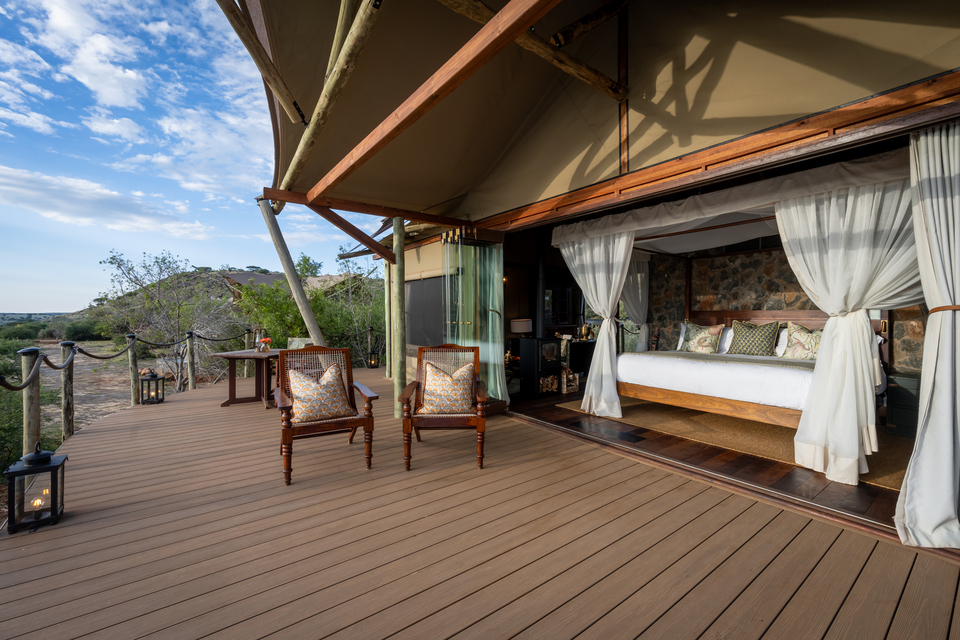
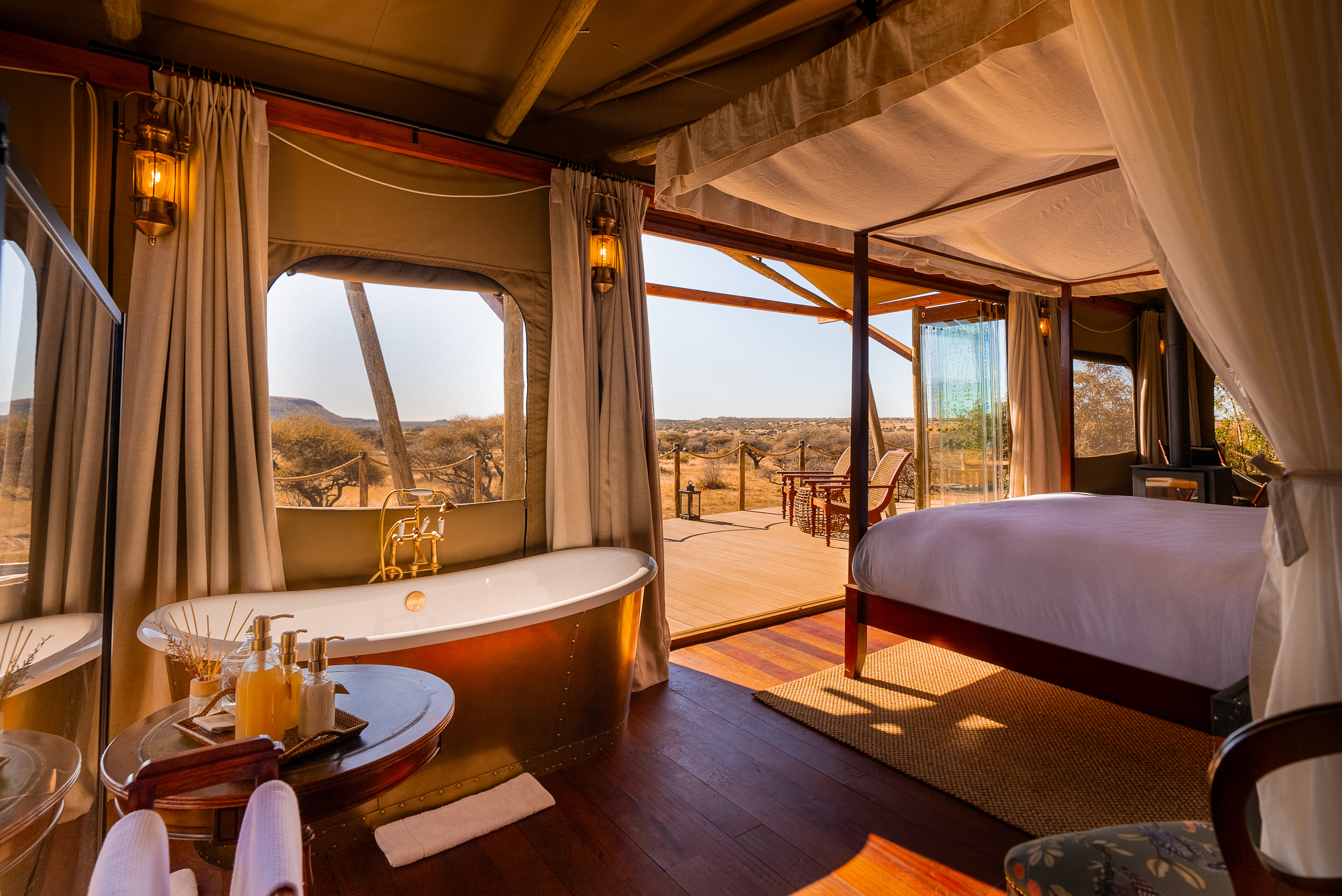
Each suite is a room designed around light and distance. A king bed faces the plains through a wide wall of glass, so the landscape is the first thing seen on waking and the last before sleep. There is a freestanding bath set where a person can lie back and watch the grass move, and both an indoor and an outdoor shower, because part of the point of being here is to feel the air on the skin even while washing off the dust of the morning. A fireplace waits for the cold end of the day. Beyond the doors, a generous terrace runs out toward the view, private enough that no other suite intrudes on it.
With only four suites in total, the reserve never fills with people. That arithmetic is the whole design. A guest at Maloba crossing from room to pool to table rarely meets a crowd, because there is no crowd to meet. The heat of the day passes in a book on the terrace, a long soak, a doze under a slow fan, the plains shimmering beyond the glass. Nothing is scheduled and nothing needs to be.
The pool, and the middle hours
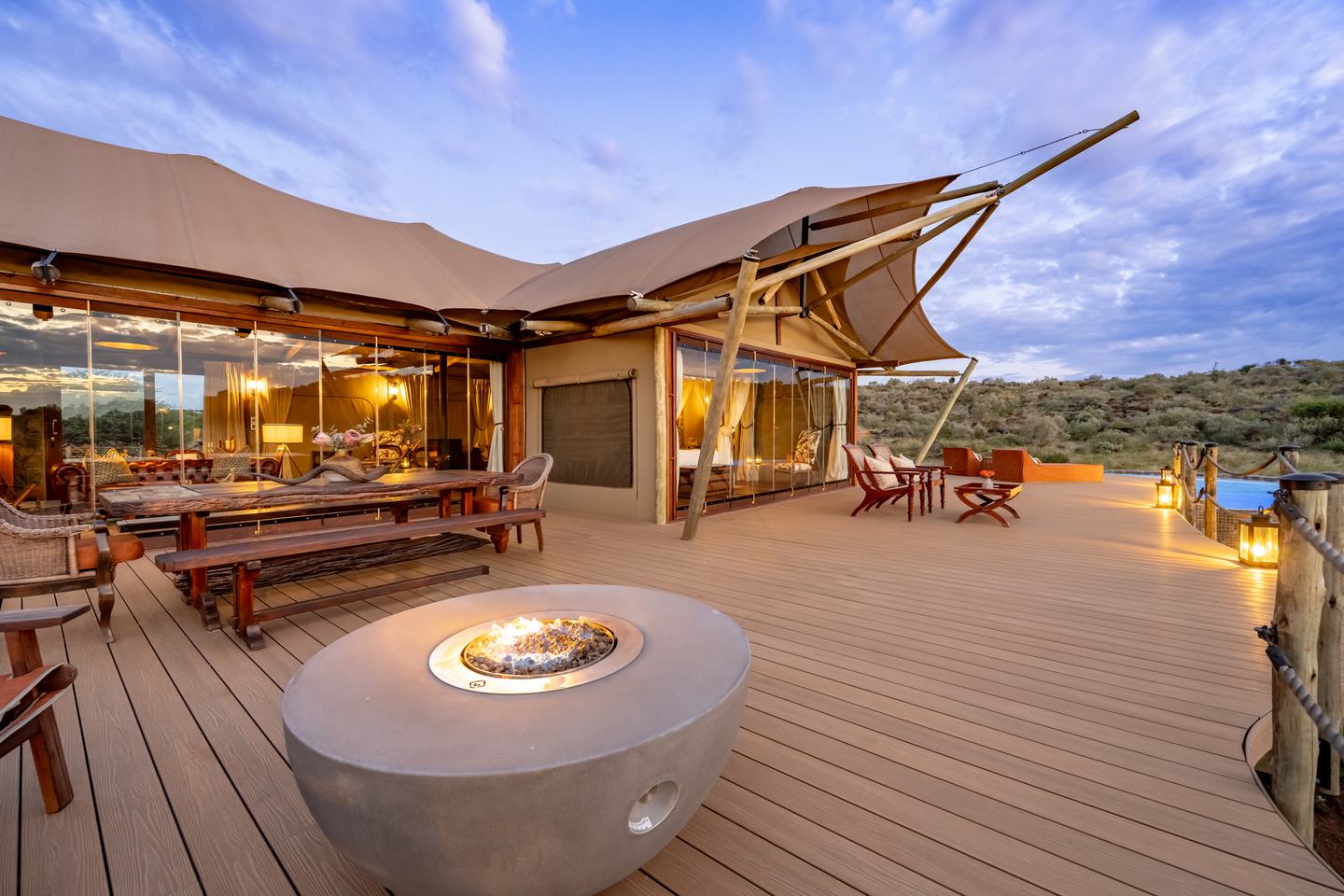
For those who cannot sit still even in the heat, the outdoor pool answers the afternoon. It sits open to the same endless view, so a swimmer doing slow lengths looks out over grassland rather than a garden wall, and the water is a cool blue interruption in all that gold. Children, if they have come, gravitate here, and the lodge is comfortable with that; this is a family-friendly place, not a hushed retreat that flinches at the sound of a child laughing.
Sundowners on the plain
The evening drive is the mirror of the morning, and for many the finer of the two. The heat has broken. The gold has deepened. The light comes in low and sideways and turns every blade of grass into something lit from within. Animals that lay up through the day are moving again, and the whole plain seems to exhale and get to its feet.
Somewhere out on the reserve the vehicle stops for the ritual that gives the safari day its punctuation. A folding table appears, glasses are set out, and a drink is poured while the sun goes down over land that runs unbroken to the edge of sight. This is the sundowner, and on twenty thousand private hectares it has no audience but the people who booked it. The sky does the work: first the amber, then a band of rose, then the fast African dusk closing the day down like a lid. No fence, no road, no other light anywhere. Conversation drops to a murmur, then stops, because there is finally nothing worth saying over it.
The drive back happens in the dark, a spotlight sweeping the grass for the shine of eyes, the night shift of the plains just coming on duty as the day shift beds down. The cold returns quickly once the sun is gone, and the blankets earn their place again on the ride home to the lodge.
The table
Dinner at a reserve is not an interval between drives; it is a set piece of the day. The kitchen at Maloba Private Game Reserve works to a fine-dining standard, plates composed with real intent, and it lands all the harder for arriving in the middle of so much wildness. There is a particular pleasure in coming off a cold, dusty evening drive to a table laid with care and a glass of good South African wine, the contrast sharpening both halves of the experience.
Because the reserve is small, the table has an intimacy that larger lodges cannot manufacture. Guides and hosts drift in and out of the conversation. The talk turns over the day, the animals seen and the ones only heard, the plans for the morning. With so few guests in residence, dinner feels less like a hotel service and more like a long meal among people who happen to have shared a remarkable day. Then the fire is lit, and the evening moves outdoors one last time.
After dark
Nothing prepares a city dweller for the sky over the Free State. With no town for miles and almost no light of any kind, the dark here is total, and into that dark the stars come out in numbers that feel frankly excessive, the Milky Way laid across the whole span of it like spilled salt. A guest who thought they had seen a starry sky before tends to fall silent again, for the second or third time in a single day.
Back in the suite, the fireplace earns everything the day owed it. The plains that ran hot at noon turn genuinely cold once the sun is long gone, and a fire in the room becomes less a luxury than a companion. Some guests draw a last bath in the freestanding tub by firelight; others simply lie in the king bed with the curtains open, watching for the shine of an eye or the drift of a shape across the starlit grass. Sleep comes fast and heavy out here, the particular deep sleep that only real silence and real dark can give. The day closes as it opened, with quiet, and with space.
Who it's for, and how many nights
A day like this suits a particular kind of traveller, and honesty serves better than a sales pitch. It rewards the person who wants space and stillness over a busy checklist, who counts a slow morning and an empty horizon as the point rather than the wait. It is well suited to families, since the four suites, the pool and the relaxed spirit of the place make room for children without pretending they are not there. It is less suited to anyone who measures a safari purely by how many rare animals were ticked off before lunch, because the deeper gift of a private reserve is the sense of having the land to oneself.
One night is enough to feel the change begin. Two or three is where the real value sits, long enough for the body to unclench, for the days to find their own rhythm of drive, rest, drive, fire, and for the plains to stop feeling foreign and start feeling like somewhere the guest belongs. Most travellers who leave after a single night say the same thing on the way out: that they wish they had given it one more.
When to go, and how to arrive
The Free State runs to extremes, and the shoulder seasons handle them best. The South African autumn and spring, roughly from April to May and again from September to October, give warm, clear days and cold, star-heavy nights without the harshness of full summer or the deep chill of midwinter. Winter, from June to August, is dry and excellent for game viewing as the land thins out, though the nights turn properly cold, which is exactly when a suite with a fireplace proves it was never mere decoration. High summer brings heat and the chance of afternoon storms that can be spectacular in their own right.
Getting to the reserve is part of the adventure and worth planning with care. Most journeys route through one of South Africa's two great gateway cities, and many travellers turn the connection into a pleasure rather than a chore. A night in Johannesburg at a garden address, makes an easy staging post before the short onward hop to Kimberley and the final drive out to the plains. From Kimberley the reserve is a straightforward transfer, and the moment the fences end, the day described here can begin again for the next guest, exactly as it did for the last, in twenty thousand hectares of silence.
Frequently asked questions
| Question | Answer |
|---|---|
| Where exactly is Maloba Private Game Reserve? | It lies near Kimberley, in South Africa's Free State, set on private plains of roughly 20,000 hectares. The landscape is open golden grassland rather than dense bush, which gives it the long horizons and strong sense of space that define a stay there. |
| How do I get there from Johannesburg or Cape Town? | Most travellers fly into Johannesburg or Cape Town first, then take a short onward flight to Kimberley, from where the reserve arranges a transfer out to the plains. Many break the trip with a night in the gateway city, for example in Johannesburg before the final leg, to arrive rested rather than road-weary. |
| Will I see the Big Five at Maloba? | A private reserve of this kind is more about space, stillness and unhurried, exclusive game viewing than about guaranteeing a full Big Five checklist. I would go for the quality of the experience and the sense of having the land to myself, and treat individual sightings as a bonus rather than a promise. |
| Is it suitable for families? | Yes. The reserve is family-friendly, with four suites, an outdoor pool and a relaxed spirit that welcomes children rather than merely tolerating them. Families who want their own space and a lodge that does not feel stiff tend to settle in quickly here. |
| When is the best time of year to visit? | The shoulder seasons, roughly April to May and September to October, offer the best balance of warm days and clear, cold nights. Winter from June to August is dry and strong for game viewing but cold after dark, when a suite with a fireplace is very welcome. High summer is hot with occasional dramatic storms. |
| How many nights should I stay? | One night lets the change begin, but two or three is where the real value lies. That is long enough for the pace to slow, for the daily rhythm of morning and evening drives to settle, and for the scale of the reserve to stop feeling foreign and start feeling restful. |
| Do the suites have a bath and a fireplace? | Each of the four Maloba Suites has a freestanding bath, both indoor and outdoor showers, a fireplace and a king bed, along with a wide private terrace facing the plains. The fireplace matters more than it sounds, since the Free State nights turn genuinely cold once the sun is down. |
| Is there a pool? | Yes. There is an outdoor pool open to the same wide view as the suites. |
A single day at Maloba Private Game Reserve does the same work every time. It takes a person used to noise and hands them, hour by hour, the rarest thing a modern traveller can buy: twenty thousand hectares of quiet, and the time to hear it.