Luxury Riads in Marrakech: The Most Beautiful Places to Stay in Morocco
A close look at four of the most beautiful luxury riads in Marrakech and the High Atlas: Olinto, The Mellah Hotel, Pure House Marrakech, and Riad Botanica.
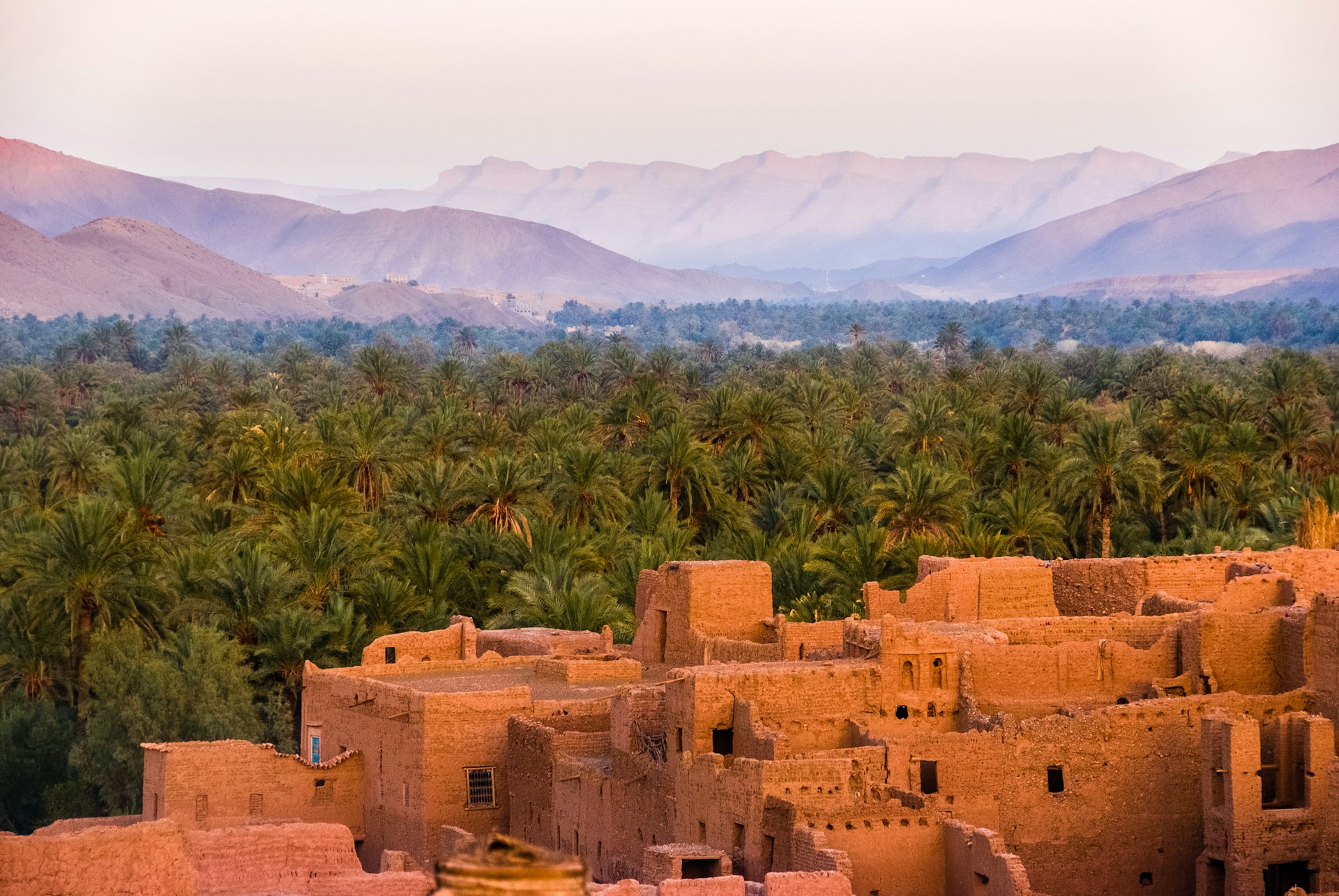
The first thing that hits you in Marrakech is the smell. Orange blossom and warm dust, cumin from a grill somewhere, the damp cool of a fountain behind a studded door you didn't notice until it swung open. Then a boy pushes past with a tray of mint tea balanced at shoulder height and you realise you've been standing still for a full minute in the middle of a derb.
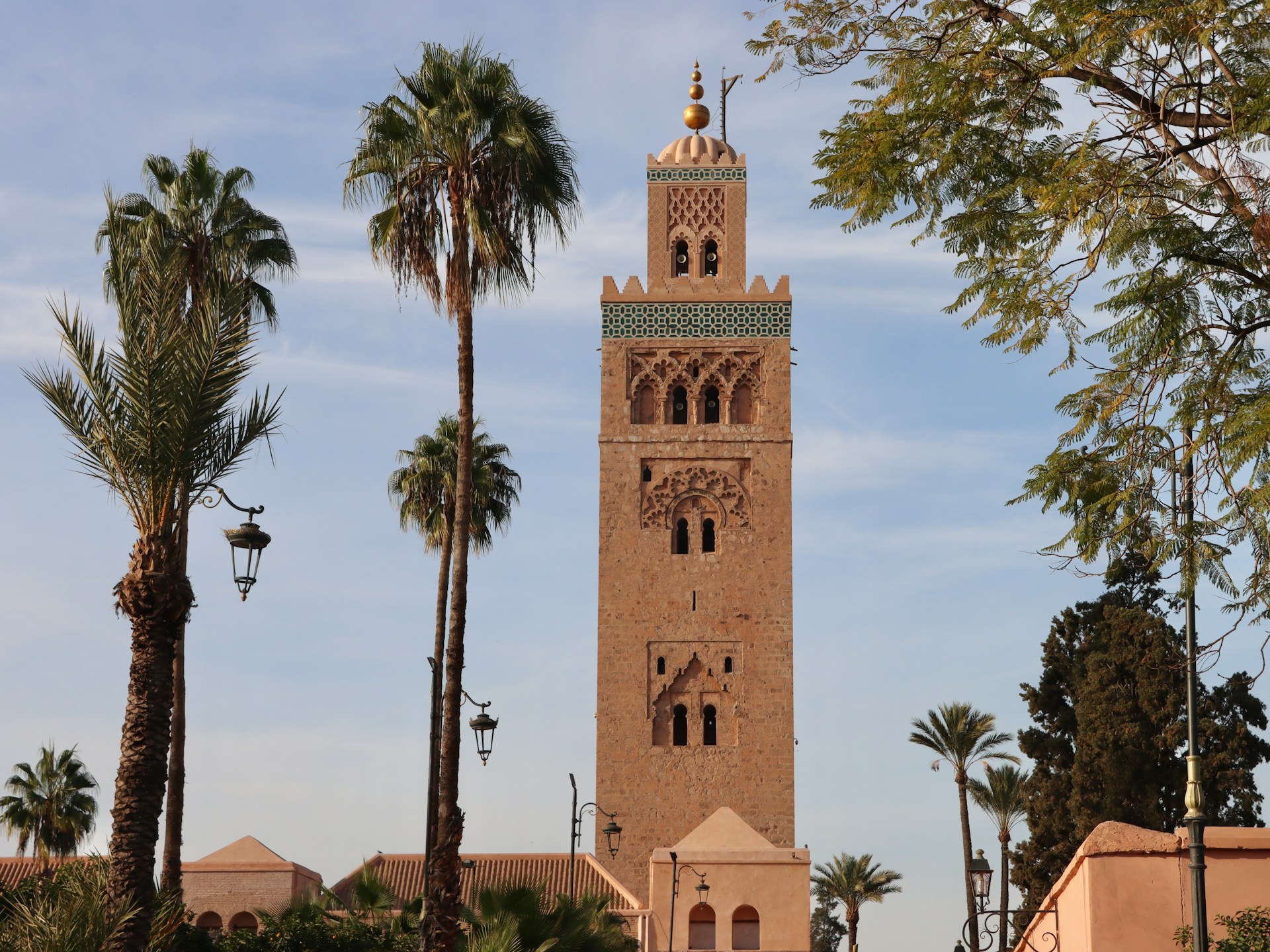
This is the trick of the medina of Marrakech. From the alley, every luxury riad looks like nothing. A blind wall. A brass knocker. Maybe a painted number. Step across the threshold and the city inverts itself. Courtyards open skyward. Zellige tiles catch the light in geometries you could study for hours. Somewhere above, a rooftop pool holds the reflection of the Koutoubia minaret against a sky that goes pink at six forty-five in winter.
The riad is not really a hotel. The word itself means garden, and the architecture is built around that idea: rooms facing inward onto a central patio, water at the centre, citrus trees, the world kept politely at bay. For centuries these were the private houses of Marrakech's merchant and aristocratic families. A wave of restoration that began in the nineties, led in no small part by a Roman prince named Fabrizio Ruspoli, turned the best of them into some of the most singular places to stay anywhere in North Africa.
What follows is a close look at four of them. Three sit inside the walls of the medina, each with its own personality and neighbourhood. The fourth lies an hour south, at the foot of Jebel Toubkal, and is the argument for why you should always give Morocco at least one day outside the city. Together they cover the range of what a luxury stay in Marrakech can mean in 2026, from mid-century design obsession to ten-century-old aristocratic bones, from adults-only slow living to a mountain retreat with nine private pavilions and its own microclimate.
Why Marrakech Still Matters
There are cities that wear their reputation heavily. Marrakech is not one of them. The souks still shout, the mopeds still miss you by inches, the snake charmers at Jemaa el-Fnaa still play the same two notes they've played for decades. What has changed, quietly and thoroughly, is what happens behind the doors.
In the late nineteen-nineties a handful of European expats, antique dealers, and one or two genuine aristocrats started buying up dilapidated courtyard houses in the medina and restoring them with the help of local maâlems, the master craftsmen who still know how to cut zellige tiles by hand, burnish tadelakt plaster to a marble-like finish, and carve cedar screens the way their grandfathers did. What began as a private passion became an industry. Today Marrakech has somewhere north of a thousand riads operating as guesthouses, of which perhaps fifty deserve the word luxury, and a smaller circle still are worth planning a trip around.
The four properties below belong to that smaller circle. They were chosen not for gloss or PR budget but for something harder to fake: a point of view. Each is run by people who know why they are there and what they are trying to say.
Olinto Atlas Mountain Retreat: A Prince's Second Act
Olinto is not in Marrakech. That is the first thing to understand. It sits fifty-five minutes south of the city by car, in the Ouirgane Valley, pressed up against the boundary of Toubkal National Park on one side and the Moroccan royal family's private hunting grounds on the other. The road climbs, the air thins, lavender and eucalyptus start to push in through the car window, and by the time you arrive you have the distinct sense of having been removed from one country and set down in another.
The Story Behind the Gate
The man responsible is Prince Fabrizio Ruspoli, an Italian aristocrat whose family tree includes the Marquis de Lafayette and the playboy who gave Fellini the idea for La Dolce Vita. Ruspoli has been a quiet hinge figure in Moroccan hospitality for thirty years. In the nineties he opened La Maison Arabe, widely considered the first boutique riad in Marrakech and the template for everything that followed. In 2019 he sold it, bought a sixty-acre olive farm in the Atlas foothills, and carved sixteen acres out of it for what became Olinto. The name is Italian for olive. He designed the whole thing himself, including the gardens, which are already being tipped as a future stop on garden-focused tours of Morocco.
The Pavilions
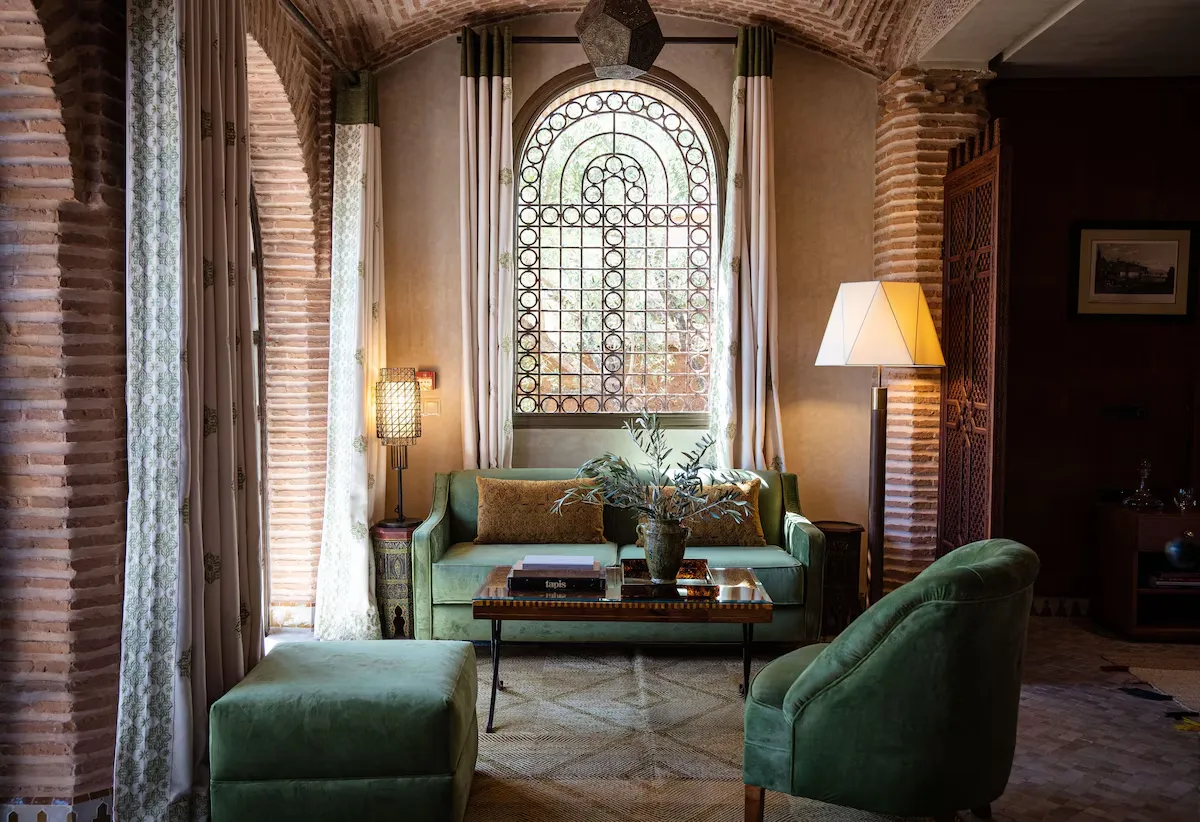
There are only nine. Each is a standalone pavilion with its own walled garden and, in the higher categories, a private heated pool that works year-round thanks to a microclimate that keeps the estate green even when the surrounding peaks are under snow. The two categories are Garden View and Private Pool, and if you can manage the latter you should. Interiors are restrained, warm, slightly theatrical in the way that someone with a real eye for proportion makes rooms feel without ever shouting about it. Beds are deep. Bathrooms are large. Windows open onto olive trees and acanthus and white roses.
The property is adults only, eighteen and up, which sets the register immediately. This is not a place for splashing and bucket-and-spade mornings. It is a place for doing very little, slowly, and reading for long stretches on a shaded terrace.
Dining, Drinking, and the Rooftop
The restaurant is farm-to-table in a way that is not a marketing line here. Much of what reaches the plate comes from the kitchen garden or the olive groves around it. Breakfast runs from eight, lunch from one, dinner from seven, and you can have any of them delivered to your pavilion or, if you prefer, eaten in bed. The drinks list is where Ruspoli's Italian side shows up. Signature cocktails include the Olinto Mule made with saffron-infused vodka, a Marrakech Negroni spiced with star anise, clove and cinnamon, and a raspberry mojito that is better than it has any right to be.
Follow the trail of emerald-green tiles up to the rooftop terrace at sunset. From there the High Atlas opens in every direction, the Toubkal massif to the south, the protected royal forests to the east, and a quiet that is genuinely difficult to find anywhere within striking distance of Marrakech airport.
Getting There
Olinto is fifty-five minutes by car from Marrakech Menara airport. The property arranges private transfers. Hiring a car is possible but largely pointless unless you plan to shuttle back and forth to the city, and the honest advice from everyone who has been is the opposite: settle in and stay. The retreat closes for one month in low season, from mid-July to mid-August.
The Mellah Hotel: Mid-Century Soul in the Old Jewish Quarter
Back inside the medina walls, in the neighbourhood that gives the hotel its name, The Mellah occupies a restored historic building at the end of a narrow derb. The Mellah is Marrakech's historical Jewish quarter, and for centuries it was the spice and jewellery heart of the city. Ochre walls, carved doors, a surviving synagogue, kosher bakeries still operating a few streets over. It is quieter than the areas nearer Jemaa el-Fnaa and, if you are staying for four or five nights, a smarter base.
A Passion Project
The hotel is the work of Simo Azzouz, a French-Moroccan entrepreneur who bought the building and restored it as what the industry politely calls a passion project. Passion projects in the medina are often a code for something over-designed or precious. The Mellah is neither. It is a boutique hotel of ten rooms, run with the kind of attention to detail that can only come from an owner who is actually on the premises, and who cares more about whether the hand-cut zellige in the courtyard reads the right way than about whether the website photographs well.
The Design Language
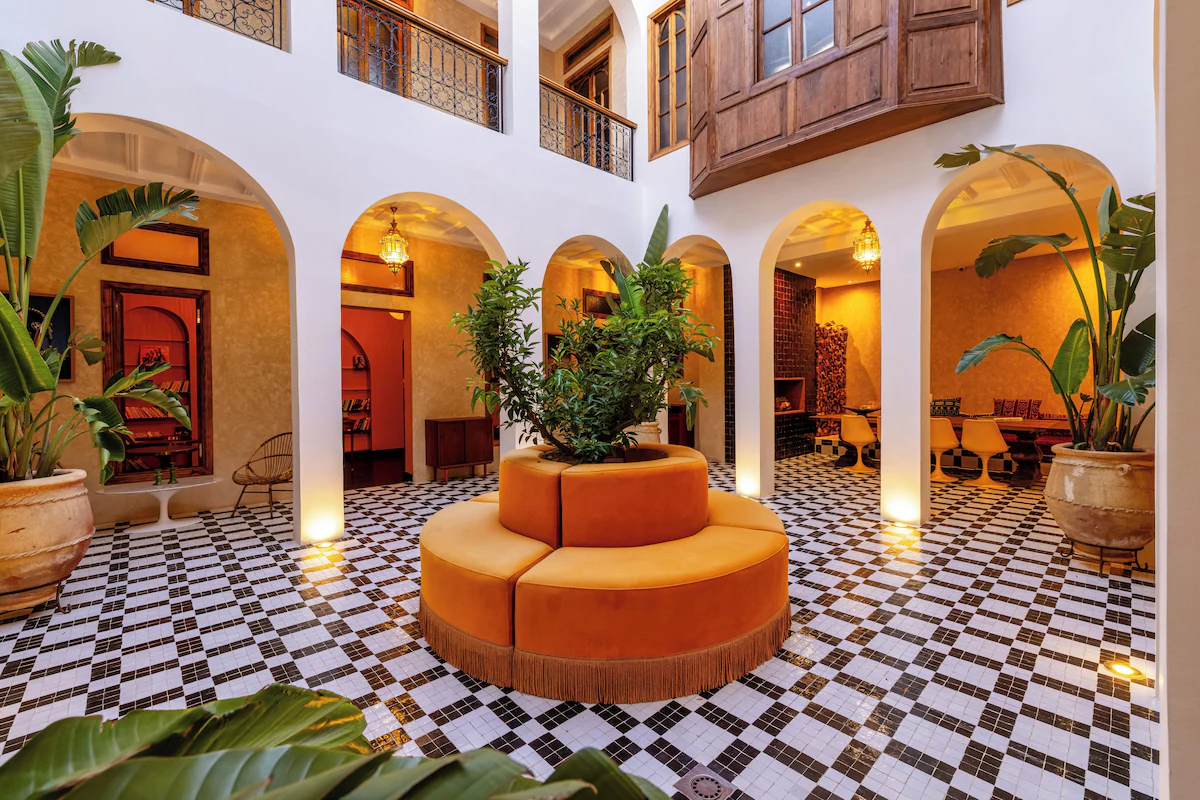
Everything at The Mellah has been chosen by someone with an argument to make. The walls are burnished tadelakt in saffron and ruby. The floors, in some rooms, are laid in traditional camel-leather tiles, a technique that has almost vanished from contemporary Moroccan interiors. The tilework is hand-cut zellige throughout, and the lighting is brass, custom, and unmistakable.
Then, on top of all that, comes the mid-century layer. Eames loungers. Sculptural wooden chairs. Individually chosen artworks that do not look like hotel art. The effect should not work, and yet it does. The argument the hotel is making is that traditional Moroccan craft and twentieth-century European modernism share more than people usually think: both prize material honesty, both love proportion, both are allergic to decoration for decoration's sake.
The Rooms
There are ten rooms in total, a mix of standard rooms, upstairs rooms, and the ground-floor Founder's Suite, which is the one to book if you can. It has a double shower, the Eames lounger already mentioned, and the most considered mid-century furniture in the property. Five of the rooms have freestanding bathtubs made locally from sandblasted copper or brass. Bath products are Botanika, organic, and actually good. Air conditioning, sound systems, free bottled water, bathrobes, slippers, everything you would expect at this level, delivered without fuss.
The Rooftop, the Pool, and the Kitchen
Crowning the courtyard is the hotel's single most photographed feature: a ten-metre rooftop pool lined with striped zellige tiling, suspended over the medina with views across to the Koutoubia. It is larger than rooftop pools in the medina usually are, and it is heated, which matters in January and February.
Food is simple and home-style. Chef Abdesamad runs the kitchen, and the cooking is the kind of Moroccan home cooking that makes you realise how much of what gets served to tourists has been flattened out for foreign palates. Tagines are slow and layered. Salads are bright. Breakfast is included in the rate and rotates through freshly pressed juices that change daily. Note that the hotel is largely stair-access, so guests with mobility issues should factor that in.
Getting There
Marrakech Menara airport is about twenty minutes away by taxi, roughly twelve euros, or the hotel can arrange a private transfer for around three hundred dirhams one way. The entrance is off an alleyway that does not allow vehicle access, so there will be a short walk with bags at the end of it. Jemaa el-Fnaa is about eighteen minutes on foot. Bahia Palace is three minutes away. The train station is a fifteen-minute taxi ride if you are continuing to Casablanca or Fez.
Pure House Marrakech: Adults-Only Slow Living Near Jemaa el-Fnaa
If The Mellah is mid-century theatre, Pure House Marrakech is the opposite register. Quiet, pared back, almost Mediterranean in the way it handles light and surface. The riad sits a four-minute walk from Jemaa el-Fnaa and two hundred metres from Le Jardin Secret, which means you can step into the full noise of the main square in under five minutes and, more importantly, step out of it again just as fast.
The Concept
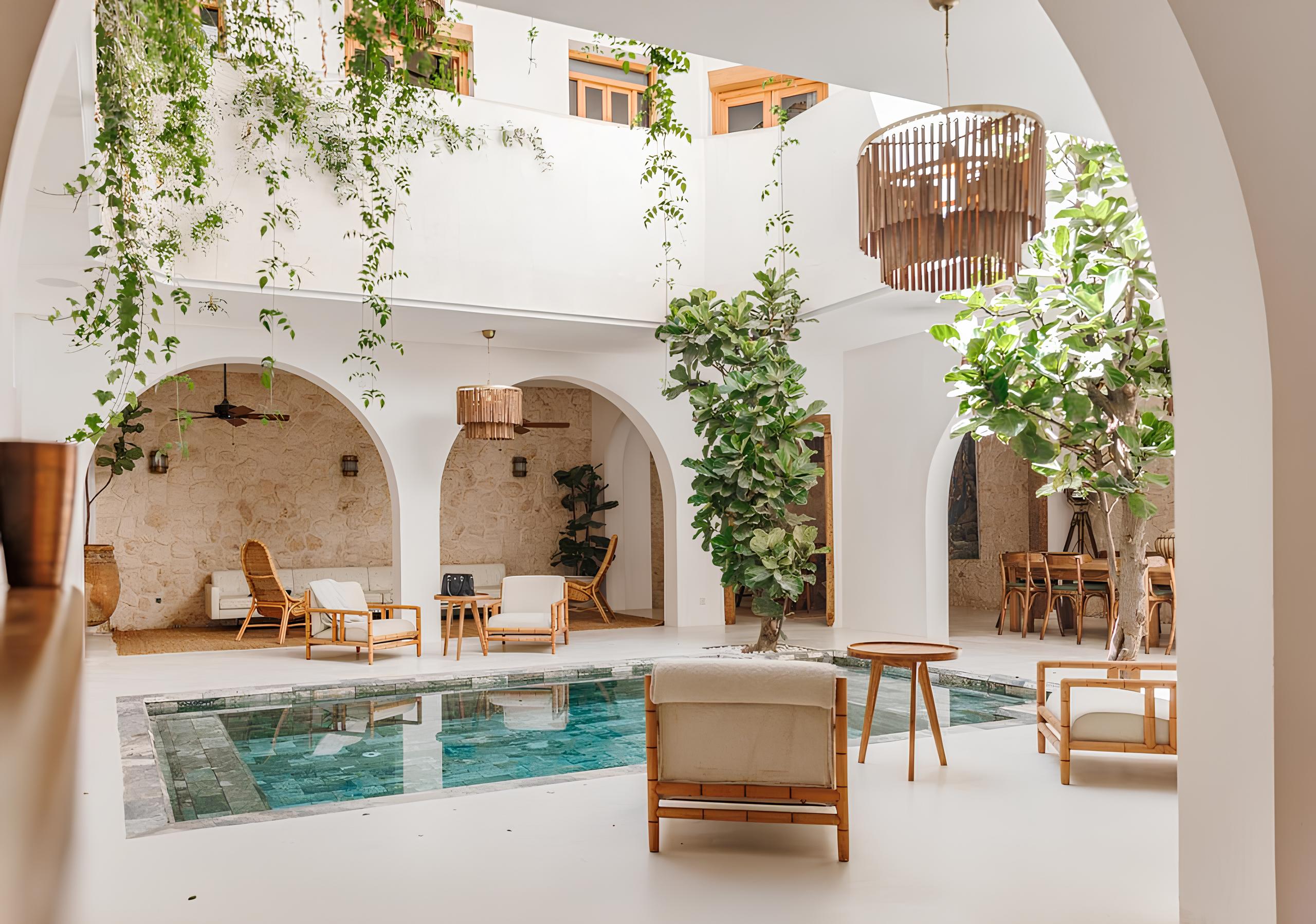
Pure House is adults only and built around the now-familiar language of slow living, but handled with more discipline than the phrase usually implies. Eleven rooms. Spacious, bright interiors in contemporary Moroccan minimalism. Clean lines. Natural materials. Tadelakt bathrooms. The palette is soft, the lines are clean, and the overall feeling is less boutique hotel and more well-edited private house that happens to welcome guests.
The team is English-speaking, multilingual (Italian, French, English), and famously attentive. Sara, who runs the riad day to day, has the kind of reputation in online reviews that matters more than any star rating: guests remember her name and write it unprompted months after they leave. On arrival you are given a local phone with staff contacts, recommended restaurants, and a working SIM, which removes the single most annoying friction of the first twenty-four hours in a new city.
The Rooms
Each of the eleven rooms is individually designed. Expect king-size beds, air conditioning, walk-in rainfall showers in tadelakt bathrooms, premium linens, bathrobes, and the kind of built-in storage that only exists when someone has thought seriously about what travellers actually need. Views are mostly onto the central courtyard, which is the point of a riad in the first place.
Two Pools and a Rooftop
The main courtyard pool is small and lovely and exactly what you want at two in the afternoon when the souks have worn you down. Upstairs, the rooftop terrace has a second plunge pool, sunloungers, a bar, and a panoramic view across medina rooftops to the Atlas Mountains on a clear day. Breakfast is served here, as is dinner on request, and if you have booked for a special occasion the team will set up a candlelit table on the rooftop without making a show of it.
Food and Wellness
The kitchen does vegetarian-leaning Moroccan cooking with Mediterranean influences, built around what is good at the market that morning. Breakfast is free-form, served at your own pace. Dinner rotates through tagines, grilled vegetables, fresh fish when it is available, and a handful of dishes that lean more Ligurian than Marrakchi but fit the overall tone of the place.
Wellness is handled properly here. There is a private hammam, a Turkish steam bath, a plunge pool, and a small spa offering massages and traditional Moroccan rituals. Morning yoga classes are available on request, typically on the rooftop before breakfast. None of this is billed as transformative or life-changing, which is a relief.
Getting There
Marrakech Menara airport is a fifteen-minute drive, and the hotel arranges pickups. The final approach is on foot through a derb that looks, as one guest honestly put it, mildly intimidating on first sight, with an empty demolished lot at the end of the street. You knock on a door and the city disappears. Children are not accepted.
Riad Botanica: A Ten-Century-Old House with Sydney Wallpaper
Riad Botanica is the outlier, and possibly the most personal of the four. It sits in the Bab Doukkala district, the neighbourhood named after the main northwest gate of the medina, in a building whose bones go back to the founding of Marrakech by the Almoravid dynasty at the end of the tenth century. The precise dating is impossible because the medina was not broken into private houses until the fourteenth century and records are patchy. What is certain is that the riad has been in a small number of Moroccan families for generations, and that its original aristocratic owners were wealthy enough to sink a private well, whose pulley system is still visible on the courtyard wall.
How It Came to Be
The story of the restoration is unusual enough to be worth telling. A traveller from Melbourne, Angela, came to Morocco more than a decade ago, fell in love with the country, and then fell in love with a Moroccan named Mohammed whom she met by chance in the souks. The two married. Angela spent the next decade imagining a riad of her own. In 2022 the current restoration was completed, and Riad Botanica opened as a guesthouse of four deluxe suites and a two-bedroom apartment, plus lounge, dining room, and rooftop.
The result is a blend that, on paper, should not work. Moroccan zellige, hand-carved plasterwork, tadelakt, brass, and marble on one hand. Hand-printed Florence Broadhurst wallpapers shipped from Sydney, Australia, on the other. Broadhurst's Arabian Bird print, in particular, turns out to sit beautifully against traditional Moroccan tilework, and the Art Deco colour palette complements rather than fights the architecture.
The Orange Tree in the Middle
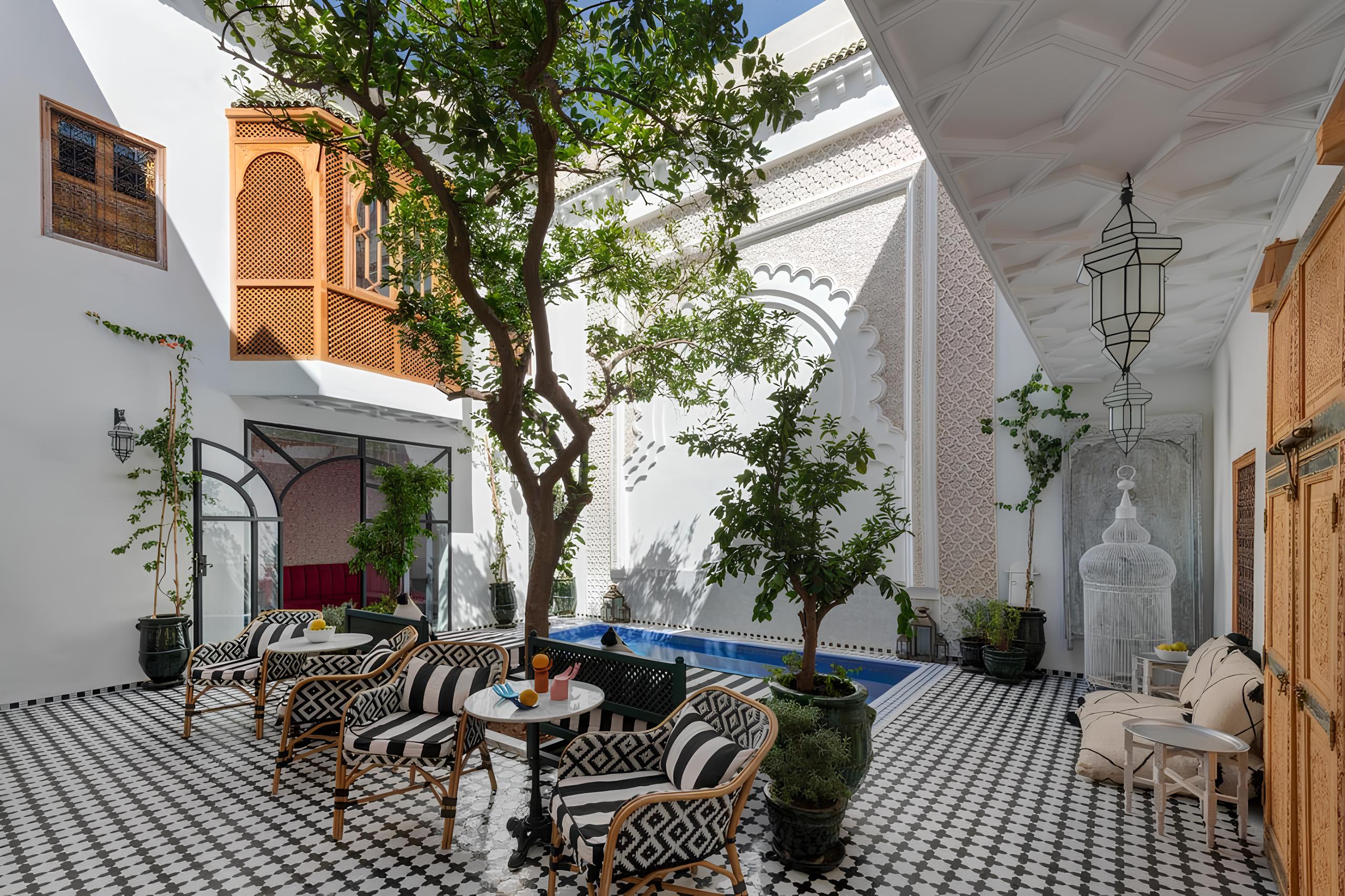
At the centre of the courtyard, watered for generations by the original well, stands an orange tree that has become the signature of the house. The word riad means garden, and the tree is both the literal and the symbolic heart of the building. Every room faces it. The morning light passes through its branches. In spring, the scent of orange blossom fills the entire courtyard and rises through the open centre of the building all the way to the rooftop.
The Rooms
There are five keys in total: four deluxe suites and one two-bedroom apartment, each named after a flower or plant. Orange Blossom, Beldi Rose, Pomegranate. Each has its own character, its own Broadhurst print, and its own configuration of hand-carved wood, plasterwork, and tilework. Beds are medical-grade memory foam with mattress toppers, protectors, luxury linens, and a choice of feather or hypoallergenic pillows. Bathrooms are modern, spacious, finished in marble and brass. The rooms can read dark during the day because the windows face the courtyard rather than the street, which is the way riads have always worked and is not a flaw.
The Art Deco Bar and the Rooftop
The ground-floor lounge has an Art Deco bar in honed green marble with brass edging and three handmade black and white stools, and it is one of the quiet triumphs of the restoration. From here you can see the Bab Doukkala minaret through a small window. Upstairs, the rooftop serves breakfast, lunch, and dinner daily, with a daybed, sunloungers, and views across the rooftops of the medina. Marrakech gets more than two hundred days of sun a year, and the rooftop is built for the fact.
Food and Service
Breakfast at Riad Botanica is cited repeatedly by guests as one of the best they have had in Morocco, which is a higher bar than it sounds. Fresh juices, seasonal fruit, warm pastries, eggs cooked to order, mint tea, local honey and jams. Lunch and dinner are served à la carte, with a two-course lunch and three-course dinner prepared fresh each day. The kitchen accommodates full English, gluten-free, halal, vegan, and vegetarian diets without fuss.
Service is where the riad pulls ahead of larger properties. With five keys and a staff that includes the owners themselves, guests are met by name, driven or walked to the riad from the nearest car drop-off, and given the kind of personalised city recommendations that only come from people who actually live in the place.
Getting There
Riad Botanica is at seventy-eight Derb Sidi Lahcen o Ali, in Bab Doukkala, about seven kilometres from Marrakech Menara airport, roughly fifteen minutes by taxi. The riad arranges airport transfers with a staff member meeting you at the drop-off point with a sign, which is the right call given how hard the address is to find on the first attempt. Jemaa el-Fnaa is under twenty minutes on foot, Le Jardin Secret is about six hundred metres away, and the Majorelle Garden is a short taxi ride.
Choosing Between Them
These four properties do not compete so much as divide the territory between them. Olinto is the mountain escape, the one you add to the end of a trip to decompress, or the one you use as a base if you want to walk in the High Atlas with a Berber guide and sleep somewhere faultless at night. The Mellah Hotel is the design obsessive's choice, the one that will appeal to anyone who cares about mid-century furniture, zellige craftsmanship, and the specific pleasure of a rooftop pool tiled in stripes. Pure House Marrakech is the adults-only slow living option for couples who want proximity to Jemaa el-Fnaa without actually hearing it, and who value a front-desk team that treats them as individuals. Riad Botanica is the quietest of the four, the smallest, the most personal, and the only one whose architecture you can trace back a thousand years.
The honest move, if you have the time, is to combine two of them. Three or four nights in a medina riad, then two or three at Olinto to clear your head. Marrakech is a city that asks a lot of you, and the contrast with the Atlas silence is one of the reasons people come back.
Frequently Asked Questions
| What is a riad and how is it different from a hotel? | A riad is a traditional Moroccan house built around a central interior courtyard, usually with a fountain or small pool at its heart, rooms facing inward rather than outward, and a rooftop terrace above. The word means garden in Arabic. Riads were originally the private homes of wealthy Moroccan families. Today, restored riads operating as small guesthouses offer a more intimate experience than conventional hotels, typically with between four and twenty rooms, personalised service, and architecture that feels closed off from the street but open to the sky. |
| When is the best time to visit Marrakech? | The best months are March, April, May, October, and November, when daytime temperatures sit comfortably in the low to mid-twenties Celsius and the light is at its best. June through August can be extremely hot, with temperatures regularly above thirty-eight degrees. December, January, and February are mild by European standards but genuinely cold at night, especially in riads without central heating, so a heated rooftop pool and proper room heating become important. |
| Is the Marrakech medina safe? | Yes, broadly. The medina is busy, loud, and occasionally disorienting, but violent crime against tourists is rare. Standard precautions apply: watch your bag in crowds, ignore unsolicited guides offering to walk you somewhere, and use official taxis or pre-arranged transfers from your riad. Most riads will send a staff member to meet you at the nearest car drop-off, which is the smart way to handle your first arrival. |
| How much should I budget for a luxury riad in Marrakech? | Rates at the properties above start around one hundred and seventy-five euros per night in low season and climb to six hundred euros or more for the best suites in high season. Olinto sits at the top of the range given its category and remoteness. Breakfast is typically included. Dinner usually runs between thirty and sixty euros per person. |
| Are luxury riads in Marrakech suitable for families with children? | It depends on the riad. Two of the four properties here, Olinto and Pure House Marrakech, are strictly adults only. The Mellah Hotel and Riad Botanica accept children. Families travelling with young children should also factor in that most riads are built around staircases with no lifts, which makes strollers and very young children harder to manage. |
| Do I need a car in Marrakech? | Almost certainly not. The medina is entirely walkable, taxis are cheap and plentiful, and your riad can arrange private drivers for day trips to the Atlas Mountains, the Agafay Desert, or the coast. A car only makes sense if you are planning a multi-city road trip through Morocco, in which case hire it at the airport on the day you leave the city. |
| What is the difference between staying in the Mellah and staying near Jemaa el-Fnaa? | The Mellah, the old Jewish quarter, is quieter, less touristed, and closer to Bahia Palace and the Saadian Tombs. The area around Jemaa el-Fnaa is louder, more central, and better if you want to be at the heart of the action. Both are inside the medina walls and both are well served by good riads. For a longer stay, many travellers prefer the Mellah. For a shorter first trip, the Jemaa el-Fnaa side can be easier to navigate. |
| Can I visit the High Atlas on a day trip from Marrakech? | Yes, and it is one of the most rewarding day trips in Morocco. Options include the Ourika Valley, the Ouirgane Valley (where Olinto sits), and trekking around Imlil at the base of Jebel Toubkal. If you are staying in the medina, any good riad will arrange a private driver and, for proper hiking, a Berber guide. Allow a full day minimum, two if you want to overnight in the mountains. |