The New Ibiza: Design Hotels Redefining the Island
Three properties, three philosophies. From a hippie-era pioneer perched on northern cliffs to a yacht-inspired clifftop village and an ex-cinema turned downtown hangout, these design hotels tell the story of an island that refuses to stand still.
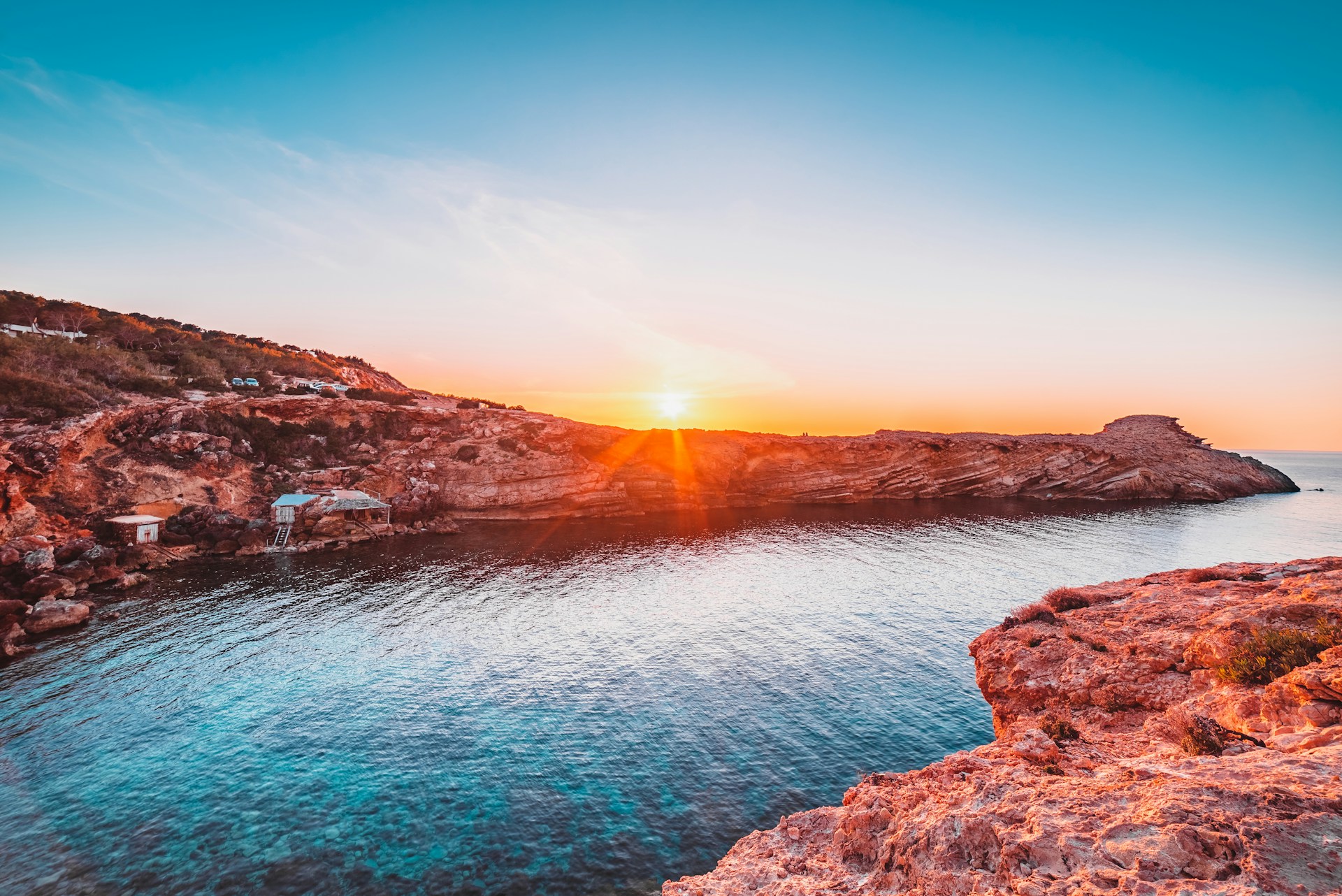
There is a version of Ibiza that exists only in memory: the fishing boats at dawn, the dirt roads through pine forests, the artist colonies where nobody asked your name. That island, the one the hippies found in the fifties and the jet set discovered in the seventies, has been written about so often it has become a kind of mythology. The clubs came later. Then the mega-hotels. Then the backlash against the mega-hotels. And somewhere in between, a handful of architects and hoteliers began asking a question that turned out to be more interesting than expected: what should a design hotel in Ibiza actually look like?
The answer, it turns out, is not singular. The three properties in this guide represent radically different philosophies, built across five decades, yet they share a common thread. Each one responds to the landscape rather than imposing upon it. Each one was shaped by someone who fell in love with the island before calculating its commercial potential. And each one manages to feel like Ibiza, rather than a version of somewhere else transplanted onto Mediterranean rock.
This matters more than you might think. The Balearics have suffered from what architectural critics politely call "placelessness," that creeping homogeneity of international resort design that could be Marbella or Mykonos or anywhere with sun and sea. The hotels here are the antidote. They are not interchangeable. They could not exist anywhere else.
Hacienda Na Xamena: The Original Vision
San Miguel, Northern Ibiza
Before there was a five-star category on the island, before the road to Na Xamena was paved, before electricity reached the northern cliffs, there was Daniel Lipszyc and a piece of land so beautiful it stopped him in his tracks.
The year was 1969. Lipszyc, a Belgian architect who had been visiting Ibiza since 1954, had spent the decade falling in love with an island that most of Europe had never heard of. This was agrarian Ibiza, isolated and poor, connected to the mainland by a single weekly ferry. The foreign visitors who found their way here were artists, writers, spiritual seekers, people running from something or toward something, drawn by the extraordinary light and the freedom of a place that asked no questions.
Lipszyc bought one hundred and fifty hectares on the Na Xamena cliff, a plot of land accessible only by foot, with no infrastructure of any kind. The local ibicencos thought he was mad. He began construction anyway, bringing in roads, water, electricity, building what would become the first luxury hotel in Ibiza through sheer pioneering determination.
Hacienda Na Xamena opened in 1971 with fifty-four rooms. It was awarded its fifth star in 1988, the first property on the island to receive the designation. Remarkably, it remains in the same family today. Alvar Lipszyc, Daniel's son, now runs the hotel with his wife Sabine, continuing his father's vision while steering it into the present.
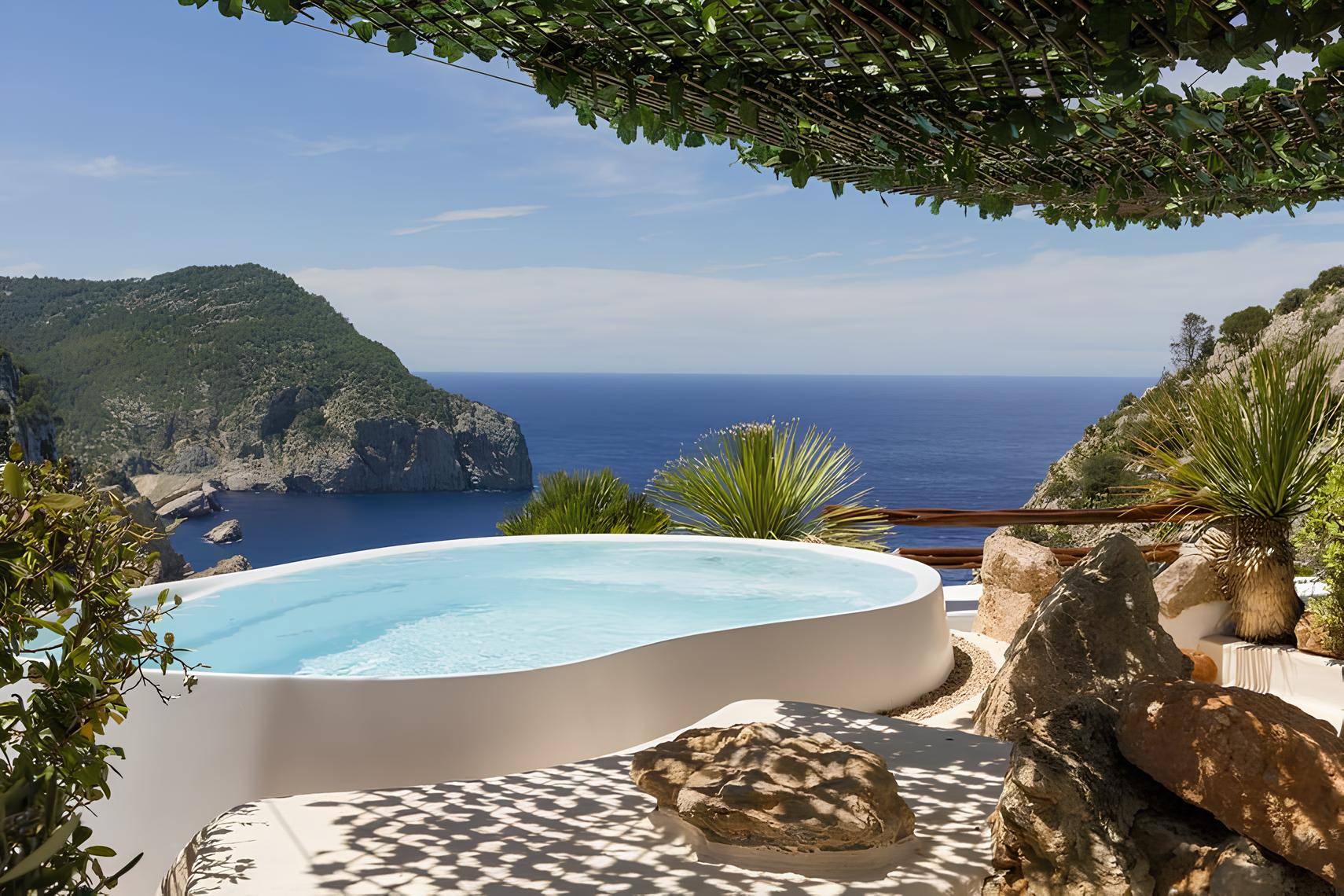
Architecture That Disappears Into Landscape
The hotel sits one hundred and eighty metres above sea level, suspended on coastal cliffs within the Es Amunts natural park. The whitewashed buildings follow the traditional Ibizan finca aesthetic, that particular vocabulary of arches, galleries, interior patios, and thick walls designed to keep cool in summer heat. From the air, the property reads as a small village rather than a hotel, its low-rise structures scattered across the terrain in a way that feels almost geological.
This was intentional. Lipszyc designed the hotel to protect rather than dominate its surroundings. The family still cares for over one hundred and fifty hectares of preserved land, including an organic farm that supplies the kitchens. The philosophy of harmony between interior and exterior spaces, established in the original construction, runs through every renovation and addition made in the five decades since.
The interiors have evolved over the years, incorporating Asian-inspired elements alongside traditional Balearic architecture. Some reviewers have noted a certain eclecticism, a maximalism that reflects the accumulated tastes of multiple generations. This is accurate, and it is also the point. Hacienda Na Xamena is not a concept hotel designed by a single vision at a single moment in time. It is a living document of one family's relationship with a place, and the layers show.
The Cascadas Suspendidas
The hotel's signature feature is the Cascadas Suspendidas, a thalassotherapy circuit that has no equivalent anywhere on the island. Eight interconnected seawater pools hang at the edge of the cliff, heated to three different temperatures, equipped with high-pressure jets that massage the body from feet to head over a forty-five minute session.
The circuit was designed exclusively for Hacienda Na Xamena after Alvar and Sabine took over the property in 1995. They also established La Posidonia Spa, named after the protected seagrass that grows in the waters around Ibiza and Formentera, and planted the traditional ibicenco fruit and vegetable garden that now feeds the restaurants.
The spa offers body treatments, SkinCeuticals facials, and wellness programmes, but the Cascadas remain the draw. There is something almost primordial about floating in heated seawater at the edge of a cliff, watching the sun sink into the Mediterranean while jets pummel the tension out of your shoulders. The circuit is open to non-guests by reservation, a rare gesture of accessibility from a five-star property that could easily keep such an asset to itself.
Dining and Daily Rhythms
The culinary programme centres on Eden Restaurant, which takes its inspiration from the surrounding land and sea. The kitchen operates on a philosophy of seasonal, sustainable sourcing, with much of the produce coming from the hotel's own organic patch. Vegetables, aromatic plants, flowers for decoration, all grown within view of the dining room.
Above the restaurant, Los Nidos offers what the hotel calls "tree-like nests," intimate perches with three-hundred-sixty-degree views for cocktails at sunset. By The Pool serves casual fare exclusively to resident guests, while twenty-four-hour room service ensures nobody goes hungry at odd hours.
The hotel also maintains a cinema room, tennis court, indoor and outdoor pools, and a programme of hiking excursions through the northern landscapes. These are not afterthoughts bolted onto a beach resort. They reflect the original understanding that guests come to Na Xamena for immersion, not escape. The pace here operates on what the hotel describes as four special moments: sunrise, noon, sunset, and starlight.
Getting There
Hacienda Na Xamena sits at the end of a narrow winding road through pine forest, approximately thirty minutes from Ibiza Airport and Ibiza Town. The nearest village is Sant Miquel, a ten-minute drive away. The hotel operates April through October, reopening each spring to guests who have been returning for decades.
7Pines Resort Ibiza: The Village on the Cliff
Cala Codolar, West Coast
The western coastline of Ibiza, between Cala Conta and Cala Codolar, is where the island's mythology lives. This is Es Vedrà territory, that offshore rock formation that has inspired painters, mystics, and tourism boards in roughly equal measure. The sunsets here are not merely pretty. They are operatic, the kind of light show that silences conversation and makes strangers feel they are sharing something sacred.
It is also, not coincidentally, the stretch of coast where 7Pines Resort Ibiza established itself in 2018, claiming one of the most privileged positions on the White Isle.
The resort was conceived by German development group 12.18 Investment Management, with interiors by Olaf Kitzig Design Studios of Düsseldorf. The brief was specific: create a luxury resort in Ibiza that felt like an Ibizan village, not a hotel complex. The result spreads across fifty-six thousand square metres of pine-covered cliff, one hundred and eighty-five suites arranged in low-rise whitewashed buildings that step down the escarpment toward the sea.
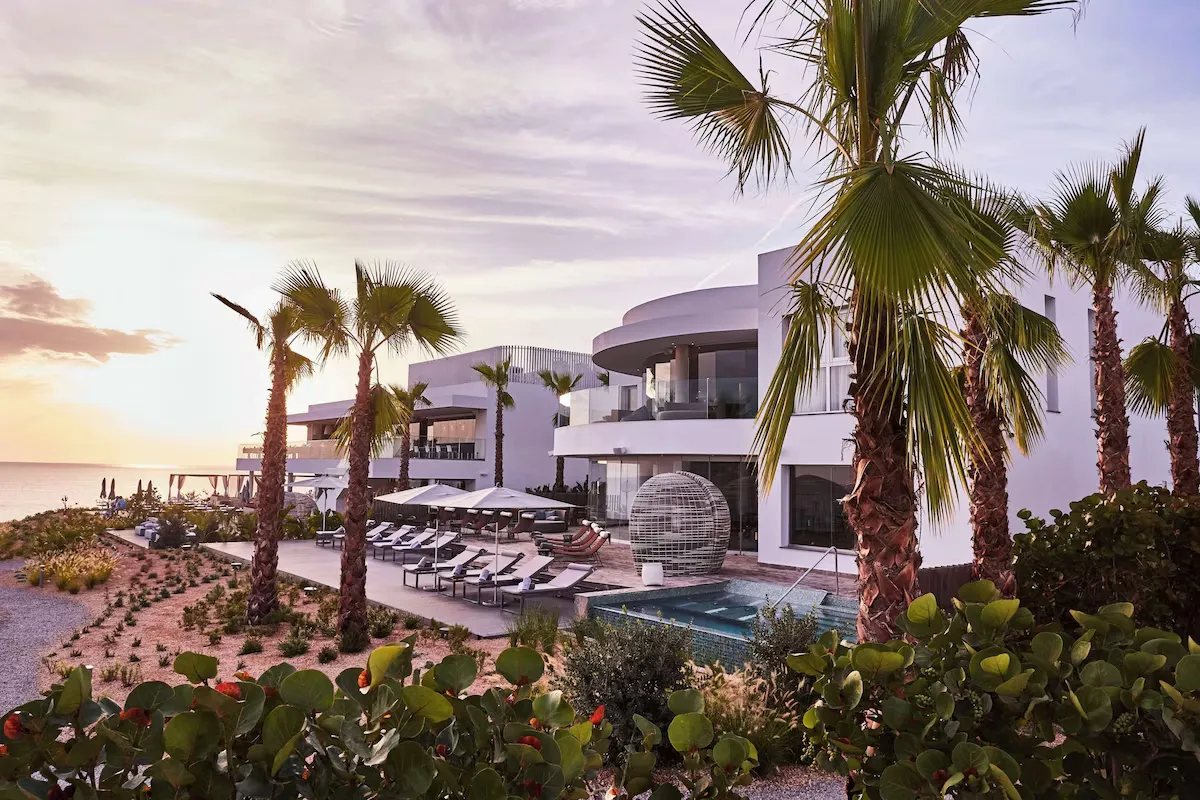
Design Philosophy: Laid-Back Luxury
Kitzig's approach centred on bringing elements from the surroundings into each individual building. Water, local materials, the iron-red of the cliff stone, the silver-green of pine needles, all became source material for a palette that reads as Mediterranean without ever becoming cliché.
The tension in the design is deliberate. Hard and soft. Cold and warm. Raw and elegant. Interior spaces combine stainless steel, brass, natural stone, oak, bronzed glass, and high-gloss surfaces in compositions that create what Kitzig describes as "moments of surprise." The suites themselves use light-washed wood-effect tile, neutral wall colours, and cushion and curtain patterns ranging from cerulean green to blue. Large windows and sliding doors flood rooms with natural light, making the landscape part of the interior rather than a view to be observed from inside.
The vocabulary is contemporary Ibizan, meaning it references the traditional finca architecture without reproducing it literally. Whitewashed walls and flat roofs nod to vernacular building methods. Private terraces and plunge pools extend living space outdoors. The overall impression is of a high-end residential development where someone happens to bring you breakfast.
The Pershing Partnership
The resort's most distinctive feature is arguably not architectural at all. In 2018, 7Pines entered an exclusive partnership with Pershing Yachts, the Italian manufacturer of high-performance motor vessels, to create the Pershing Yacht Terrace, the first bar on land designed by the yacht maker's in-house team.
The space was conceived by Fulvio Di Simoni, Pershing's longtime stylist, working with the 7Pines architects to translate the brand's nautical DNA into a fixed location. The result features a carbon-fibre bar shaped to emulate the side wing of a Pershing 9X, teakwood flooring, and surfaces finished in the signature Pershing grey. The effect is of boarding a superyacht that happens to be anchored at the edge of a cliff.
The terrace offers modern Japanese izakaya-style cuisine alongside a cocktail programme developed by award-winning mixologists. The intent is to create an experience that extends the Pershing lifestyle beyond the water, and for guests chartering one of the resort's three Pershing yachts, a 5X, 9X, and 74, the continuity between vessel and venue is seamless.
Dining and Wellness
Beyond the Pershing Yacht Terrace, the resort operates five distinct food and beverage venues. The View serves modern Mediterranean cuisine from an elevated position overlooking Es Vedrà, with a menu developed by Executive Chef Óscar Salazar. Cone Club, positioned at the cliff's edge, has become famous for its nightly sunset ritual, a DJ-led gathering that pauses the music as the sun touches the horizon, inviting guests to watch in collective silence before the evening programme begins.
The wellness offering centres on Pure Seven Spa, a fifteen-hundred-square-metre facility designed by Kitzig with natural stone, lively wooden surfaces, and views through the pine trees to the sea. The spa includes two saunas, a steam room, three waterbeds in a dedicated relaxation area, and an outdoor section with whirlpool and loungers arranged for privacy. Treatments draw on Mediterranean ingredients and Ibiza's particular energy, aiming to reconnect body and mind through what the resort calls "holistic experiences."
The infinity pool, cantilevered above the cliff edge, frames Es Vedrà with the precision of a composed photograph. An eight-metre glass wall forms the pool's outer boundary, allowing swimmers to float at eye level with the horizon. This is perhaps the single most photographed feature of the property, and it earns its reputation.
Accommodation Categories
The one hundred and eighty-five suites are distributed across three distinct areas: the Ibicenco Village, The Laguna, and The Cliff. Categories range from the forty-eight-square-metre Laguna Suite with terrace to the one-hundred-twenty-eight-square-metre Cliff Duplex Deluxe with two bedrooms, private pool, and panoramic sea views.
The Cliff suites occupy the most exclusive position, perched at the very edge of the escarpment with direct sightlines to Es Vedrà. These duplex units spread across two levels, combining living space with outdoor terraces that function as private sun decks. The premium is substantial, but the views are genuinely unreproducible.
For guests seeking residential scale, Villa Alba and Villa Aurora offer four-bedroom retreats with private glass swimming pools, jacuzzis, and gardens. Each villa accommodates up to eight guests with access to a twenty-four-hour Clefs d'Or concierge service. The villas represent the pinnacle of the 7Pines concept, that idea of a private home with hotel services, taken to its logical conclusion.
Getting There
7Pines Resort Ibiza is located approximately twenty-two kilometres from Ibiza Airport, a drive of roughly thirty minutes depending on traffic. The resort operates seasonally, closing for winter and reopening each spring. Cala Codolar beach is a five-minute walk, Cala Conta a five-minute drive.
The Standard, Ibiza: Cinema Becomes Scene
Ibiza Town, Old Quarter
The Standard arrived in Ibiza in 2022, twenty-three years after André Balazs opened the original Hollywood property on Sunset Boulevard. The brand had become famous for flipping hospitality conventions, literally writing its logo upside down as a statement of intent. Now the question was whether that irreverent energy could translate to a Mediterranean island already saturated with lifestyle hotels.
The answer came in the form of a former cinema in the heart of Ibiza Town, a building on the main plaza where locals had gathered for decades. The site spoke to something essential about The Standard's philosophy: hotels as social centres, places that belong to their cities rather than operating as sealed environments for visitors.
The Standard Ibiza occupies a new building conceived by acclaimed Spanish architectural designer Lázaro Rosa-Violán, with local architect Carlos Ferrater contributing to the structure. The exterior presents a crisp white, streamlined facade with shuttered balconies that echo the town's traditional architecture. It is a building that speaks Ibizan while clearly belonging to the present.
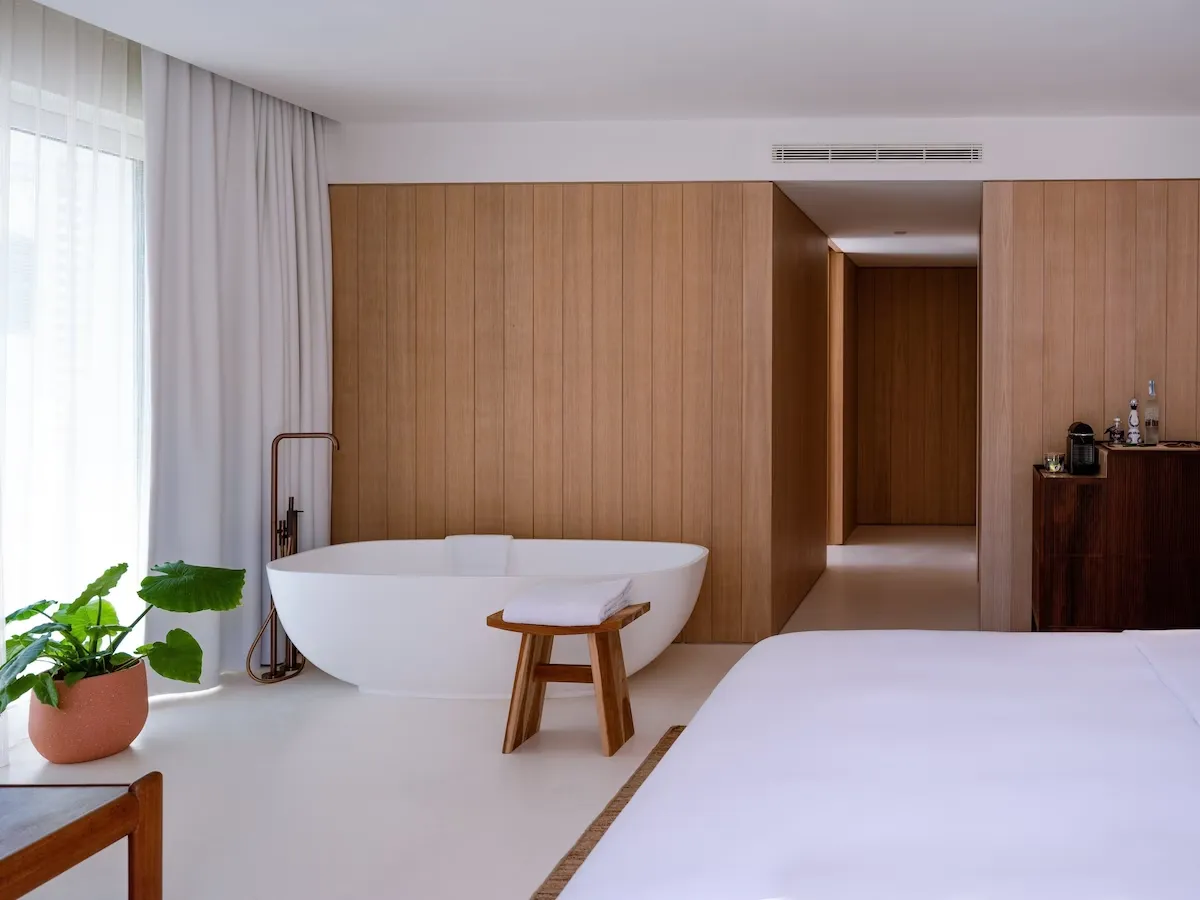
Interiors: California Meets the Mediterranean
The interior design, overseen by Oskar Kohnen Studio in collaboration with The Standard's in-house team led by Chief Design Officer Verena Haller, introduces a Californian mid-century language attuned to the island's landscape and heritage. This is not accidental. The original Standard Hollywood closed permanently in 2021, and the Ibiza property was designed as a spiritual successor, carrying forward the DNA of a defunct legend.
The approach differs between private and public spaces. Guest rooms operate on a palette of muted hues, natural materials, and organic textures. The effect is calm, almost austere, a refuge from the stimulation of the public areas. Vintage European furniture pieces add tactility and age, disrupting the sheen of new construction. Street-art-style murals by Colombian, Madrid-based artist Nicolás Villamizar celebrate the fluidity of island life, injecting playful touches without overwhelming the visual field.
The public spaces take a maximalist turn. The ground-floor restaurant Jara, named after a flowering plant native to the Mediterranean, incorporates retro shapes, tropical leaf-printed fabrics, rich greens, and lush plantings. The effect is energetic, almost theatrical, designed to be a scene as much as a dining room. This is classic Standard programming: hotels as social infrastructure, places where locals and travellers mix, where the lobby functions as living room for the neighbourhood.
The Rooftop: Day to Night
UP, the hotel's rooftop venue, encapsulates The Standard's approach to hospitality as entertainment. The space combines a seasonal swimming pool, one of the few rooftop pools in Ibiza, with a bar and restaurant offering sweeping views over Dalt Vila, the fortified old town that earned UNESCO World Heritage status.
By day, the programming is familiar luxury resort fare: swimwear, sun loungers, cocktails, poolside snacks including fresh ceviche and fish tacos. As evening approaches, the atmosphere shifts. The kitchen pivots to more substantial offerings, celebrating Ibiza's port history with sea bass and fruits de mer. DJ sets and intimate acoustic sessions carry the energy into the early hours.
The rooftop has become a destination in its own right, drawing both hotel guests and locals seeking an alternative to the club-centric nightlife that dominates the island's southern coast. This was the intention. The Standard brand has always positioned itself against the mega-club mentality, offering high-style fun without requiring a six-hour commitment to a dance floor.
Accommodation and Casa Privada
The main hotel contains sixty-seven rooms and suites, ranging from compact doubles to junior suites with soaking tubs in the bedroom and Juliet balconies. The design maintains consistency with the calm residential approach of the guest floor corridors, cloud-like beds, rain showers, and curated minibars providing the essentials without unnecessary flourish.
One block from the main building, Casa Privada operates as a satellite property offering the experience of a stylish private residence with hotel services. The fourteen-room building includes two Terrace Suites with outdoor tubs and a dedicated rooftop pool accessible only to Casa guests. The concept suits groups or families seeking privacy without complete isolation, a middle ground between hotel and villa rental.
Dining and Scene-Making
Jara, the street-level restaurant, opens onto the iconic Vara de Rey plaza, creating a fluid boundary between hotel and city. The menu combines agrarian Ibizan staples, vine-ripened tomato tartare, paellas, with Spanish classics and international touches. The space functions as café by morning, brasserie by afternoon, and social destination by evening, with a DJ booth by the bar and curtained banquettes enabling whatever intimacy the hour requires.
The farm-to-table philosophy drives sourcing decisions, emphasising seasonal produce and local suppliers. This is not revolutionary for a hotel of this calibre, but the execution is confident, avoiding the preciousness that sometimes accompanies such commitments.
Getting There
The Standard Ibiza is located in the heart of Ibiza Town, one block from the marina and within walking distance of the old quarter. The airport is approximately fifteen minutes by taxi. Unlike the cliff-bound resorts of the west coast, this is an urban hotel, designed for guests who want to be in the middle of things rather than observing from a distance.
Design Hotels Ibiza: What They Share
These three properties, built across five decades by Belgian pioneers, German developers, and American lifestyle brands, represent distinct philosophies of what a design hotel in Ibiza should be. Hacienda Na Xamena offers immersion in landscape and legacy, a place where the built environment serves as frame for natural drama. 7Pines provides contemporary village life at the edge of the most photographed cliffs on the island. The Standard brings urban energy and social infrastructure to a town that had been overlooked by the hospitality industry's biggest names.
What unites them is more interesting than what divides them. Each property was shaped by people who understood Ibiza before designing for it. Daniel Lipszyc visited for fifteen years before breaking ground. Olaf Kitzig spent extended time on the island absorbing its landscapes, culture, and the perspectives of ibicencos themselves. The Standard's team explicitly referenced the "golden age" of the island, the bohemian era that preceded the club explosion, as source material for their vision.
This matters because Ibiza has been subjected to more architectural indifference than most islands of its fame. The resorts that line the southern beaches could exist anywhere in the Mediterranean. They speak no particular language, respond to no particular history, make no particular claim on the imagination. The hotels in this guide refuse that anonymity. They are placed in a way that could only be Ibiza.
For travellers seeking luxury hotels in Ibiza that reward attention, that reveal themselves over multiple visits, that feel as if they have been thought about rather than merely constructed, these three properties represent the current standard. The pun is unavoidable. And accurate.
Frequently Asked Questions
| Which Ibiza design hotel is best for families? | 7Pines Resort Ibiza offers the most comprehensive family facilities, including Kío House of Kids club with eco-focused programming, family-oriented suite categories in The Laguna area, and multiple pools. Hacienda Na Xamena welcomes families but operates at a quieter register. The Standard Ibiza is most suitable for adults seeking urban energy. |
| Are these hotels open year-round? | No. All three properties operate seasonally, typically from April or May through October. Hacienda Na Xamena and 7Pines close for winter. The Standard Ibiza maintains limited winter operations with special rates for island residents. |
| Which hotel has the best spa? | Hacienda Na Xamena's La Posidonia Spa with its unique Cascadas Suspendidas thalassotherapy circuit is unmatched on the island. 7Pines Resort Ibiza's Pure Seven Spa offers a larger facility at fifteen hundred square metres with more conventional spa programming. The Standard Ibiza does not operate a dedicated spa. |
| How far are these hotels from the airport? | The Standard Ibiza: approximately fifteen minutes. 7Pines Resort Ibiza: approximately thirty minutes. Hacienda Na Xamena: approximately thirty minutes. Distances vary with traffic during peak summer months. |
| Can non-guests visit these hotels? | The Standard Ibiza operates as an open property with restaurants and rooftop accessible to the public. 7Pines welcomes external guests to its restaurants and Pure Seven Spa by reservation. Hacienda Na Xamena offers day packages combining the Cascadas Suspendidas with dining at Eden Restaurant, though pools and terraces remain exclusive to resident guests. |
| Which hotel is closest to Ibiza nightlife? | The Standard Ibiza sits in the centre of Ibiza Town, within walking distance of bars, restaurants, and the marina where boats depart for beach clubs. Both 7Pines and Hacienda Na Xamena require a thirty-minute drive to reach the club zones around Playa d'en Bossa and San Antonio. |