The Mountain Cure: Five Alpine Hotels Where Wellness Comes From Altitude
Five hotels in the Italian Dolomites, the Mont Blanc and Cervino valleys, the Bernese Oberland of Switzerland and the Stubai of Austrian Tyrol. The argument: the most underrated wellness in 2026 is the one you do not pay extra for, because it is what the mountain is doing to your body whether you book a treatment or not.
The wellness industry has become very good at the brochure. Massages with twelve hands, twelve oils, twelve stones. Treatments named after Sanskrit nouns the front office cannot pronounce. Sleep programmes that have absorbed every recent finding in chronobiology and re-packaged them as a six-night retreat. Some of this is excellent. Most of it is decoration.
In the Alps, something quieter is happening, and it is not new. At 1500 metres of altitude, your sleep architecture changes within the first forty-eight hours. Your resting heart rate drops by four to seven beats per minute by the end of the first week. The cooler night air and the lower barometric pressure send you into deeper stages of sleep than any treatment can imitate, and the absence of artificial noise, no city traffic, no high-frequency electronic hum, no constant background of an air-conditioning system, gives your parasympathetic nervous system the chance to recover that it almost never gets at sea level.
This is the mountain cure. It is what European nineteenth-century Höhenkur and cura d’alta quota knew, and what the great Swiss and Tyrolean sanatoria of the early twentieth century knew, and what we forgot for a few decades during which “wellness” became synonymous with paid treatments. The good news is that the best mountain hotels in 2026 are quietly remembering. The five that follow are, in our reading, the clearest examples of this re-remembering currently bookable in the Alps, in Italy, Austria and Switzerland.
These are not five hotels in the same place. They are five very different alpine geographies. We have organised them in three short chapters, the silence cure, the altitude cure, the seasonal cure, because the most useful way to choose between them is not by hotel but by which kind of cure your nervous system needs most.
I. The silence cure
Modern noise is not what most people think it is. The dominant noise of contemporary urban life is not loud, it is continuous. The drone of climate systems, the high-frequency whine of LED lighting drivers, the distant background of vehicles even at three in the morning. The brain measures these as constant low-level threats, and the parasympathetic nervous system, the one that handles rest and digestion and repair, cannot fully take over. The first thing the Alps give you is the removal of this. Real silence. Silence with a wind in it, a stream, a single cowbell three valleys down, but no human noise.
Two hotels in this article are organised around this silence.
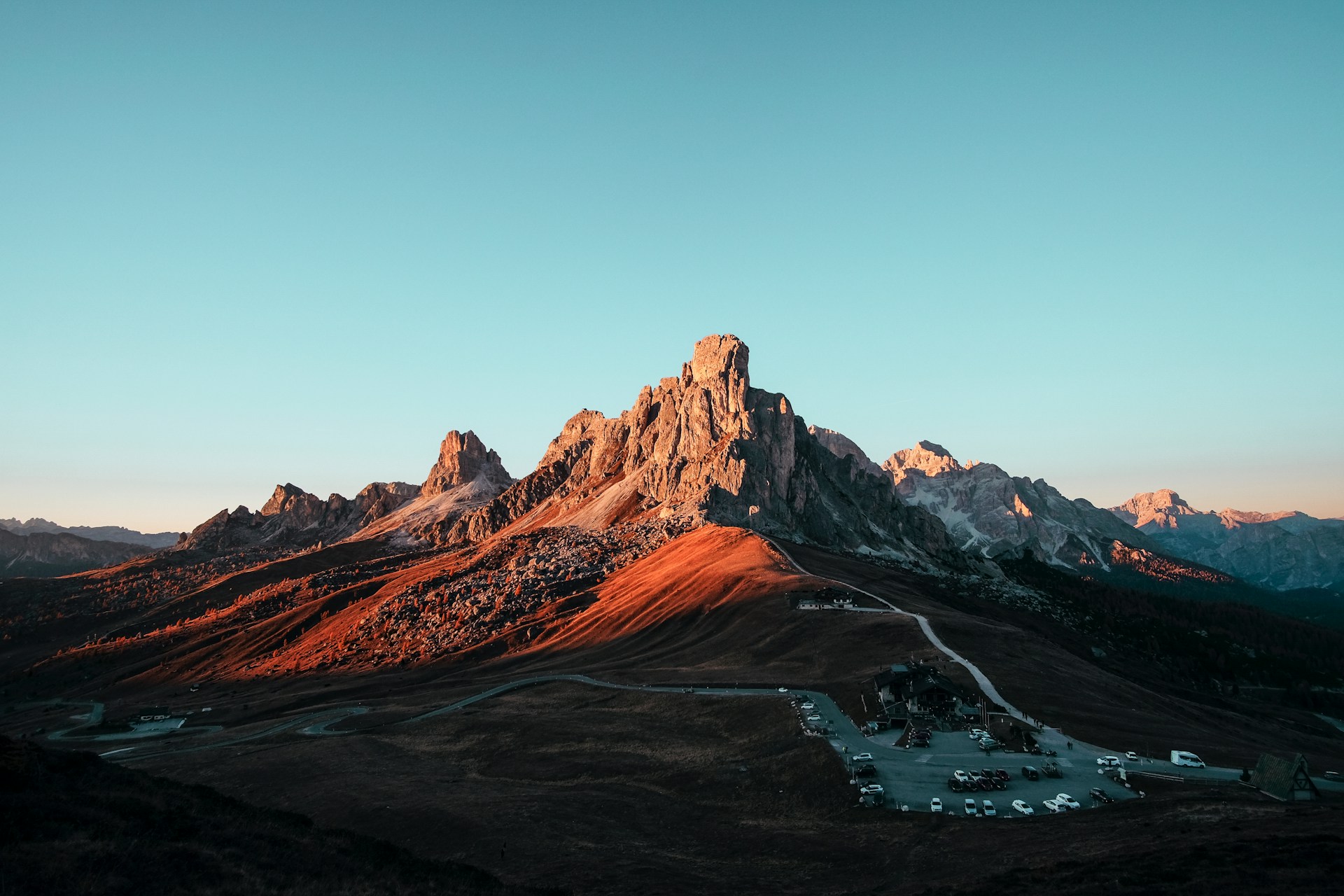
The first is Cyprianerhof Dolomit Resort, a family-run hotel in Tires al Catinaro at the foot of the Rosengarten massif in South Tyrol. The hotel sits at 1170 metres in a small village inside the Dolomiti UNESCO World Heritage area. The Pale Mountains rise directly behind it. The architectural concept is one of the most coherent in the Italian Alps: a low timber-and-stone building that pushes itself into the slope rather than dominating it, with a contemporary spa wing that has views directly into the Rosengarten. The hotel is run by the Damiani family, and the cooking is alpine-modern with very serious South Tyrolean ingredients, speck, juniper-smoked Lamm, fresh trout from the valley’s streams. The Cyprianerhof has been on a slow improvement curve for thirty years. It is the kind of hotel that does not announce itself, and that you find by recommendation.
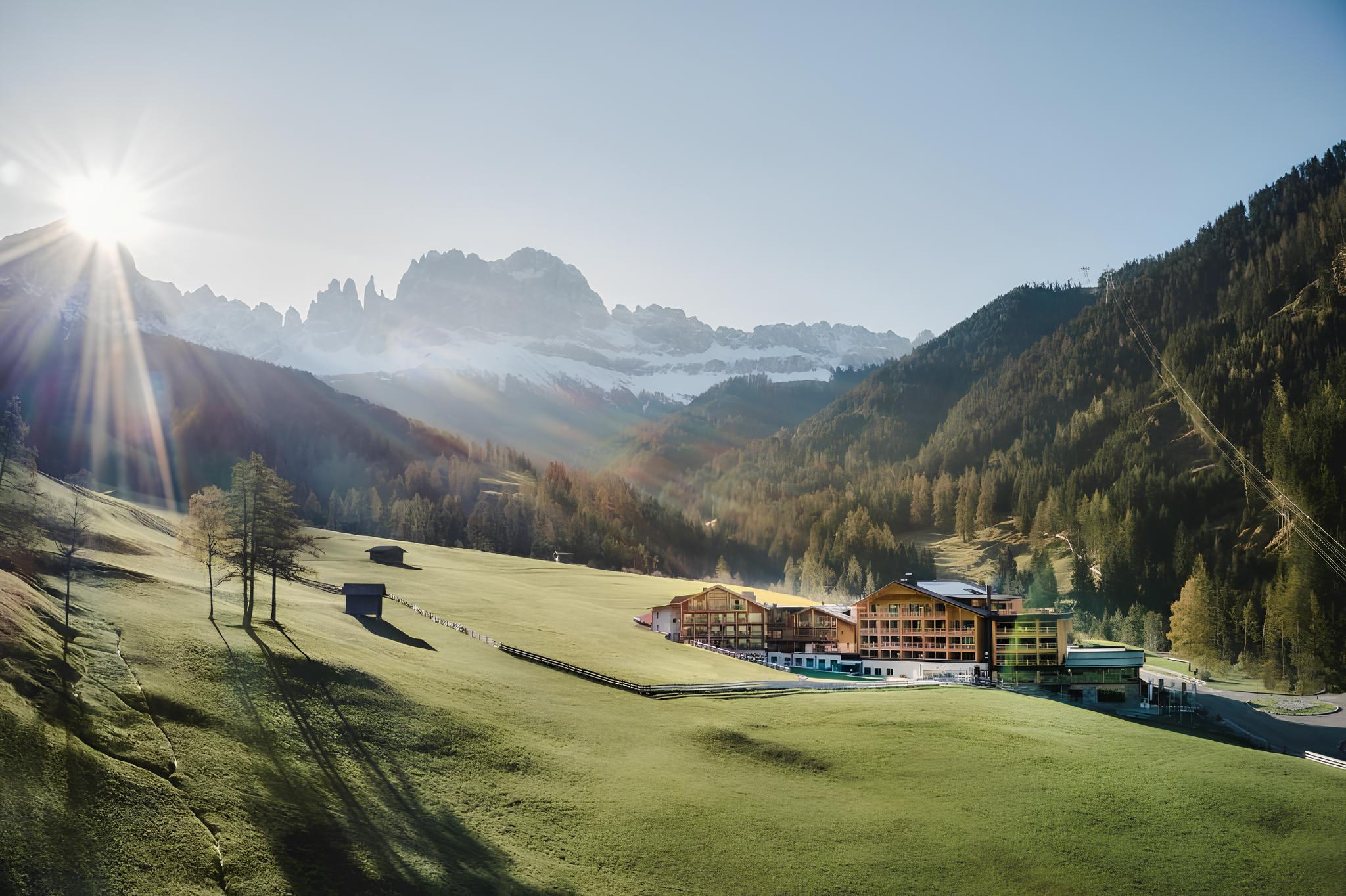
What matters here for the silence cure is the location. Tires is a small village. The road dead-ends at the foot of the massif. After 9pm, you can stand on the hotel terrace and hear, in order: your own breath, the river at the bottom of the slope, and occasionally the wind in the larches. That is the entire soundscape.
The second silence hotel is Larchenlodge, in Fulpmes, in the Stubaital of Austrian Tyrol. The Stubai is a long, narrow valley that runs south from Innsbruck for thirty-five kilometres, ending at the Stubai Glacier. Larchenlodge sits roughly halfway down the valley, in a setting of larch forests (hence the name, Lärche is larch in German) that are uniquely peaceful in early summer when the trees are just coming back into leaf.
What Larchenlodge does well is the cabin approach: small property, wooden architecture, large windows, a sauna with a view, very limited interaction with other guests if you do not want it. The food is Tyrolean-rustic done seriously, game in autumn, lamb in summer, freshwater fish from the Stubai’s streams. The valley itself is one of the great walking valleys of the Alps: dozens of marked trails, almost no tour bus traffic, and a chain of high-altitude refuges where you can stop for lunch.
Both Cyprianerhof and Larchenlodge belong to the same tradition: the family-run alpine Wellnesshotel, refined over decades, where the wellness is the building’s relationship to the mountain rather than a product on a treatment menu. If silence is what your body needs in 2026, these are the answers.
II. The altitude cure
The second cure is harder to feel and easier to measure. From about 1500 metres up, your physiology changes. The partial pressure of oxygen in inhaled air drops by roughly 15% per 1000 metres of altitude gain. Your body responds, within forty-eight to seventy-two hours, by producing more 2,3-bisphosphoglycerate in your red blood cells, which makes oxygen release into tissues more efficient. By the end of a week, your erythropoietin levels are slightly elevated and you are, in a small and temporary way, producing more red blood cells than you would at sea level. This is the same physiology that endurance athletes train at altitude to exploit. Done at a non-athletic level, long walks, slow days, several nights of good sleep, it is genuinely measurable as a feeling of cardiovascular ease ten days after you return home.
Two hotels in this article are built for the altitude cure. They are both in the Italian Alps, in two of the highest valleys of Western Europe.
Saint-Hubertus Resort, in Breuil-Cervinia, sits at 2050 metres at the foot of the Matterhorn (Mont Cervino on the Italian side). At this altitude, the cardiovascular effect described above is unmistakable after a week. The hotel is purpose-built for the cure: large rooms with deep balconies all facing the Matterhorn, a Wellness centre that emphasises long, slow programmes (multiple sauna sessions per day, cold plunges, careful hydration, alpine herbal infusions), and a culinary line that leans into the protein-and-vegetable density that altitude metabolism prefers.
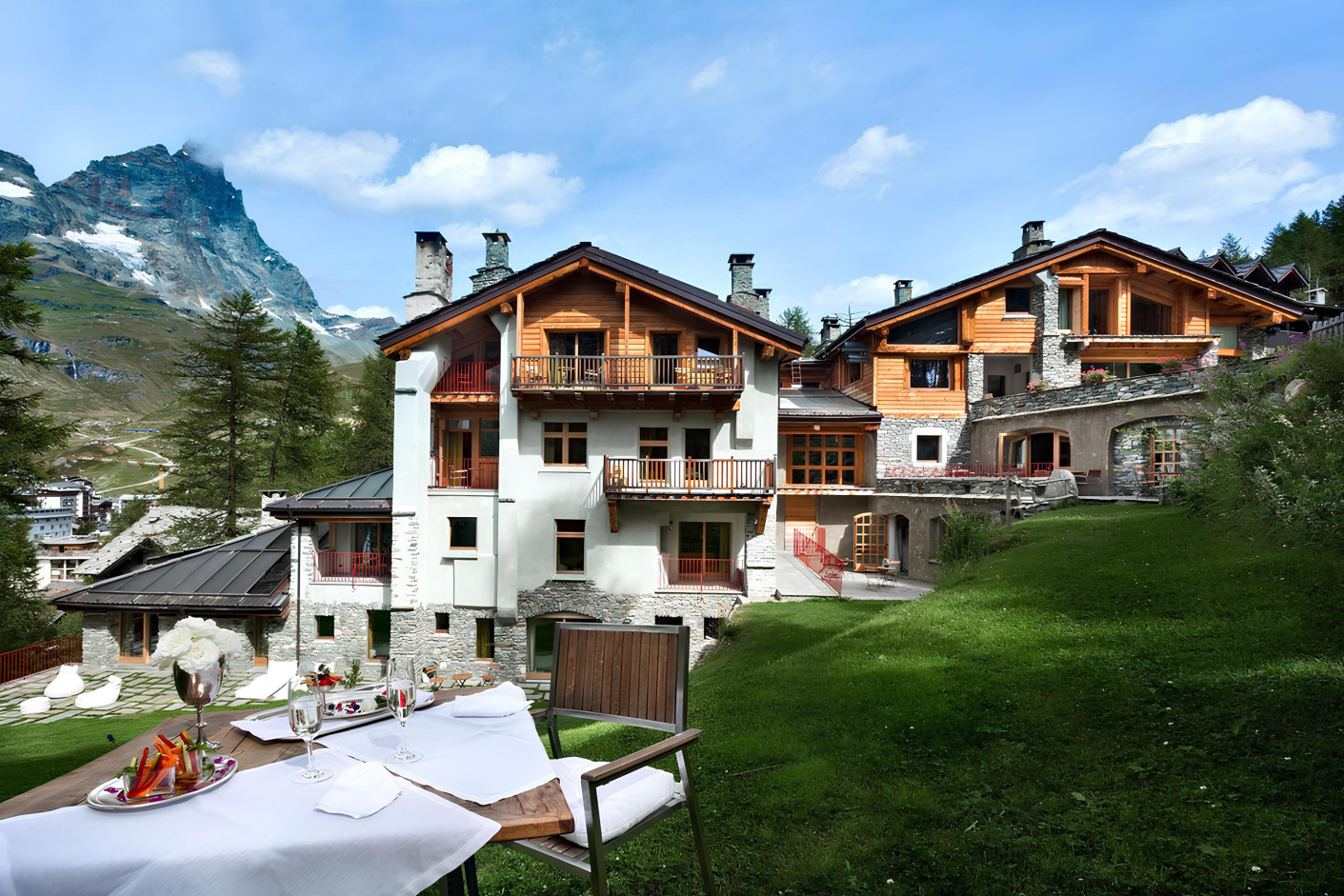
What you do at Saint-Hubertus is exactly what the great alpine cura hotels of the late nineteenth century intended: you walk, you sit in the sun, you sleep heavily, you eat a long lunch, you sleep more. Breuil-Cervinia in summer is one of the most spectacular high-altitude bases in Europe, the Matterhorn dominates the entire view, the surrounding 4000-metre peaks (the Breithorn, the Pollux, the Castor) are visible on clear days, and the walking trails start at the hotel door.
Auberge de la Maison, in Courmayeur at the foot of Mont Blanc, is the second altitude hotel. Courmayeur sits at 1224 metres — lower than Cervinia, but with a much steeper vertical access (the Skyway cable car climbs from 1300 to 3466 metres in two stages, and you can be above 3000m within ninety minutes of breakfast). The Auberge is a small, family-run alpine boutique on the edge of the village, with a wooden-and-stone architecture that is unusually warm. The wellness offer is restrained but very well done: a small panoramic spa with view of Mont Blanc, an outdoor pool, and several alpine treatment protocols that lean on local plants (mountain pine, juniper, gentian).
What makes the Auberge particularly suited to the altitude cure is the combination of base altitude with very easy access to higher elevations. You can sleep at 1200m (which is gentle on most bodies) and walk at 2500-3000m every day, then come back down for dinner. This is the protocol the old high-altitude clinics in Davos and Leysin used a century ago, and it works.
Both Saint-Hubertus and Auberge de la Maison are at their best in the late spring and summer windows (June, early July; then early September). The crowds are low, the high-altitude trails are open, the days are long, and the cardiovascular adaptation has time to do its work.
III. The seasonal cure
The third cure is the one the Alps have always done best: changing the way your body reads the season. Modern life is largely seasonless. You wake up in artificial light, work in artificial light, eat foods that arrive from the other hemisphere, exercise in temperature-controlled rooms. The result is that your circadian rhythms and your seasonal hormonal cycles lose their amplitude. You stop having strong mornings. You stop being deeply tired in the evening. You stop being properly hungry. The alpine summer, with its long daylight, its dramatic temperature swing between day and night, and its high-protein high-vegetable seasonal cuisine, is one of the most effective ways to restore those amplitudes in two weeks.
One hotel in this article is built almost entirely around the seasonal cure.
The Brecon, in Adelboden, in the Bernese Oberland of Switzerland, sits in one of the most spectacular alpine valleys in the country, at 1350 metres. The hotel is a contemporary reinvention of the classic Swiss Berghotel, warm wood, large fireplaces, big south-facing windows that capture the daylight that is the actual medicine here. In summer, the daylight in the Bernese Oberland stretches from before 5am to past 9pm. The hotel’s daily rhythm follows that arc precisely: early breakfasts on the terrace, midday menus that are deliberately heavier (the long European seasonal lunch the way the Alps still do it), afternoons that are slow, dinners that finish in time for the alpenglow.
What makes The Brecon useful for the seasonal cure is the discipline of the rhythm. The hotel does not encourage you to live by the schedule you brought with you from the city. The kitchen serves at certain hours. The lights in the public rooms dim early. The wellness programme is built around morning movement and evening rest. After five days, your body is on the schedule the season actually wants, and that is the thing you will take home.
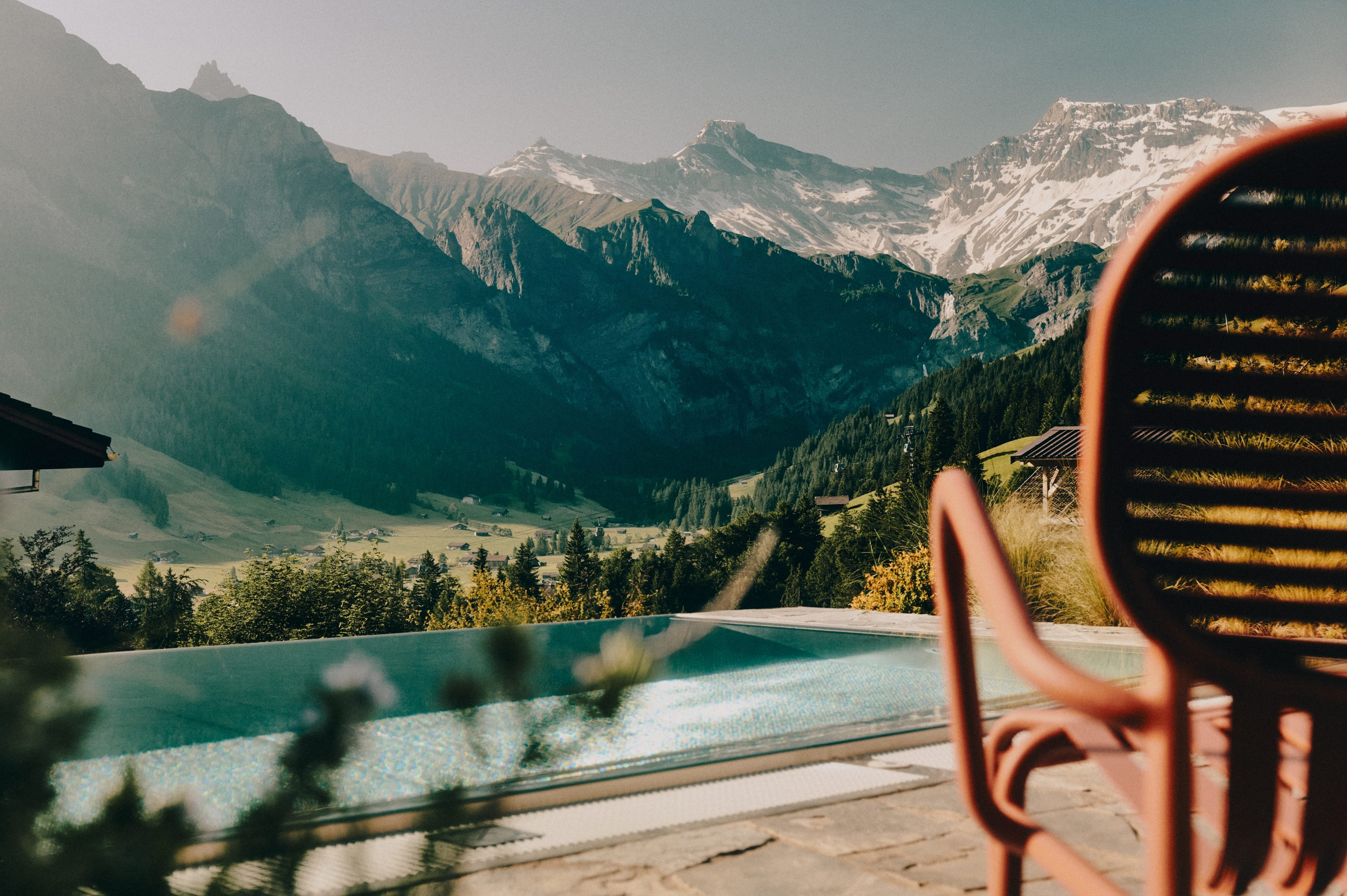
Adelboden in summer is one of the great walking regions of the Alps. The Engstligenalp plateau, the Engstligen waterfall, the long ridge walks above Sillerenbühl, all of these are within reach of the hotel without using a car. The Brecon arranges most of it.
How to choose: three quick reads
A simplified decision tree.
- Your nervous system is loud: start with Cyprianerhof or Larchenlodge. Silence will do most of the work.
- You feel cardiovascularly slow and want a measurable lift: Saint-Hubertus or Auberge de la Maison. Plan a full week. Two weeks if you can.
- You feel out of season: The Brecon. Six nights, in June or early September. Eat with the kitchen’s hours, walk in the long daylight, sleep when the light goes.
For a first proper mountain cure of seven to ten days, the most rewarding combination is three nights at altitude + four nights of silence. We would pair Saint-Hubertus (high altitude, reset) with Cyprianerhof (silence, sleep recovery). Or Auberge de la Maison with Larchenlodge. The country borders are irrelevant: the cure is the same.
When to go
Mid-June to mid-July and the first three weeks of September are the strongest windows for all five hotels. The high passes and high-altitude trails are open. The hotels are not yet full. The daylight is long. The temperature is between 18 and 25°C during the day, between 8 and 14°C at night, which is, incidentally, the temperature window in which human sleep is at its best.
August is also wonderful, but is the only month in which alpine summer becomes busy. Book early if you are travelling then.
The shoulders, late May, late September, are the connoisseur’s months. Some of the high-altitude trails are still snow-covered in late May; some of the higher refuges have closed by late September. But the light is the most beautiful, and the hotels are at their quietest.
What is real and what is brochure
Three honest pieces of context.
Treatment menus matter less than the building does. The single most important variable in an alpine wellness hotel is not the size of the spa or the brand of the products. It is the architecture’s relationship to the mountain, whether the rooms open onto the view, whether the windows can be opened at night for the cold mountain air, whether the building is quiet. All five hotels in this article get this right. Many more expensive hotels get this wrong.
The cure works only if you slow the days down. A common mistake is to bring city pace into the mountains: a packed itinerary, multiple bookings per day, screens at every meal. The cure works through the parasympathetic system, and the parasympathetic system needs the day to slow down. Two activities a day, long lunches, an hour of doing nothing on a balcony, this is what the protocol looks like.
Altitude takes 48–72 hours. If you only have a long weekend, the physiology of the altitude cure will not have time to start. The first three nights are when your body is still adjusting. Stay seven. If you cannot stay seven, prioritise silence over altitude, silence works almost immediately, altitude needs a week.
Frequently asked questions
| What is the difference between a mountain spa and a city spa? | The mountain spa is supported by what is happening outside the spa: lower oxygen pressure, cooler air, longer sleep, absence of urban noise. The city spa has to do all the work itself. This is why a good two-treatment day in the Alps will, for most people, feel deeper than a much more expensive day at a city wellness clinic. The mountain is doing half the work. |
| Are these hotels family-friendly? | Cyprianerhof and The Brecon are the most family-suitable of the five. Auberge de la Maison and Larchenlodge accommodate families but are small properties and not built around children. Saint-Hubertus is the most adult-skewing, at altitude with a focus on slow rhythms. |
| Do I need to be in good physical shape to do this? | No. The cure does not require fitness. It requires availability. Even gentle walking, slow swimming and long sitting in alpine sun produce most of the cardiovascular and circadian benefits described above. The hotels all have adapted programmes for guests who arrive depleted rather than athletic, which is, in fact, most guests. |
| Can I do this in winter? | Yes, but with caveats. Winter at altitude is a slightly different physiology, colder, drier, with shorter daylight. The cure still works, but the seasonal-amplitude version is harder to do in winter because the daylight is so short. For first-time visitors to alpine wellness, we recommend June or September. Save winter for a second visit, when you already know the hotel. |