Villa Fiorentino Positano: The Doctor's House on the Cliff
A WWII escape, three generations of healers, and Positano's most storied address. The family villa where hospitality runs deeper than the sea below.
The cross on the mountain above Positano glows after dark, visible from the sea, from the beach, from nearly every terrace in the village. Tourists assume it belongs to the Church. Locals know the truth. In 1978, a doctor named Domenico Fiorentino climbed the slope and fixed the cross himself, a seal on a promise he had made decades earlier, when he walked three months across war-torn Europe to return to the people who needed him.
Domenico's story belongs to a different era. A Medical Captain during the Second World War, he was captured and placed on a deportation train heading north. At the border, he escaped. What followed was a three-month journey on foot, through mountains and checkpoints and a continent in ruins, driven by the single purpose of reaching Positano. When he finally arrived, he found his wife dead. His parents dead. The village waiting for its only doctor.
He stayed. He raised his children alone. He built a medical practice in a house on the cliff, where patients could knock at any hour, where no one was turned away. First on foot, then by mule, then on a Vespa that locals recognized by sound, he reached the sick wherever they were. The cross he placed on the mountain was not decoration. It was a covenant with the town he had walked through hell to serve.
That house on the cliff is now Villa Fiorentino.
Three Generations
The medical legacy passed to Domenico's son Vito, who became a cardiologist and general practitioner. Like his father, Vito kept hours that had nothing to do with schedules. His red Fiat 500 became famous on the coastal curves, a scarlet blur racing toward emergencies in an era when Positano had no hospital, no ambulance, no backup. He trained the local Red Cross volunteers and built the infrastructure for the medical outpost that serves the community today. A Senator of the Order of Doctors, he received the Gold Cross from the Presidency of the Republic. He died in April 2025, two days before the ceremony marking sixty years since his graduation from medical school. His daughter Paola accepted the medal on his behalf.
The tradition continues through Dr. Isabella Fiorentino, Vito's daughter, a physician and nutritionist who specializes in the Mediterranean Diet. She has transformed local food traditions into clinical practice, connecting the family's healing mission to the cuisine of the coast.
Vito's wife Giuseppina, a luxury fashion designer born in Positano, shaped the villa's interiors. Their children and grandchildren work alongside the staff. The property operates as a hotel, but the Fiorentinos do not use that word. They call it home. Guests, they insist, are friends of the family.
In 2015, to mark the 50th anniversary of his graduation, Vito completed a renovation that transformed the medical house into a hospitality property. The original building expanded across multiple levels of the cliff, adding pools and terraces and accommodations while preserving the character of a private residence. The result is a place where the amenities meet five-star expectations but the atmosphere remains personal, where breakfast arrives on the terrace and the family knows every guest by name.
The Vertical Estate
Positano builds upward. Paul Klee called it the only place conceived on a vertical rather than horizontal axis. Villa Fiorentino follows this logic, its accommodations arranged across different levels of the cliff, connected by pathways, stairs, and elevators.
The property divides into three categories: suites with private pools for couples seeking romance, aparthotels with full kitchens for families and groups, and superior rooms for those who want comfort without excess.
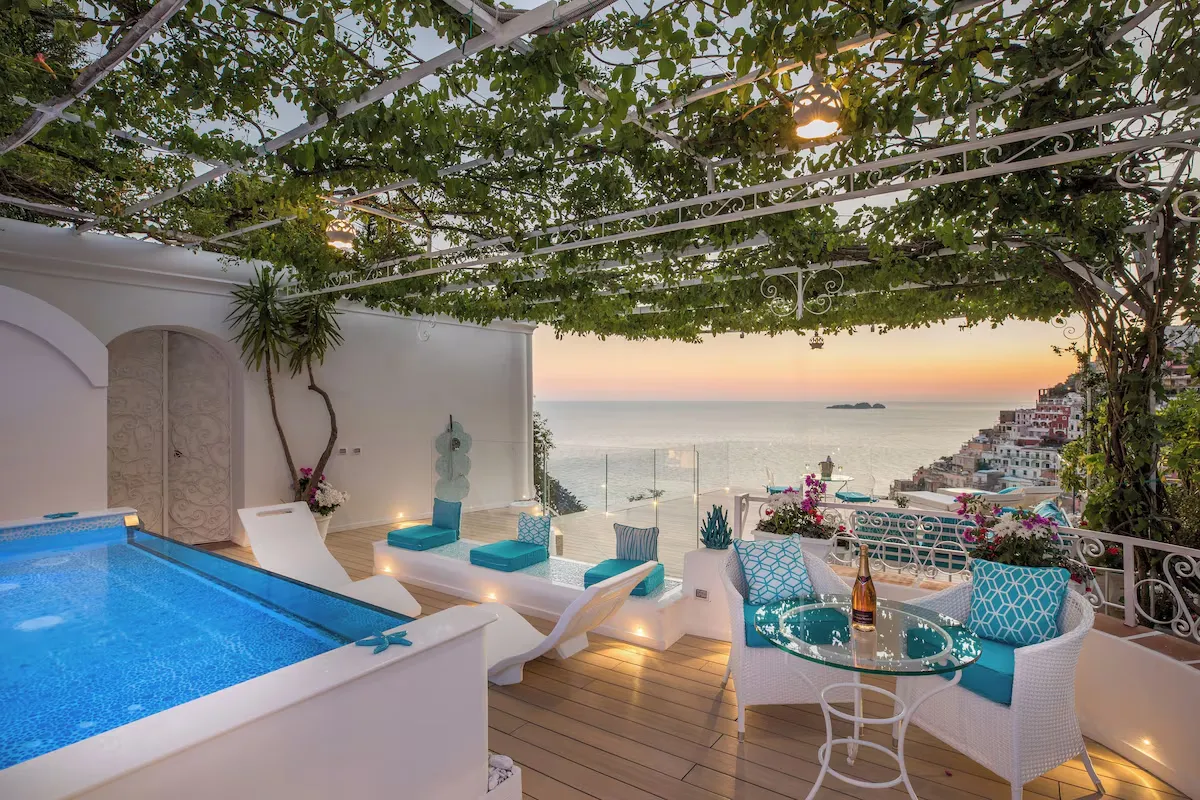
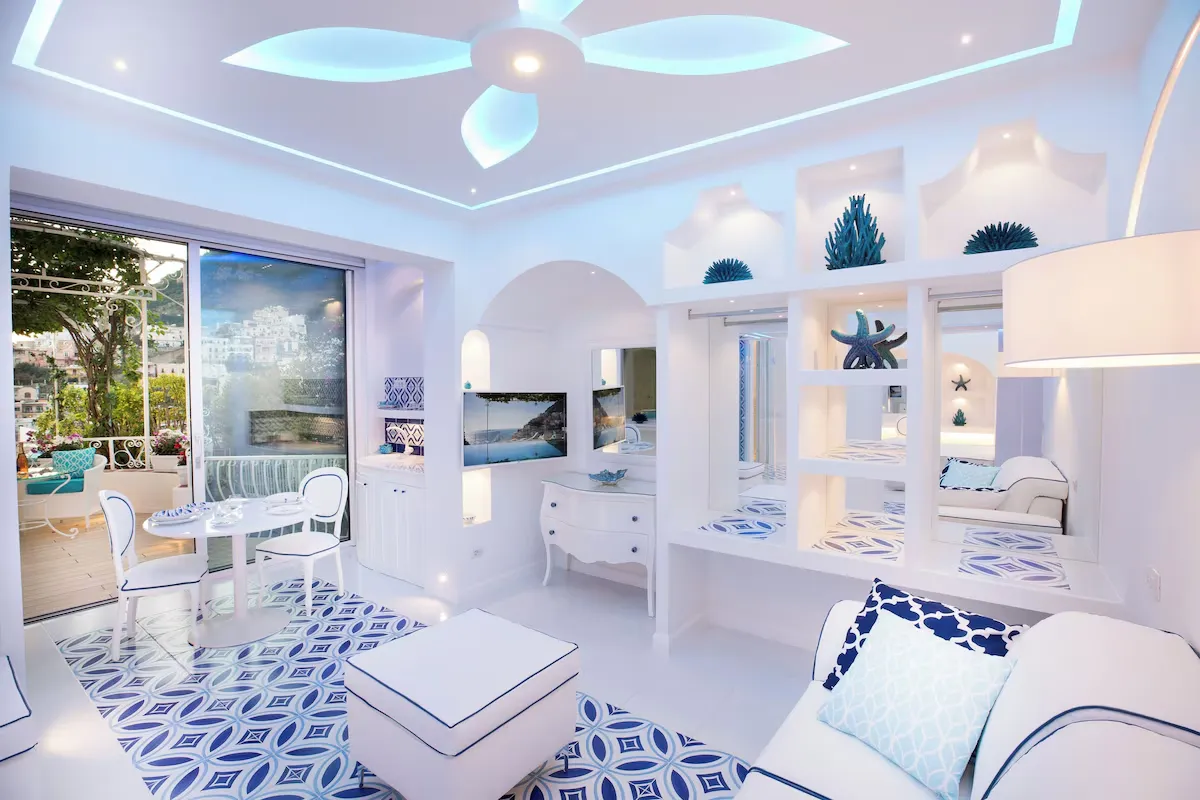
The Exclusive Lifestyle Suite and The Honeymoon Suite occupy the highest positions, each with a private terrace and hydromassage pool overlooking the coast. The Honeymoon Suite, approximately 120 square meters, incorporates a 17th-century structure that once served as a watchtower against Saracen raids. The outdoor bathroom, improbable anywhere else, makes sense here, where privacy is guaranteed by altitude and the climate forgives exposure. Vaulted ceilings rise above interiors that mix periods without confusion: 18th-century chandeliers and bronze sculptures alongside wicker and teak furniture, the combination feeling collected rather than decorated. An ancient brass cradle sits in one corner, a piece of Fiorentino history that Giuseppina refused to remove when the villa opened to guests. The terrace extends the living space outdoors, its private pool positioned to catch the morning sun and the evening light, the kind of place where dinners for two can be arranged under stars that appear brighter than they have any right to be.
The Exclusive Lifestyle Suite offers similar pleasures at a slightly different scale, its own pool and terrace providing the privacy that honeymooners and anniversary couples seek. Both suites are reached by stairs, a reality of Positano that the property mitigates with elevators where possible but cannot entirely eliminate. The climb becomes part of the experience, the reward waiting at the top.
The Primavera Junior Suite offers a middle ground: generous space, sea views, a terrace large enough for breakfast and afternoon reading, without the private pool. The interior carries the same attention to materials and light that characterizes the larger accommodations, scaled to suit couples who want comfort without extravagance.
For families and longer stays, the aparthotels provide independence. Victoria, the largest, sleeps six across three bedrooms, its walls decorated with majolica tiles designed by the artist Domenico Fiorentino, a family member. Three bathrooms, a full kitchen, two terraces, and 170 square meters of interior space. Sogno d'Amore accommodates four in two bedrooms, its living room facing the Li Galli islands where the sirens supposedly tempted Ulysses. Garden adds something rare in vertical Positano: a shaded terrace with lemon trees, a cool retreat when summer overwhelms the coast.
The Superior Rooms, Azzurra and Blue, deliver the essentials with precision. Sea views, private terraces, the morning light that makes waking early worthwhile. The scale is intimate, the details considered.
The Rooftop
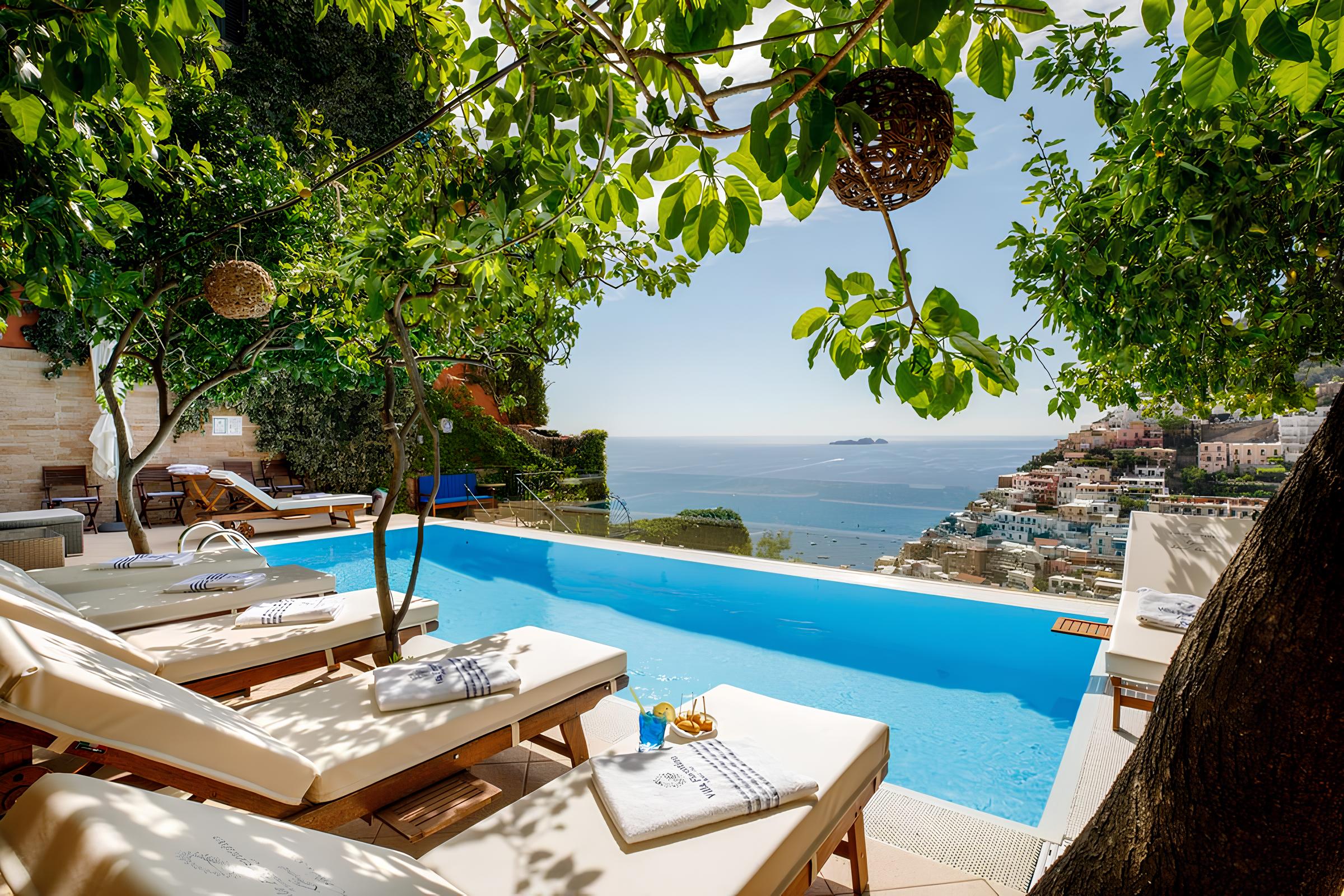
Three infinity pools occupy the top level, their edges dissolving into the horizon, the water appearing to merge with the Tyrrhenian below. The design is simple: clean lines, no visual clutter, nothing to compete with the view. Sun loungers arrange themselves across the deck in configurations that allow both sociability and solitude. The light shifts through the day, morning clarity giving way to afternoon heat, then the golden hour that photographers travel here to capture.
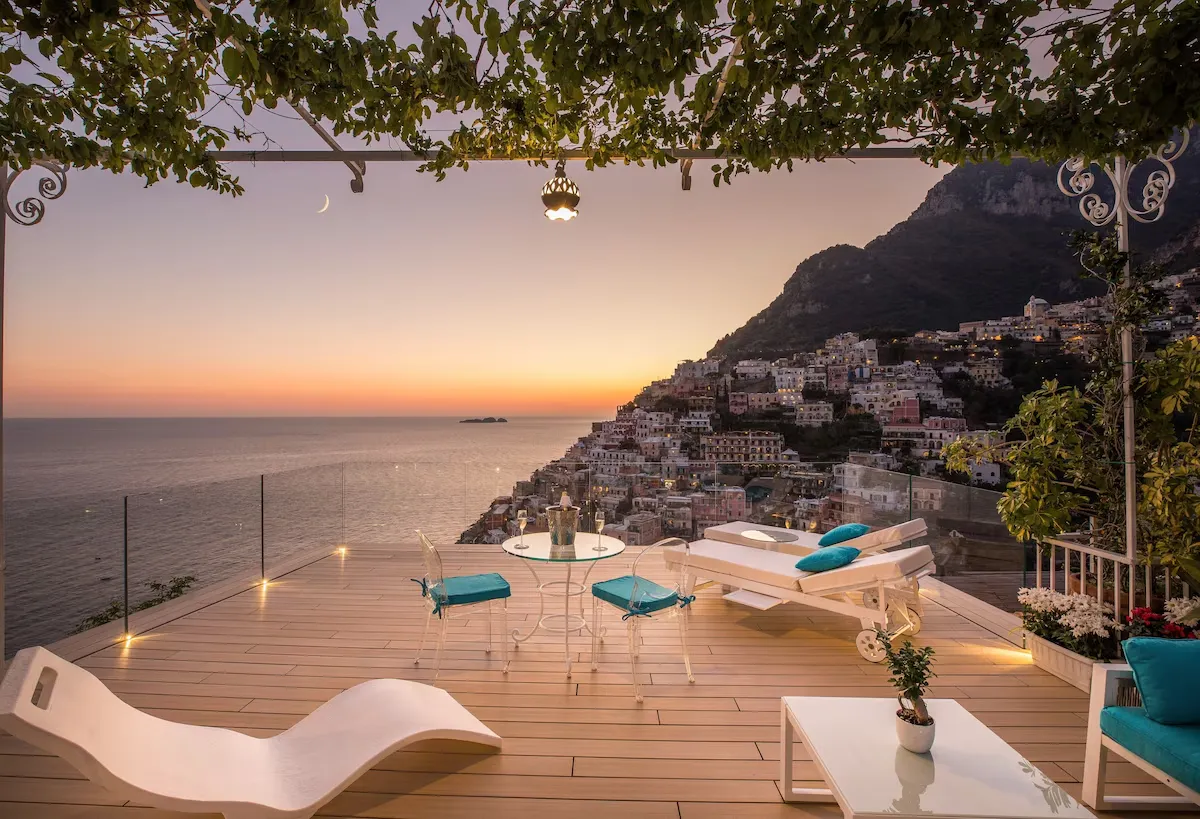
The perspective from this height changes the relationship to Positano. The village spreads below in its full vertical improbability, the pastel buildings stacked against the cliff, the dome of Santa Maria Assunta catching the light, the boats moving across the bay like scattered punctuation. The crowds that fill the lower streets become abstraction, human figures reduced to pattern and movement. The pools offer not just swimming but vantage, a place to understand the town's shape and to feel, briefly, above the complications of navigating its stairs.
The rooftop bar operates from morning through evening, serving coffee at breakfast, Aperol spritzes at sunset, local wines after dark. The terrace fills as the sun drops, guests gathering to watch Positano's buildings turn gold, then pink, then illuminate one window at a time as night arrives. The transition takes about an hour, and the bar seems designed around it, the seating arranged to face west, the service unhurried, the atmosphere suggesting that watching this particular sunset might be the most important thing anyone does all day.
Below the pools, a spa and wellness area offers treatments that draw on both Thai traditions and local practices. Massages can be arranged in treatment rooms or on private terraces. Yoga sessions take place on the panoramic deck when weather permits. The approach is unhurried, integrated into the general rhythm of a property that encourages slowness, that treats relaxation not as amenity but as purpose.
The Position
Villa Fiorentino sits in the upper part of Positano, removed from the crowds that fill the beach and lower streets, but close enough that everything remains walkable. Five minutes to the town center, ten to Spiaggia Grande, the main beach where sunbeds line the shore and restaurants serve lunch with views.
The location matters more than it might elsewhere. Positano's vertical layout means that every property involves trade-offs between accessibility and tranquility, between being in the action and above it. The villa occupies the sweet spot: high enough for privacy and perspective, connected enough that guests engage with the village rather than retreating from it.
The concierge arranges what the town cannot provide directly. Boat trips along the coast, stopping at grottos and hidden beaches. Transfers to Ravello, Amalfi, the Path of the Gods. Private chefs who cook dinner in the apartment kitchens while guests watch from the terrace. Restaurant reservations at places that otherwise require local knowledge to secure.
The Table
No restaurant operates at Villa Fiorentino. The decision is deliberate. Positano has dozens of places to eat, from simple trattorias to ambitious dining rooms, and discovering them is part of the pleasure of staying in a town rather than a resort.
Breakfast arrives each morning on private terraces: fresh pastries from local bakeries, fruit from the surrounding groves, eggs prepared to order, coffee made properly. The meal sets the day's pace, which on this coast should begin slowly and accelerate only if necessary.
For dinners, private chefs can be arranged to cook in the suites and apartments. They arrive in the late afternoon with ingredients from the morning market, seafood from the boats, tomatoes and lemons from the hills. The meal takes shape in the kitchen while guests swim or watch the light change. Spaghetti alle vongole, grilled fish, desserts involving the local citrus. Wine from the nearby slopes. The experience falls somewhere between restaurant and home cooking, formal in its execution, intimate in its setting.
Positano
John Steinbeck arrived in 1953, escaping Rome's summer heat, and wrote the essay that changed everything. "Positano bites deep," he declared in Harper's Bazaar. "It is a dream place that isn't quite real when you are there and becomes beckoningly real after you have gone." The line appears on every tourist website now, quoted so often it risks becoming wallpaper. But Steinbeck earned his claim. He understood something about the place that casual visitors miss: Positano does not photograph well because photographs cannot capture the vertical dimension, the way the town seems to pour down the cliff rather than sit upon it, the strange sensation of walking through a settlement that exists in three dimensions where most towns content themselves with two.
Before Steinbeck, Positano was a fishing village in decline, its population emigrating to America and Australia as the maritime economy collapsed. Russian artists discovered it first, in the early 20th century, drawn by the light and the isolation. Picasso came. Escher made lithographs. Klee painted and declared it "the only place in the world conceived on a vertical rather than horizontal axis." Then the film stars arrived, and the fashion designers, and eventually the tourists who follow wherever glamour leads.
The town remains small, its population around 3,700, its streets too narrow for cars, its stairs as steep as ladders in places. Steinbeck counted the steps and noted that some of them required hands as well as feet. The Church of Santa Maria Assunta dominates the lower village, its majolica dome visible from every angle, its interior holding a Byzantine icon of a black Madonna with a legend involving pirates and storms and divine intervention. The pirates, the story goes, stole the icon from Constantinople. When a storm threatened their ship off this coast, the painting spoke: "Posa, posa." Lay me down. The pirates obeyed, converted to Christianity, and the town took its name from the miracle. Whether true or invented, the legend captures something about Positano's character: sacred objects wash up here, and people stay.
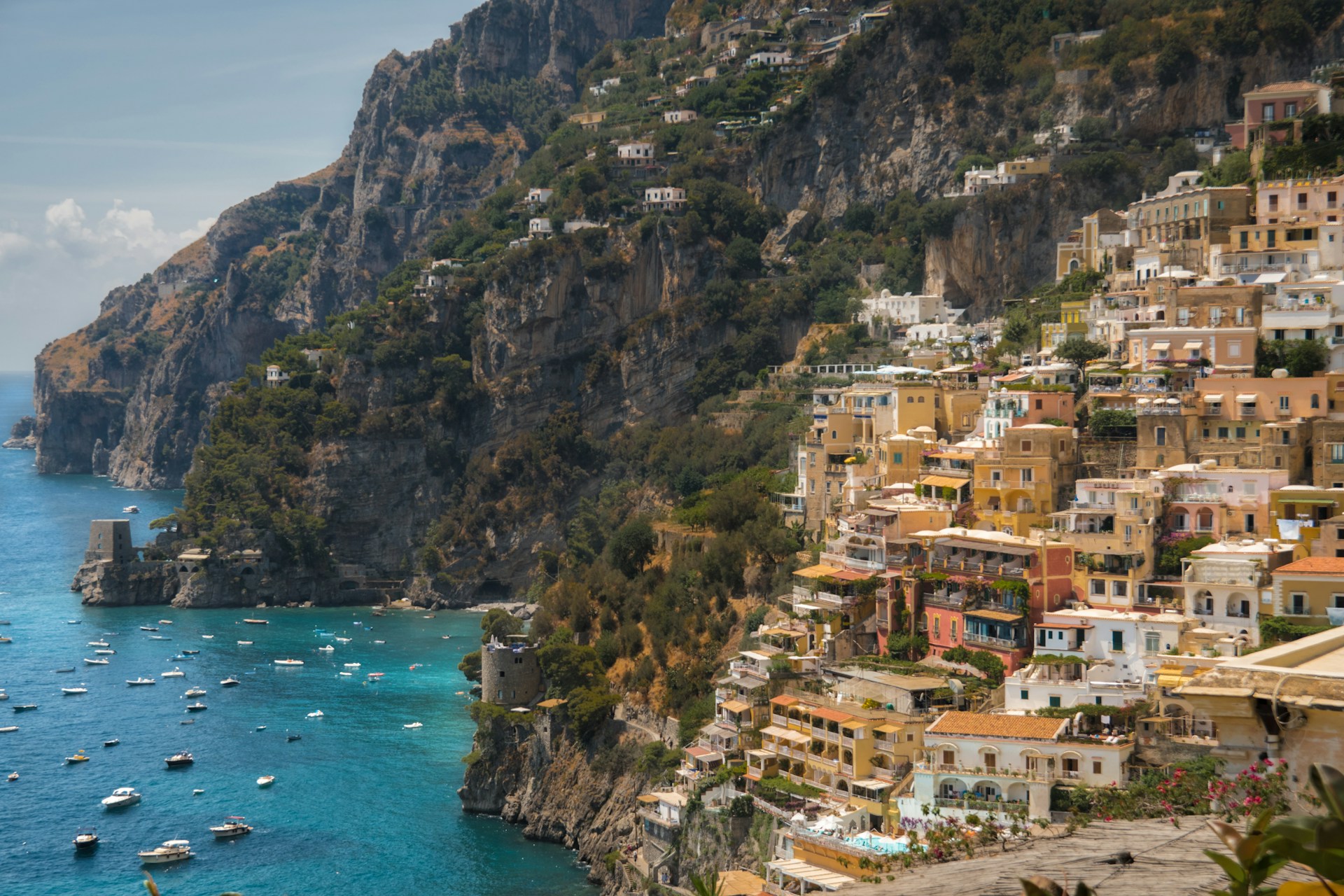
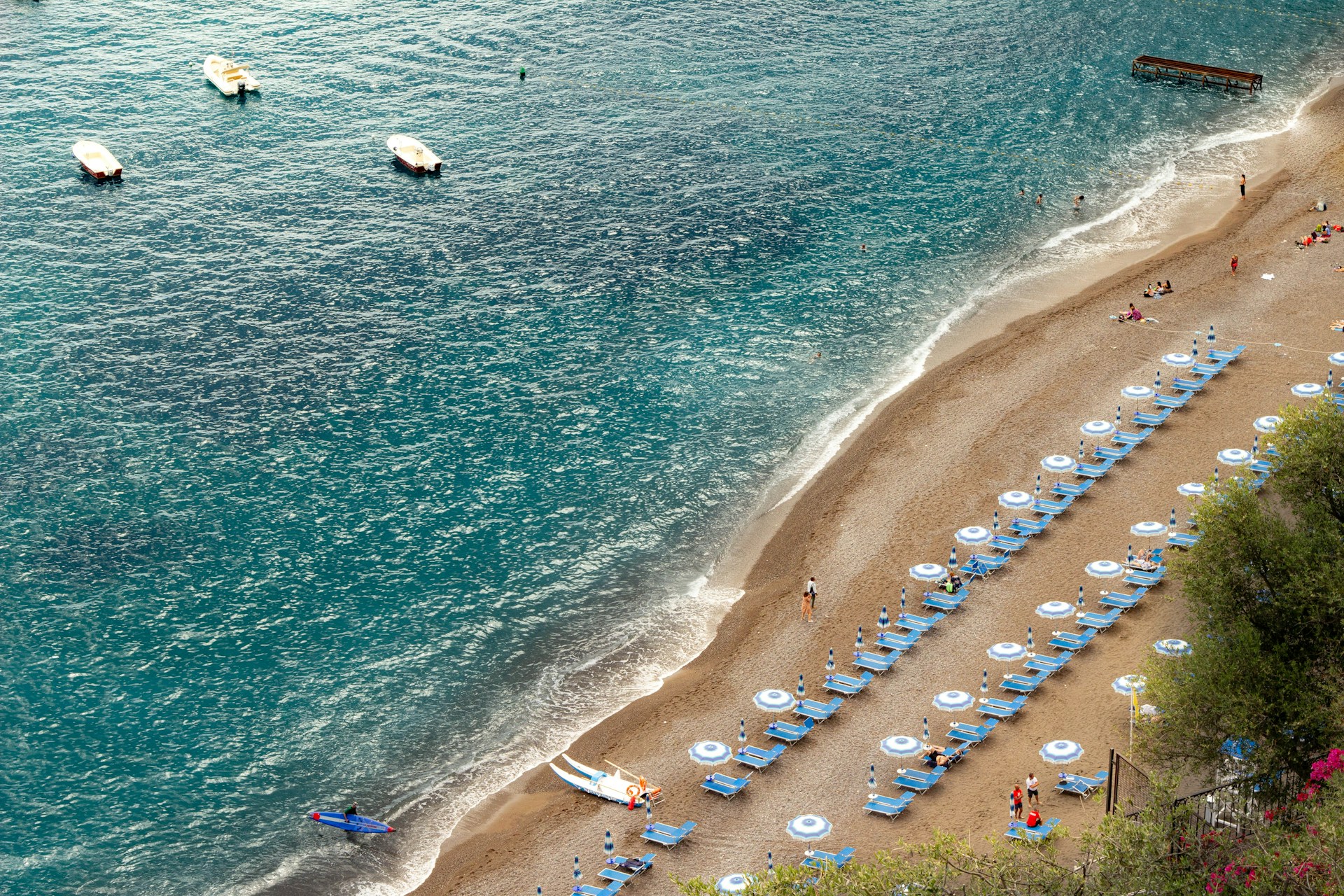
The beaches spread along the bay: Spiaggia Grande for socializing, its sunbeds arranged in rows, its restaurants serving lunch to a crowd that cares about being seen; Fornillo for relative quiet, reached by a coastal path that discourages casual visitors; Arienzo for those willing to descend 300 steps to earn their solitude, returning later with legs that remember the climb.
The Li Galli islands float offshore, three rocky outcrops that the dancer Leonide Massine bought in 1919 and Rudolf Nureyev owned later. They cannot be visited, but boats circle them on coastal tours, and from Villa Fiorentino's terraces they appear close enough to swim to. According to myth, these were the rocks where the sirens sang to Ulysses. The acoustics, locals claim, still carry sound in unusual ways.
The Coast
Amalfi lies twenty minutes east, its cathedral and paper mills and medieval streets offering different pleasures than Positano's vertical glamour. The town that gave its name to the coast was once a maritime republic rivaling Venice and Genoa, its merchants trading across the Mediterranean, its naval code governing commerce throughout the region. The paper mills, fed by mountain streams, produced the stock on which medieval merchants kept their accounts. The cathedral rises at the top of a dramatic staircase, its facade striped in the Arab-Norman style, its interior cool even in summer. The Chiostro del Paradiso, a 13th-century cloister beside the cathedral, provides one of the most peaceful spaces on the entire coast.
Ravello sits above Amalfi, cooler and quieter, its gardens hosting summer concerts as the sun sets over the water. Villa Rufolo inspired Wagner to imagine the garden of Klingsor in Parsifal. Villa Cimbrone terminates in the Terrace of Infinity, a belvedere lined with marble busts that appears to float above the coast. Gore Vidal lived here for decades, calling it his home and writing about it with proprietary affection.
Sorrento spreads to the west, larger and more commercial than its neighbors, with ferries to Capri departing every half hour in season. The town sits on cliffs above the Bay of Naples, its grand hotels dating to the era of the Grand Tour, when wealthy Europeans made the Italian south their winter refuge. Beyond Sorrento, the ruins of Pompeii and Herculaneum wait for those willing to venture inland, cities frozen in 79 AD by the eruption that buried them.
The Sentiero degli Dei, the Path of the Gods, traces the ridge of the Lattari Mountains from Bomerano to Nocelle, three hours of walking with views that justify the name. The trail follows routes that connected coastal villages before roads existed, climbing through Mediterranean scrub and terraced lemon groves with the sea always visible below. The path is not difficult, but it is not short, and the reward increases with every kilometer: the coast revealing itself in sections, each turn offering a new composition of cliff and water and distant headland.
The concierge at Villa Fiorentino arranges guides, transfers, picnics. Boats can be chartered for private tours of the coast, stopping at grottos and hidden beaches accessible only from the water. The property's position makes it a natural base for exploring, returning each evening to the pools and terraces and the particular quiet that comes from being above rather than within the village.
The Details
Location: Via Guglielmo Marconi 150, Positano. Five minutes walk to town center, ten minutes to Spiaggia Grande.
Accommodations: 2 Suites with private pools (Exclusive Lifestyle, Honeymoon), 1 Junior Suite (Primavera), 3 Aparthotels with kitchens (Victoria, Sogno d'Amore, Garden), 2 Superior Rooms (Azzurra, Blue).
Facilities: Three infinity pools, rooftop bar, spa and wellness area, elevators, concierge, shuttle service.
Dining: Breakfast served on private terraces. Private chef available for lunch and dinner in suites and apartments.
Getting There: Naples Airport 60 km (75 minutes by car). Sorrento 16 km. Ferry connections from Naples, Sorrento, Amalfi, and Capri in season. No parking at property.
Check-in: 3:00 PM. Check-out: 11:00 AM.
Rates: From €1,396 per night.
Season: April through October. Best months: May, June, September.
Frequently Asked Questions
What is the story behind Villa Fiorentino?
Villa Fiorentino began as the medical practice of Dr. Domenico Fiorentino, Positano's first doctor. After escaping deportation during WWII and walking three months to return home, Domenico dedicated his life to serving the village. His son Dr. Vito continued the medical legacy for sixty years. In 2015, the family transformed the property into a hospitality venue while preserving its character as a private home. The illuminated cross on the mountain above Positano was placed by Domenico in 1978 as a symbol of his promise to protect the community.
Does Villa Fiorentino have private pools?
Yes. The Exclusive Lifestyle Suite and Honeymoon Suite each have private hydromassage pools on their terraces. Additionally, three infinity pools on the rooftop are available to all guests.
Is Villa Fiorentino good for honeymoons?
The property is particularly suited for honeymoons. The Honeymoon Suite occupies 120 square meters in a 17th-century structure with private pool, outdoor bathroom, antique furnishings, and panoramic views. Private dinners can be arranged on the terrace.
Is Villa Fiorentino good for families?
Yes. The aparthotels (Victoria, Sogno d'Amore, Garden) offer multiple bedrooms, full kitchens, and space for families. Baby cots and high chairs available. Elevators connect main levels, though some stairs are unavoidable in vertical Positano.
How far is Villa Fiorentino from Positano beach?
Approximately 10 minutes on foot to Spiaggia Grande, descending through the town's characteristic stairways. The town center with shops and restaurants is 5 minutes away.
Does Villa Fiorentino have a restaurant?
No on-site restaurant. Breakfast is served on private terraces. Private chefs can be arranged for lunch and dinner in suites and apartments, cooking local specialties with market-fresh ingredients.