Vietnam, Slowly: A Ten-Day Journey From the Northern Hills to the Southern Sea
Vietnam is one of the longest countries in Asia, almost two thousand kilometres from the Chinese border in the north to the Mekong delta in the south. The standard ten-day itinerary tries to do all of it, fails, and produces a blurred memory of airports and identical conical hats. This guide proposes the opposite: three stops, three properties, and a single principle. The pleasure of Vietnam is not in covering distance. It is in stopping.

There is a way of travelling Vietnam that has dominated the international guidebooks for two decades. It starts in Hanoi, includes a junk-boat night on Halong Bay, runs the central coast at Hue and Hoi An, and ends in Ho Chi Minh City with a Mekong day trip. It moves by domestic flight every two days. It produces dozens of photographs and very little memory.
There is another way. It starts inland, in the karst hills west of Hanoi, with three nights of mountain quiet. It descends to the central coast for the cultural heart of the country, with Hoi An and the Cham temples reachable but not consumed. It ends on the southern shore at Cam Ranh Bay, where the sea is warm into November and the resorts sit on white sand without the crowds of Phu Quoc or Nha Trang town.
Three stops. Ten days. Three properties from the Top World Hotel network in Vietnam, each chosen for a different reason. The geography of the country does the rest.
01Why three stops and not seven
The argument for moving constantly in Vietnam is that the country offers so much. The argument for stopping is that the country rewards depth more than breadth.
A morning in a single rice valley, watching the light come up over the paddies and then fade an hour later as the haze rises, contains more of Vietnam than a hurried day-trip from a city base. A market in a small mountain town, visited on a Wednesday morning when the Hmong and Thai villagers come down from the surrounding hills, is unlike any market on the tourist circuit. The same applies to the central coast and to the southern shore.
Three stops also reduce the most exhausting part of Vietnamese travel: the airports. Hanoi to Da Nang is a one-hour flight that takes four hours door to door once transfers and security are counted. Da Nang to Cam Ranh is the same. Doing these two transitions in ten days, and giving each stop three or four full nights, is the right rhythm. Doing four transitions in ten days is the wrong one.
The pleasure of Vietnam is not in covering distance. It is in stopping.
| Stop | Region | Nights | The reason to be there |
|---|---|---|---|
| Avana Retreat | Northern hills (Phuc Tho) | 3 to 4 | Mai Chau valley, karst landscape, working ethnic villages |
| Namia River Retreat | Central coast (Da Nang) | 3 | Hoi An at dawn, My Son Cham temples, river-house quiet |
| The Anam Cam Ranh | Southern shore (Cam Ranh) | 3 to 5 | Warm sea into November, Indochine table, deep beach |
02When to go
Vietnam has three climates, not one. This matters more than guidebooks admit.
The north (Hanoi, the karst hills, Sapa) has four seasons. Winter is genuinely cold, with grey damp days in January and February. Summer is hot and rainy, peaking in July and August. The best windows are late September through November, and March through early May.
The centre (Da Nang, Hoi An, Hue) has a long dry summer from February to August and a wet autumn from September to December, with the heaviest rain in October and November. The best window is February through May, before the worst of the summer heat arrives in June.
The south (Cam Ranh, Nha Trang, Ho Chi Minh City, the Mekong) is tropical year-round with two seasons: dry from December to April, wet from May to October. The Cam Ranh coast is at its best December through April, with calm water and reliable sun.
The window that works for all three regions together is late February through April, with March being the strongest single month. Late October to early November is the second-best window if the north and centre matter more than the south. Avoid July and August unless the central coast is the main draw and the heat is acceptable.
03How to get there and around
Most international arrivals come through Hanoi (HAN) in the north or Ho Chi Minh City (SGN) in the south. For the itinerary that follows, fly into Hanoi and out of Cam Ranh (CXR), or out of Ho Chi Minh City after a short connecting hop. The open-jaw ticket usually costs the same as a round-trip into Hanoi and avoids one full day of backtracking.
Inside the country, two domestic flights connect the three stops: Hanoi to Da Nang (DAD) and Da Nang to Cam Ranh (CXR). Both are roughly seventy minutes in the air. Vietnam Airlines and Bamboo Airways operate the routes; the morning departures are more reliable than the afternoon ones.
For ground transport, the properties below all arrange private transfers from the relevant airports. The drive from Hanoi out to the karst hills around Phuc Tho is about ninety minutes; from Da Nang airport to Da Nang city is twenty minutes; from Cam Ranh airport to the Anam resorts the road is a thirty-minute coastal drive.
For getting around once stationed, scooters are everywhere and are how most of Vietnam moves. Renting one as a foreign traveller is straightforward in Hoi An or Cam Ranh, less advisable in Hanoi where the traffic culture is harder to read on a first visit. Grab (the regional ride-hailing app) works in Hanoi, Da Nang and Nha Trang; outside the cities, the hotel concierge is the right channel.
04The Northern Hills: three nights west of Hanoi
Avana Retreat, Mai Chau Valley (Hoa Binh province)
Most visitors to northern Vietnam choose Sapa or Halong Bay. Both are extraordinary, both are also heavily trafficked. The Mai Chau valley, about a hundred and forty kilometres west of Hanoi by car, is the third option. It does not appear on most international itineraries.
The valley is a long flat plain of rice fields surrounded by karst limestone hills that rise vertically out of the rice. The villages are inhabited by White Thai and Black Thai minority communities, with stilt-houses still standing in the working configuration: livestock below, family above, kitchen at one end. The pace of the valley is agricultural and slow. There is no major town. There are no large hotels.
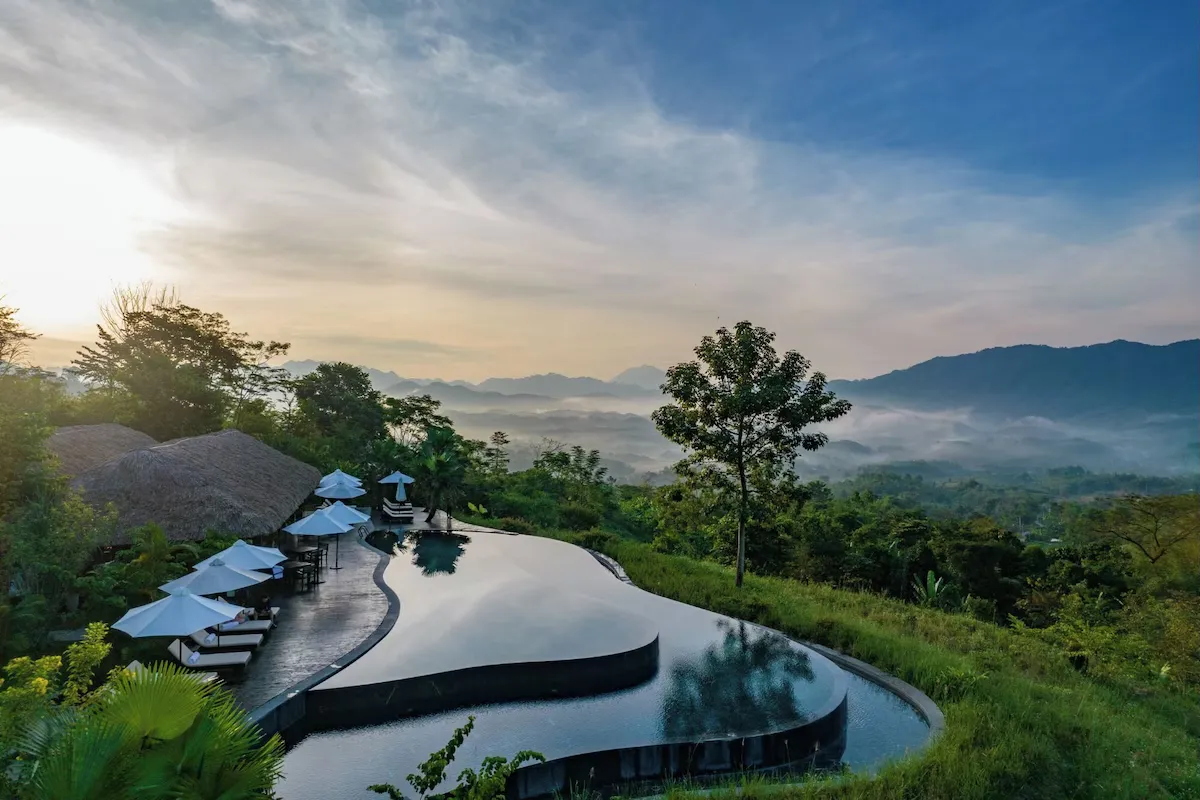
Avana Retreat sits above the valley floor, on a slope that gives every room a long view across the rice and toward the karst. The property is built in a hybrid vernacular: stilt-house silhouettes, contemporary materials, generous covered terraces. There are around thirty villas spread across the hillside, far enough apart that the property feels half-empty even at full occupancy. The spa works with steam, hot stones and herbal compresses drawn from the surrounding hills, in the regional Thai tradition.
What the location offers, beyond the obvious quiet, is access to the working life of the valley. The hotel arranges morning walks through the villages with a local guide who is from one of them, visits to the small Wednesday market at Mai Chau town, longer hikes up into the karst with a packed lunch, evenings of music performed by villagers in the longhouse model. None of this is staged in the modern sense. The market is the market the villagers use; the music is the music they play.
The food at Avana leans on regional ingredients: pho at breakfast in the proper northern style (thinner broth, more anise than ginger), nem chua (the fermented pork roll) at lunch, grilled buffalo with bamboo at dinner. The rice on the table is grown within walking distance.
Best for: travellers who want the northern landscape without the Sapa crowd, who value silence over amenities, and who are prepared to spend three full days at a single property.
Length of stay: three nights minimum, four ideal.
Memorable detail: the early-morning view from the terrace, when the haze sits between the karst peaks and lifts slowly as the rice fields take on colour.
05The Central Coast: three nights at Da Nang
Namia River Retreat, Da Nang
Da Nang is the third city of Vietnam, on the central coast, halfway between Hanoi and Ho Chi Minh City. Twenty years ago it was an industrial port. Today it is one of the country's better-managed urban transitions, with a clean river running through the centre, a long usable beach to the east, and several thoughtful boutique properties on the river itself.
Da Nang is also the right base for the central region's two cultural anchors: Hoi An, the preserved trading port thirty kilometres south, and the My Son sanctuary, the Cham temple complex an hour inland. From a Da Nang river property, both are easy half-day trips with a private driver, and both are best done before nine in the morning, before the day-trip buses from Hue arrive.
Namia River Retreat sits on a quiet bend of the Co Co River, ten minutes from central Da Nang and twenty minutes from Hoi An. The property is built around water: the river on one side, a long lap pool through the centre of the grounds, a wetland garden between the villas. There are around forty rooms and villas, with the larger pool villas offering private river access.
The architecture is contemporary tropical, with deep overhangs, timber screens, and open-plan rooms that open to private terraces. The spa is one of the strongest in the region, with a treatment menu that includes traditional Vietnamese cupping and a long-form Cham-inspired massage. The kitchen runs three restaurants: a Vietnamese fine-dining room, an open-fire grill on the river deck, and a beach club on the East Sea fifteen minutes away by complimentary shuttle.
The location is the property's best argument. Hoi An at sunrise, before the tour groups, is a different town from Hoi An at lunch. The same applies to My Son, where the morning light catches the red brick of the Cham temples in a way that the afternoon does not. Both visits are possible as proper half-day excursions from Namia, with time to return for lunch by the river.
The beach club, on the Da Nang side rather than the Hoi An side, is uncluttered. The beach itself runs for thirty kilometres without significant development for long stretches, and the swimming is excellent from March through September.
Best for: travellers who want the central region's culture (Hoi An, the Cham temples, the Da Nang street food scene) with a contemporary base on quiet water.
Length of stay: three nights minimum.
Memorable detail: the small wooden boat the hotel keeps on the river, which can be taken out at dawn with one of the property's boatmen, when the fishing nets are still going up between the banks.
06The Southern Sea: three nights at Cam Ranh
The Anam Cam Ranh, Cam Ranh Bay (Khanh Hoa province)
The southern coast has two reputations: Phu Quoc, the island in the Gulf of Thailand that has been heavily developed in the last decade, and Nha Trang, the long-established beach city. Both are worth knowing about. Neither is what this itinerary closes with.
Cam Ranh, just south of Nha Trang, is a different geography. The bay is one of the deepest natural harbours in Southeast Asia, and the coastline that runs north and south of the airport is a long stretch of white-sand beaches between low headlands, with a string of resorts that are deliberately spaced apart. There is no Cam Ranh town in the resort sense. The closest urban centre is Nha Trang, twenty-five minutes away by the new airport road.
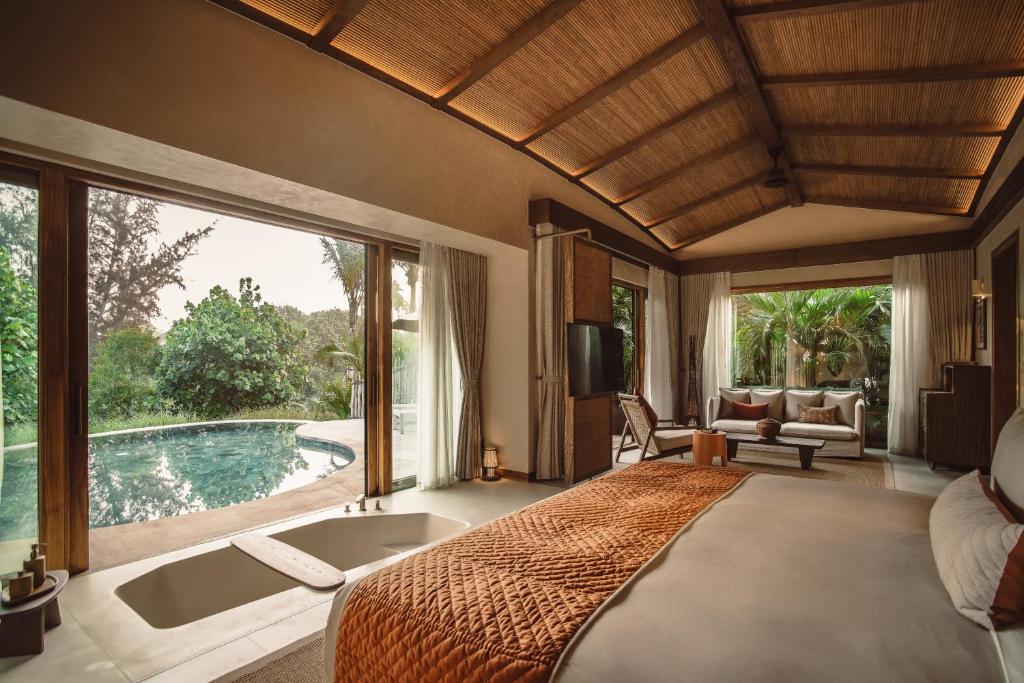
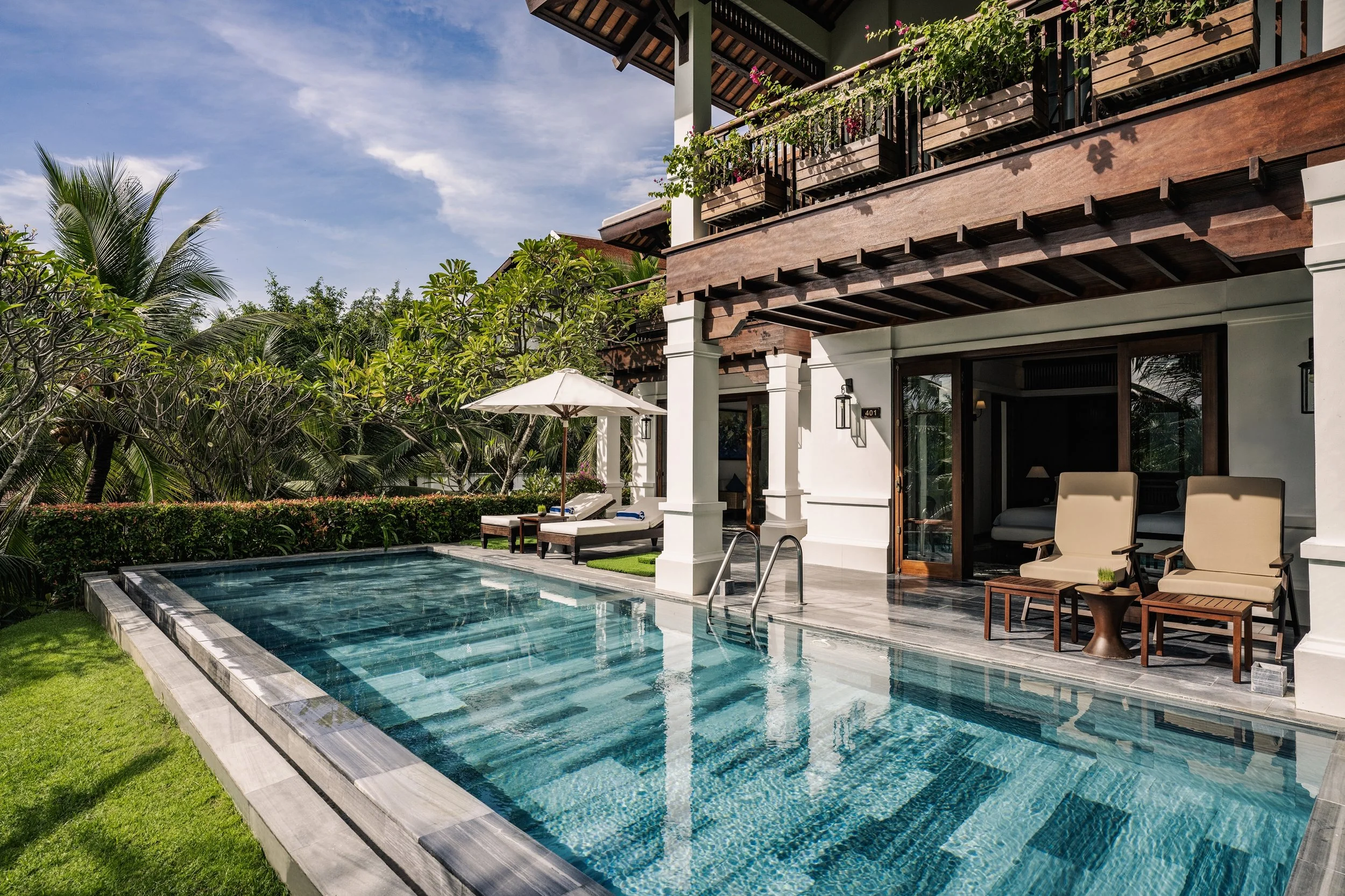
The Anam Cam Ranh is the second property in the Anam group (the original is at Long Beach further south). The aesthetic is colonial-Indochina with strong Vietnamese craft, in the tradition that includes the Metropole in Hanoi and La Residence in Hue: black-and-white floor tiles, lacquered wood, hand-painted ceramics, ceiling fans turning slowly above tall louvred doors. The property has about two hundred rooms across villas and a low main building, with a beachfront that runs for several hundred metres of private sand.
What distinguishes the Anam is the level of finish in the public spaces. The library has actual books, not the hotel-decoration kind. The art collection (mostly contemporary Vietnamese painting) is on rotation rather than fixed. The spa offers an unusually long menu including a four-hand Vietnamese massage that lasts ninety minutes and a programme of three full-day wellness sessions for guests staying longer than four nights.
The kitchen is the property's other argument. The Indochine restaurant serves a tasting menu of southern Vietnamese cooking that includes the dishes that get less coverage abroad: bun mam (the fermented fish noodle soup of the Mekong delta), banh xeo (the rice-flour crepe), com tam (the broken-rice plate that is the working-class lunch of Saigon). The seafood comes from the boats that work the bay, and the menu changes weekly.
For travellers who want to leave the property: Nha Trang is half an hour away and has the best of central Vietnam's Cham architecture at the Po Nagar towers, plus a serious seafood scene at the small port restaurants. The Hon Mun marine reserve, an hour by boat from Cam Ranh, is one of the better snorkelling sites on the Vietnamese coast.
Best for: the closing three or four nights of a Vietnam trip, on warm water, with strong food and a deep beach.
Length of stay: three nights minimum, five if the trip is the more relaxed eleven-night version.
Memorable detail: the verandah at the front of the main building, at six in the evening, when the bay light goes pink and the staff bring out the first round of banh tom (shrimp fritters) at the bar.
07The ten-day structure, at a glance
- Day 1: arrive Hanoi, transfer to Avana Retreat (90 minutes by road).
- Days 2 to 4: Avana, with one half-day in the villages and one longer karst hike.
- Day 5: fly Hanoi to Da Nang (morning), transfer to Namia.
- Days 6 to 8: Namia, with one morning at Hoi An and one half-day at My Son.
- Day 9: fly Da Nang to Cam Ranh (morning), transfer to The Anam.
- Days 10 to 12: The Anam, with one boat day at Hon Mun if conditions allow.
- Day 13: depart Cam Ranh, or transfer to Ho Chi Minh City for a final urban night.
The structure gives three or four nights at each property, two domestic flights only, and roughly two thousand kilometres of distance covered with very little of it in transit time.
08Clichés worth ignoring
"You have to do Halong Bay." Halong is dramatic and overcrowded. The karst landscape inland (around Mai Chau, or Ninh Binh further south) offers a comparable visual experience without the tour-boat density. If Halong matters, do it as a one-night junk and accept the trade-off; otherwise replace it.
"Hanoi needs three days." Hanoi's old quarter is best experienced in concentrated bursts of one or two days. Adding a third day usually produces fatigue with the traffic and the noise. Better to skip Hanoi entirely or to spend the night there only on transit, and to use the time saved in the mountains.
"The food is best in the south." Strong opinions in Vietnam. The north has the older food tradition, with subtler broths and less sugar. The centre (especially Hue) has the most refined imperial cooking. The south has the most variety and the heaviest hands. Different rather than better. Eat in all three regions before concluding.
"You can do Vietnam in seven days." Possible only by flying constantly and missing the country. Ten days is the minimum that gives the geography room to breathe. Fourteen is better.
09Frequently asked questions
| Question | Answer |
|---|---|
| When is the best month to visit Vietnam? | March, for the combination of warm weather across all three regions and the absence of either northern winter or southern monsoon. Late October to early November is a close second if the north and centre are the priority. |
| Is ten days enough for Vietnam? | Ten days is the minimum for a trip that covers the country meaningfully. The structure above uses three stops with three or four nights each, plus two domestic flights. Anything shorter forces either constant movement or one region only. |
| Do visitors need a visa for Vietnam? | Most nationalities require an e-visa, available online in advance and valid for ninety days. A small number of European nationalities have visa-free entry for stays up to forty-five days. Check the current rules before booking. |
| Is Vietnam safe? | Yes. One of the safer countries in Southeast Asia for international travel. Common-sense precautions in cities (traffic awareness, valuables) apply. The countryside and the resort coasts are calm. |
| Should travellers tip in Vietnam? | Tipping is not customary in restaurants outside the high-end international properties. In the properties listed above, a service charge is already included; additional tipping is appreciated but not expected. Drivers and guides on private excursions: a daily gratuity of around 200,000 VND is standard. |
| What about the Mekong delta? | The Mekong is a separate region of the country, best added as a two or three-night extension from Ho Chi Minh City rather than squeezed into a coastal itinerary. The standard day-trip out of Saigon is not worth the journey; the proper experience requires at least a night at a delta property. |
| How does Vietnam compare to Cambodia or Laos? | Vietnam is bigger, more developed, and more food-oriented than its neighbours. Cambodia is built around a single iconic destination (Angkor). Laos is the slowest of the three and the least visited. Many travellers combine Vietnam and Cambodia in a single longer trip, with a flight from Ho Chi Minh City to Siem Reap as the connector. |