Four Hotels to Find Yourself in India and Sri Lanka
From a 14th-century Rajasthan fort to Sri Lanka's mountaintop wellness retreats. Four hotels where design, heritage and Ayurveda converge for genuine transformation.
There is a particular kind of traveller who has grown weary of the European grand tour, who finds the Maldives too flat and Bali too familiar. For this traveller, India and Sri Lanka offer something that nowhere else quite manages: the sensation that a trip might actually change you. Not in the vague, Instagram-caption sense, but in the way that sleeping inside a 700-year-old fort, or watching mist rise over rice paddies from a concrete pavilion designed to induce silence, tends to recalibrate one's nervous system.
The best luxury hotels in India and Sri Lanka have moved beyond ashram simplicity and colonial nostalgia. What has emerged is something more interesting: properties that take the region's profound wellness traditions, its architectural heritage, and its raw landscapes seriously, housing them in contemporary design that would satisfy anyone who has ever lingered too long in a Tadao Ando building.
The four hotels in this guide represent the pinnacle of Subcontinental luxury hospitality. Two in India, two in Sri Lanka. One occupies a fortress where Rajput warriors once stood watch; another sits in a patch of pastoral Rajasthani countryside so quiet you can hear the peacocks from three fields away. In Sri Lanka, there is a mountaintop retreat where the architecture itself is designed to slow your breathing, and a hillside hideaway near the coast where colonial grandeur meets Balinese minimalism.
Why India and Sri Lanka Are the Destinations for 2026
The numbers tell part of the story. Sri Lanka welcomed 2.36 million visitors in 2025, its best year on record, and has set a target of three million for 2026. India remains Sri Lanka's largest source market, though European arrivals are climbing steadily. Both countries have invested heavily in the kind of infrastructure that makes luxury travel frictionless: new highways, improved airports, better domestic connectivity.
But the real shift is qualitative. The travellers arriving now seek what the industry calls "experiential luxury": hotels that offer more than a comfortable bed. They want transformation.
India and Sri Lanka are uniquely positioned to deliver this. Ayurveda, yoga, meditation, the entire apparatus of wellness that has become a $1.8 trillion global industry, all of it originated here. So did some of the world's most sophisticated architectural traditions. When these things are done well, in proper context, with genuine expertise rather than imported spa therapists and downloaded playlists, the results can be remarkable.
India: Where History Meets Healing
Six Senses Fort Barwara, Rajasthan
Six Senses Fort Barwara is a 48-suite wellness resort inside a restored 14th-century Rajasthan fortress, located 30 minutes from Ranthambore National Park and 2.5 hours from Jaipur. It is one of the most ambitious heritage hotel restorations in India.
The drive from Jaipur takes two and a half hours, most of it through the kind of Rajasthani countryside that looks like a Satyajit Ray film: mustard fields, water buffalo, villages where the women wear colours so bright they seem to vibrate. Eventually the road climbs, and there, rising from a hill above the village of Chauth Ka Barwara, are the sandstone ramparts of a 14th-century Chauhan dynasty fort.
The restoration took more than a decade. The result is the kind of hotel that makes architecture critics weep with gratitude: 48 suites distributed through the old palace wings, plus two original temples and a conservation project that extends into the surrounding forest. The property is actively rewilding the landscape, removing invasive plants and working to bring back leopards, jackals, and endemic birdlife.
The suites range from 70 to 280 square metres. Each has been designed in contemporary Rajasthani style: jali screens, Shekhawati art, arched doorways, draped canopies, and bathrooms built into the original tower structures where soldiers once kept watch for Mughal armies. The Raja Man Singh Pool Suite includes a private pool, dining pavilion, and views across the Aravalli hills.
The Six Senses Spa occupies 2,800 square metres inside the original women's palace (Zenana). Facilities include treatment rooms, hydrotherapy pools, an aerial yoga pavilion suspended by silk, an Alchemy Bar for blending custom oils and scrubs, and consultation rooms where Ayurvedic doctors design multi-day wellness programmes. This is serious wellness, not spa theatre.
Ranthambore National Park lies just 30 minutes away. The hotel arranges dawn tiger safaris in electric SUVs. Guests regularly return having seen Bengal tigers in the wild, an experience that tends to put spa treatments in proper perspective.
Dining at Six Senses Fort Barwara follows the brand's "Eat With Six Senses" philosophy. The flagship restaurant Roohani showcases Rajasthani-inspired cuisine using produce from the resort's organic garden and nearby village farms. Cortile offers all-day Mediterranean, pan-Asian, and Indian comfort food beneath the medieval domes. Rani Bagh serves flame-to-table cooking by the pool. The Rajawat Room is the place for pre-dinner cocktails and local spirits. Private dining can be arranged throughout the fort, from the ramparts at sunset to candlelit courtyards.
The property also functions as a world-class wedding and events venue. The Barwara Royal Ballroom and various outdoor lawns accommodate celebrations from intimate gatherings to large destination weddings, all with the dramatic backdrop of a seven-century-old fortress.
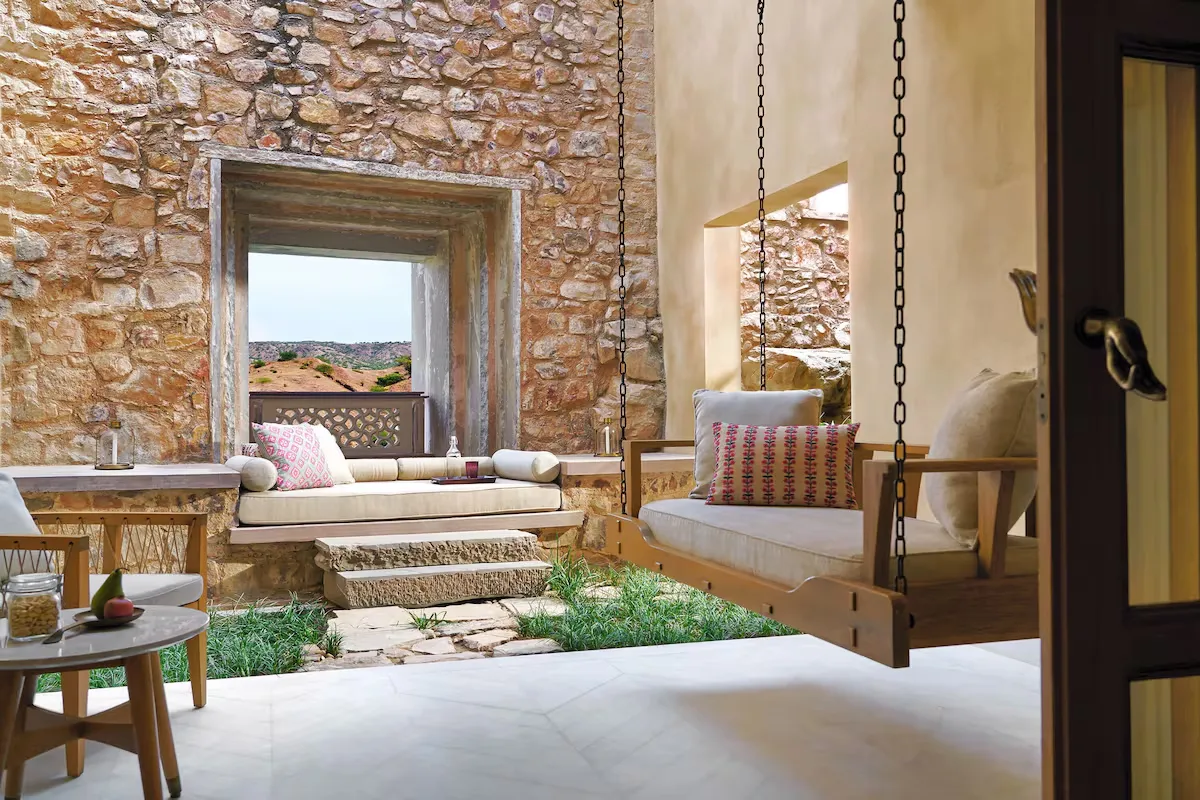
Six Senses Fort Barwara: Essential Information
Location: Chauth Ka Barwara village, Sawai Madhopur district, Rajasthan, India
Rooms: 48 suites (70-280 sqm), including Fort Suites, Garden Pool Suites, Burj Suites, and the Raja Man Singh Pool Suite
Price range: From ₹80,000/night (approximately $950 USD). Specialty suites considerably higher. Most rates include breakfast.
Best time to visit: October to April (Rajasthan winter). Summer brings extreme heat but lower rates.
Getting there: 2.5 hours from Jaipur International Airport. 30 minutes from Sawai Madhopur railway station. Hotel provides transfers in hybrid SUVs.
Best for: Heritage lovers, wildlife enthusiasts, serious wellness seekers, couples, special occasions
Anopura, Jaipur Countryside
Anopura is an intimate boutique hotel with just 13 rooms set on 8 acres of organic farmland in the Aravalli foothills, one hour from Jaipur. Often called "the world's smallest luxury hotel," it offers radical privacy and farm-to-table dining in pastoral Rajasthan.
If Six Senses Fort Barwara represents Subcontinental hospitality at its most monumental, Anopura represents something almost opposite: a hotel so small, so hidden, so deliberately underscaled that it feels less like a hotel than an extremely comfortable house party hosted by people with impeccable taste.
The property sits on eight acres of working farmland surrounded by lemon groves, marigold fields, and rose gardens. There are no signs on the road. The vegetables served at dinner likely grew within sight of your table. The chef comes from the local village. The staff grew up in the surrounding countryside and can arrange walks to meet their families, should guests wish to share chai with people who have never heard of TripAdvisor.
The accommodation ranges from 700 to 12,500 square feet. The signature Pravas Villa spans 2,300 square feet and includes a private temperature-controlled pool surrounded by frangipani flowers, a thatched Tibari lounge, and gardens that make you want to lie down in the grass and not move for several hours. Even the smallest suite offers panoramic views of the Aravalli hills.
There is no formal restaurant, no bar, no fixed schedule. You tell the staff what you want, where you want it, and when, and they make it appear. Breakfast by the pool at 11am? Done. A private dinner in the lemon grove at sunset? Absolutely. The kitchen produces European-Indian fusion cuisine that Ottolenghi fans would recognise, alongside traditional Rajasthani dishes.
Activities include leopard-watching expeditions, rides on rare Marwari horses (the breed with distinctive inward-curving ears), motorbike tours on vintage Royal Enfields, and visits to the 1,000-year-old Jamwa Ramgarh fort. But most guests simply stay on property, wandering the farm, swimming in the pools, eating food that tastes like it was grown because someone cared about it.
The spa is modest but effective, offering massages and beauty treatments in the gardens or in a small dedicated space. There is no gym, but a cross-country track winds through the eight-acre farm for those who need movement. The real wellness here is environmental: clean air, silence broken only by birdsong, the circadian rhythm of farm life, and food that your body recognises as real.
Anopura is part of the IHG network through Mr & Mrs Smith, meaning loyalty programme members can earn and redeem points. The property has quietly built a devoted following among travellers who have stayed at every Six Senses and Aman and arrived here to find something they did not know they were looking for: genuine peace.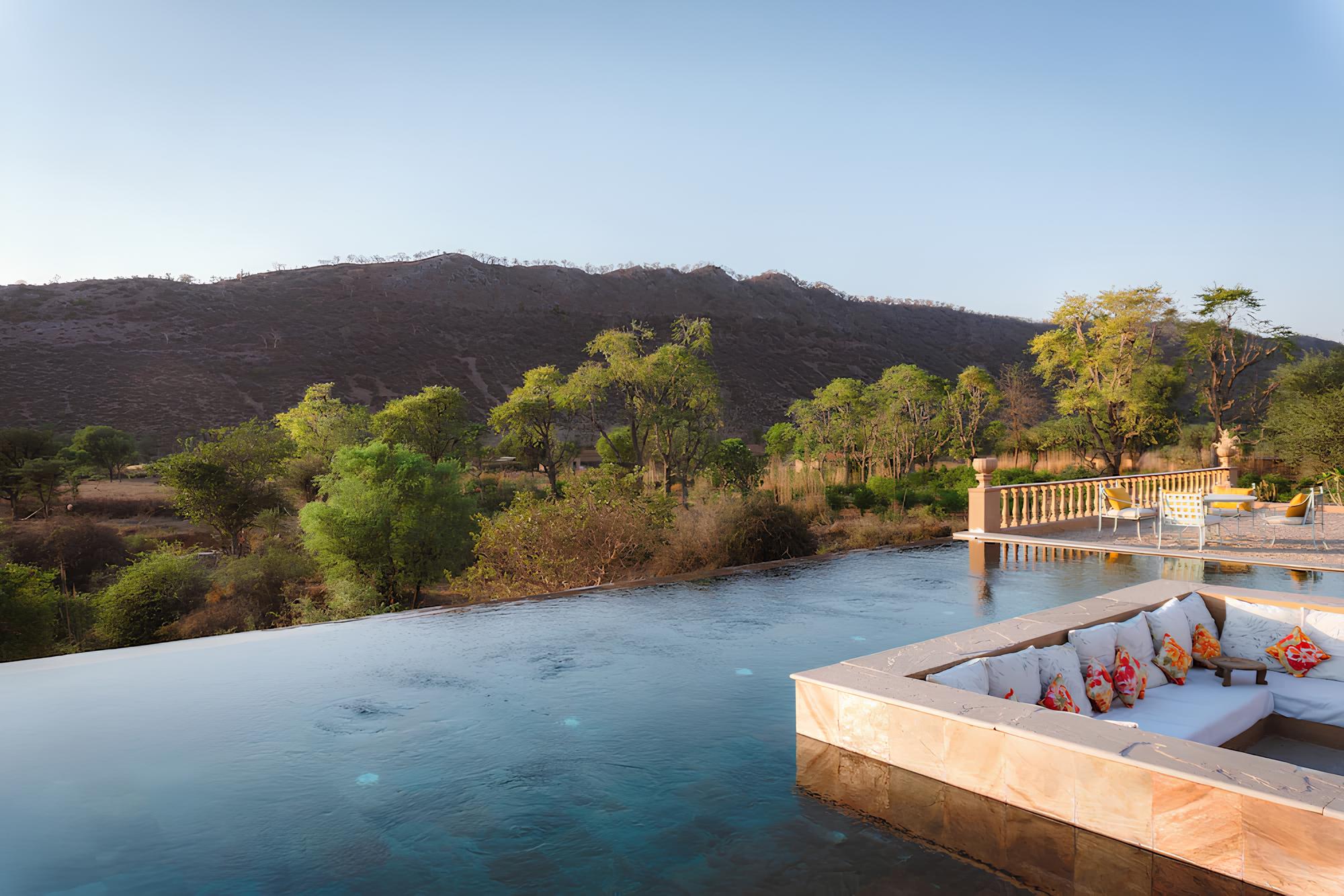
Anopura: Essential Information
Location: Ramgarh village, approximately 45km from Jaipur, Rajasthan, India
Rooms: 13 rooms and villas (700-12,500 sqft), including suites, pool villas, and the two-bedroom Pravas Villa
Price range: From $500-800/night. All rates include breakfast, lunch, dinner, selected drinks, and guided village walk.
Best time to visit: October to March
Getting there: 1 hour from Jaipur International Airport. 3.5 hours from Delhi. 30 minutes from Amber Fort. Hotel arranges transfers.
Best for: Couples seeking privacy, honeymooners, families wanting a rural escape, anyone tired of large resorts
Sri Lanka: Architecture of Silence
Santani Wellness Kandy
Santani Wellness Kandy is a 20-villa destination spa built on a 48-acre former tea plantation in Sri Lanka's hill country, designed around the concept of "architecture of silence." It was selected by TIME Magazine as one of the World's 100 Greatest Places and named one of Tatler's 8 Best Spas in the World.
The journey from Colombo takes about four hours, though "journey" may be too gentle a word. The last 90 minutes involve C-roads with sheer drops and hairpin turns that would alarm even experienced drivers. By the time you reach the reception pavilion, a simple wooden structure surrounded by trees with no visible rooms anywhere, the outside world feels very far away indeed.
This is deliberate. Santani was designed by Thisara Thanapathy, a two-time winner of Sri Lanka's Geoffrey Bawa Award for Excellence in Architecture. His intention was to create buildings that disappear into the landscape. The villas are designed like caves, with only a single opening facing forward, eliminating peripheral distractions in the same way that meditating monks use actual caves to focus their minds.
The property spans 48 acres overlooking the Dumbara valley and the Knuckles mountain range, a UNESCO World Heritage site. The Hulu River runs through the grounds (guests are encouraged to swim in it). Twenty standalone villas tumble down the hillsides, each elevated on steel pillars that barely touch the earth.
Inside the villas: industrial minimalism. Unadorned concrete floors, recycled rubberwood furniture, king beds facing floor-to-ceiling windows that frame the jungle and mountains. There is no air conditioning (the architecture provides natural ventilation). No televisions. WiFi is available on request, but the staff clearly hope you will not request it.
The tri-level spa descends into the hillside like stepped rice terraces. Facilities include a cedar-wood sauna with glass walls facing the Knuckles, a thermal salt soak pool (the only one in Sri Lanka), hydrotherapy circuits, and treatment rooms where Ayurvedic doctors prescribe personalised programmes for detox, weight loss, anti-aging, and dosha balancing.
There are no menus at Santani. The head chef meets each guest personally to discuss preferences and body type according to Ayurvedic principles. Every meal follows the concept of "Rasa Haya" (taste-based nutrition), balancing six distinct tastes. No two guests eat quite the same thing.
The wellness programmes are comprehensive and medically supervised. Options include weight loss, detox, anti-aging, stress management, and personalised dosha-balancing retreats. Two Ayurvedic doctors rotate through the property, and Santani regularly hosts "Visiting Masters", guest therapists and healers from around the world including Reiki practitioners, osteopaths, psychological coaches, and specialist yoga instructors.
Daily activities are included in all stays: morning and evening yoga or pilates in the dedicated shala, guided hikes through the 48 acres, forest bathing along the Hulu River, walks to the Hanging Bridge of Werapitiya, and visits to the ancient Narampanawa temple. Off-property excursions to the Knuckles range, Kandy city, and local tea factories can be arranged.
The sustainability credentials are serious. Santani uses no air conditioning (the design handles climate control naturally), nearly 90% of timber is recycled or upcycled, and the property operates as one of the most energy-efficient hotels in the world. This is wellness that extends beyond the individual guest to the environment itself.
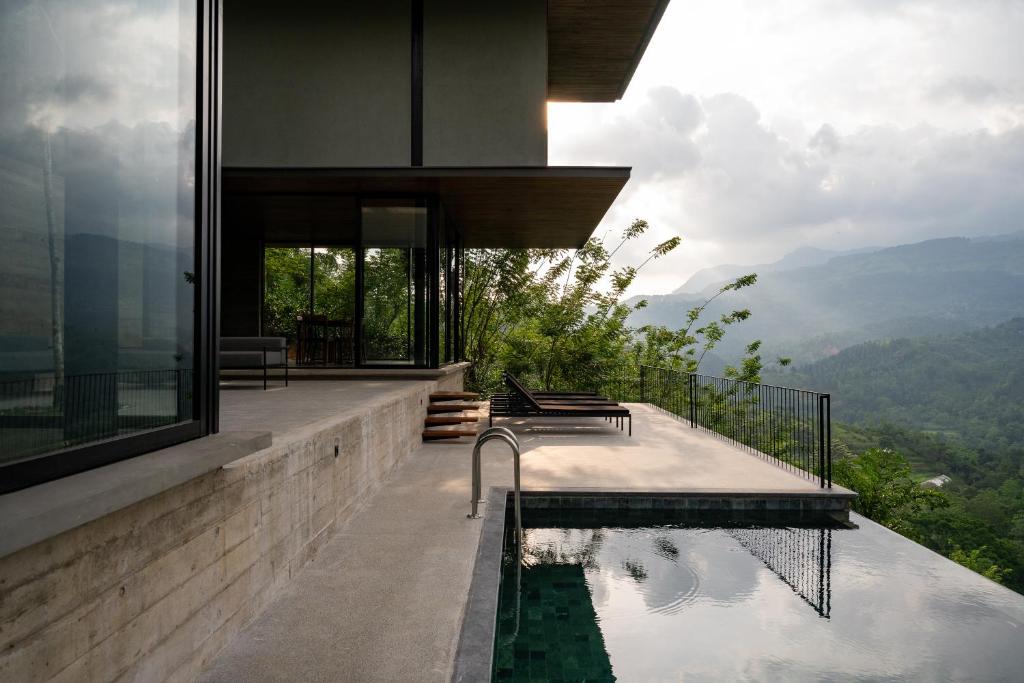
Santani Wellness Kandy: Essential Information
Location: Aratenna Estate, Werapitiya, approximately 1 hour from Kandy city, Sri Lanka
Rooms: 20 standalone villas (approximately 500 sqft), plus new two-bedroom and three-bedroom residences with private infinity pools
Price range: From $485/night. All stays include full board (three gourmet meals daily), morning and evening yoga/pilates, spa facility access, and hiking on property. Ayurvedic treatments extra.
Best time to visit: Year-round (hill country climate is relatively stable). Mist and rain possible any month.
Getting there: 4 hours from Bandaranaike International Airport (Colombo). 1 hour from Kandy. Hotel arranges transfers.
Minimum age: 12 years
Best for: Serious wellness seekers, digital detox, architecture enthusiasts, solo travellers, couples without young children
Haritha Villas & Spa, Hikkaduwa
Haritha Villas & Spa is a boutique resort of 7 contemporary pool villas and 2 colonial mansions set on a jungle hillside near Hikkaduwa, combining Ayurvedic wellness with hedonistic luxury on Sri Lanka's southern coast. It features two resident Ayurvedic doctors, an "unscripted menu" dining concept, and private butler service.
After the asceticism of Santani, Haritha offers something different: a property that takes wellness seriously but doesn't expect you to suffer for it. Located about 20 kilometres from Galle and just 900 metres from the coast, Haritha combines serious Ayurvedic credentials with the pleasures, infinity pools, floating breakfasts, sunset cocktails, that remind you holidays are supposed to be enjoyable.
The design by Gary Fell of GFAB Architects (a Bali-based firm known for luxury resort work) blends contemporary Balinese minimalism with colonial Sri Lankan grandeur. Seven modern pool villas cascade down the hillside, their glass walls and planted roofs making them seem like natural outgrowths of the jungle. Above them sit two grand colonial-style mansions with white columns, outdoor bathrooms, and the atmosphere of a rubber baron's weekend house circa 1920.
The integration with nature is striking. Peacocks wander the gardens. Monkeys swing through the trees. Views extend across rice paddies that glow nearly neon green under the tropical sun. Each villa includes a personal butler, iPad, Bose speakers, and saltwater plunge pool. The mansions share a larger infinity pool and can be booked exclusively for groups.
Two resident Ayurvedic doctors consult with every guest to create personalised wellness plans. The Jungle Spa offers everything from simple massage to intensive Panchakarma detox programmes. But unlike at some wellness resorts, nobody judges you for ordering a gin and tonic afterward.
The "unscripted menu" concept means you can order anything, anywhere, anytime. The chef sources fish from local markets at dawn and vegetables from the property's gardens. There are no dress codes, no fixed meal times. The signature cocktail is the Haritha Colada. Breakfast can be floated to your private pool on a decorated tray.
The beaches are close. Hikkaduwa and Narigama lie within a five-minute tuk-tuk ride (complimentary transfers provided). Surfing, scuba diving, snorkeling, and whale watching can all be arranged. Galle, the UNESCO-listed fort city, makes an easy afternoon excursion, as do the turtle hatcheries, moonstone mines, and Madu River boat safaris.
The spa facilities are extensive: sauna, jacuzzi, steam room, fully equipped gym, Vichy shower, nail bar, and a yoga pavilion overlooking the serene Haritha Lake. A local monastery welcomes guests for meditation sessions. The wellness programmes range from simple pampering to serious Panchakarma, with options from three nights to several weeks.
The property's origin story adds character. Built by a Sri Lankan entrepreneur who wanted to create something personal rather than corporate, Haritha feels like a private estate that happens to accept guests. The art collection, the locally sourced furniture, the vintage details, all of it reflects individual taste rather than a hospitality committee's decisions. General Manager Axel Knoerl runs the operation with the kind of Germanic precision that ensures everything works while maintaining the warmth that makes guests return.
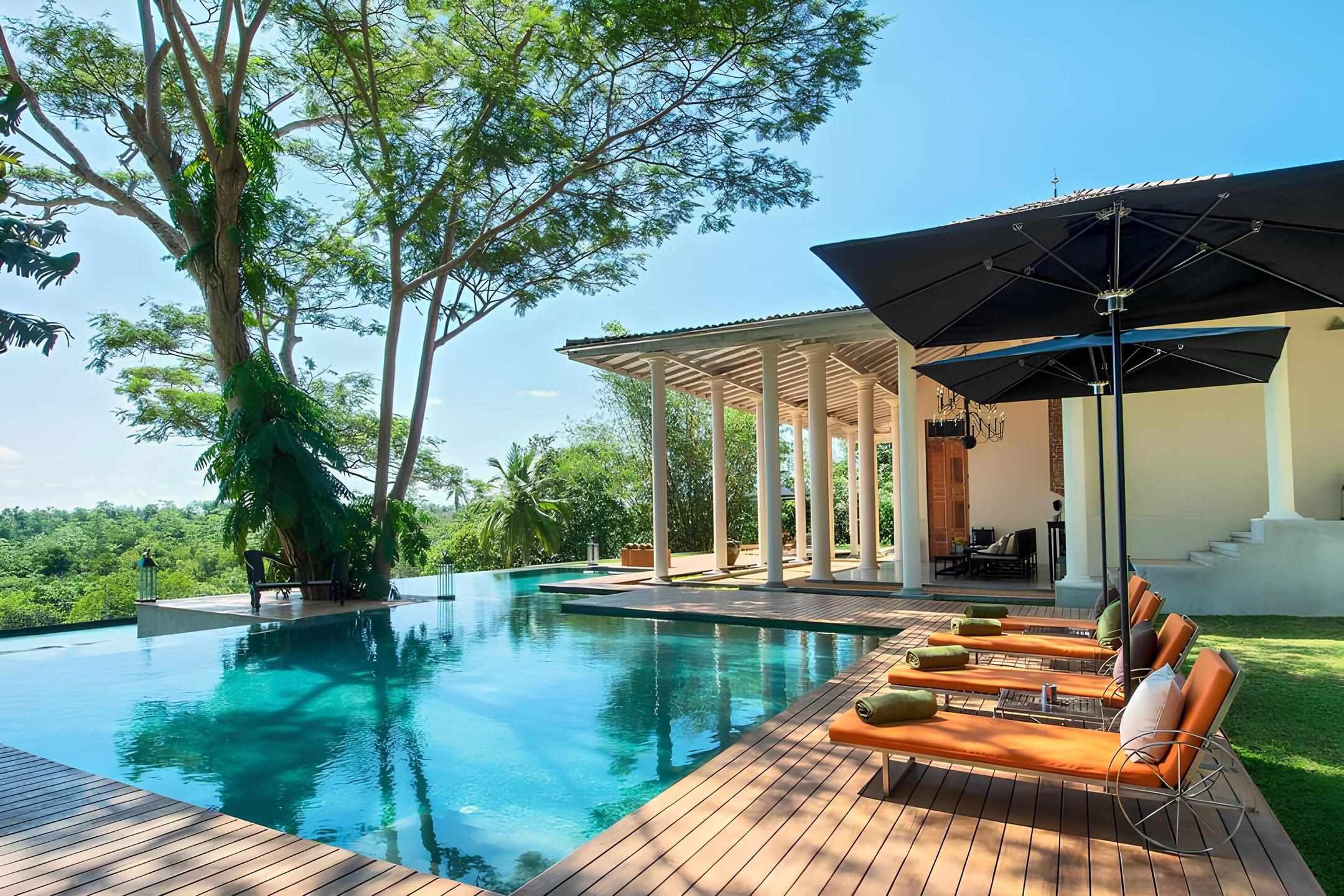
Haritha Villas & Spa: Essential Information
Location: Thiranagama, near Hikkaduwa, approximately 20km from Galle, southern Sri Lanka
Rooms: 7 contemporary pool villas (115 sqm, max 2 adults) and 2 colonial mansions (462-485 sqm, up to 5-6 guests). All with private or shared saltwater pools.
Price range: From $320-480/night depending on villa type and season. Extended stay discounts available.
Best time to visit: December to April (south coast dry season)
Getting there: Under 2 hours from Bandaranaike International Airport via new highway. 3 hours via scenic coastal route. 20 minutes from Galle.
Best for: Couples, honeymooners, families, groups, anyone wanting wellness without austerity
How to Plan Your India and Sri Lanka Hotel Itinerary
Suggested Combinations
The Wellness Circuit (10-14 nights) Start at Six Senses Fort Barwara (2-3 nights, including tiger safari) → Anopura (2 nights, pastoral decompression) → fly to Colombo → Santani Wellness Kandy (4-5 nights, intensive Ayurveda programme) → Haritha Villas (2-3 nights, beach and soft landing before departure)
The Heritage & Beach Route (7-10 nights) Six Senses Fort Barwara (3 nights) → fly to Sri Lanka → Haritha Villas (4-5 nights, using as base for Galle, beaches, shorter wellness treatments)
The Deep Wellness Journey (14+ nights) Extended Santani stay (7+ nights for serious Panchakarma or detox) bookended by Anopura (arrival) and Haritha (departure) for softer transitions
Best Time to Visit India and Sri Lanka
Rajasthan (India): October through March offers ideal temperatures. December-January is peak season. Summer (April-September) brings extreme heat but significantly lower rates.
Sri Lanka hill country (Santani): Relatively stable year-round. Light layers useful for evenings.
Sri Lanka south coast (Haritha): December to April is optimal. May-November brings monsoon rains.
The Deeper Proposition
There is a temptation, when writing about luxury hotels, to focus on thread counts and menu items. But what makes these four properties remarkable is something harder to quantify: the sense that checking in might constitute more than a holiday.
At Six Senses Fort Barwara, you are sleeping inside seven centuries of history, in a building that Rajput warriors died defending. The spa treatments are good, but so is the feeling of watching sunset from ramparts where archers once stood.
At Anopura, the point is subtraction rather than addition. There are no activities scheduled because the activity is simply being there, in a landscape so quiet and cared-for that doing nothing feels like an accomplishment.
Santani makes its intentions explicit. The architecture is designed to change your mental state. The food is calibrated to your body. The whole operation exists to send you home different than you arrived.
Haritha Villas offers a gentler proposition: that wellness and pleasure need not be opposites. That you can see an Ayurvedic doctor in the morning and drink cocktails by the pool in the afternoon, and both experiences might be good for you.
What unites all four is a seriousness of purpose that goes beyond hospitality. These are not hotels that happen to be in India and Sri Lanka. They are hotels that could only exist in India and Sri Lanka, drawing on traditions and landscapes that cannot be replicated elsewhere.
Frequently Asked Questions
| Six Senses Fort Barwara | is widely considered the best luxury wellness hotel in Rajasthan. It combines a restored 14th-century fortress with a 2,800-square-metre spa, Ayurvedic programmes, and proximity to Ranthambore tiger reserve. Room rates start around $950/night. |
| Santani Wellness Kandy | is Sri Lanka's premier destination spa, selected by TIME Magazine as one of the World's 100 Greatest Places. It offers serious Ayurvedic programmes, award-winning minimalist architecture, and a mountaintop setting overlooking the Knuckles UNESCO World Heritage site. Rates from $485/night including full board. |
| Haritha Villas & Spa | and Anopura welcome children of all ages and offer accommodations suitable for families. Six Senses Fort Barwara accepts families but is better suited to older children. Santani has a minimum age of 12 years. |