Cyprianerhof Dolomit Resort: A Mountain That Teaches a Family How to Build a Hotel
A close look at the Cyprianerhof Dolomit Resort in Tires al Catinaccio, South Tyrol.
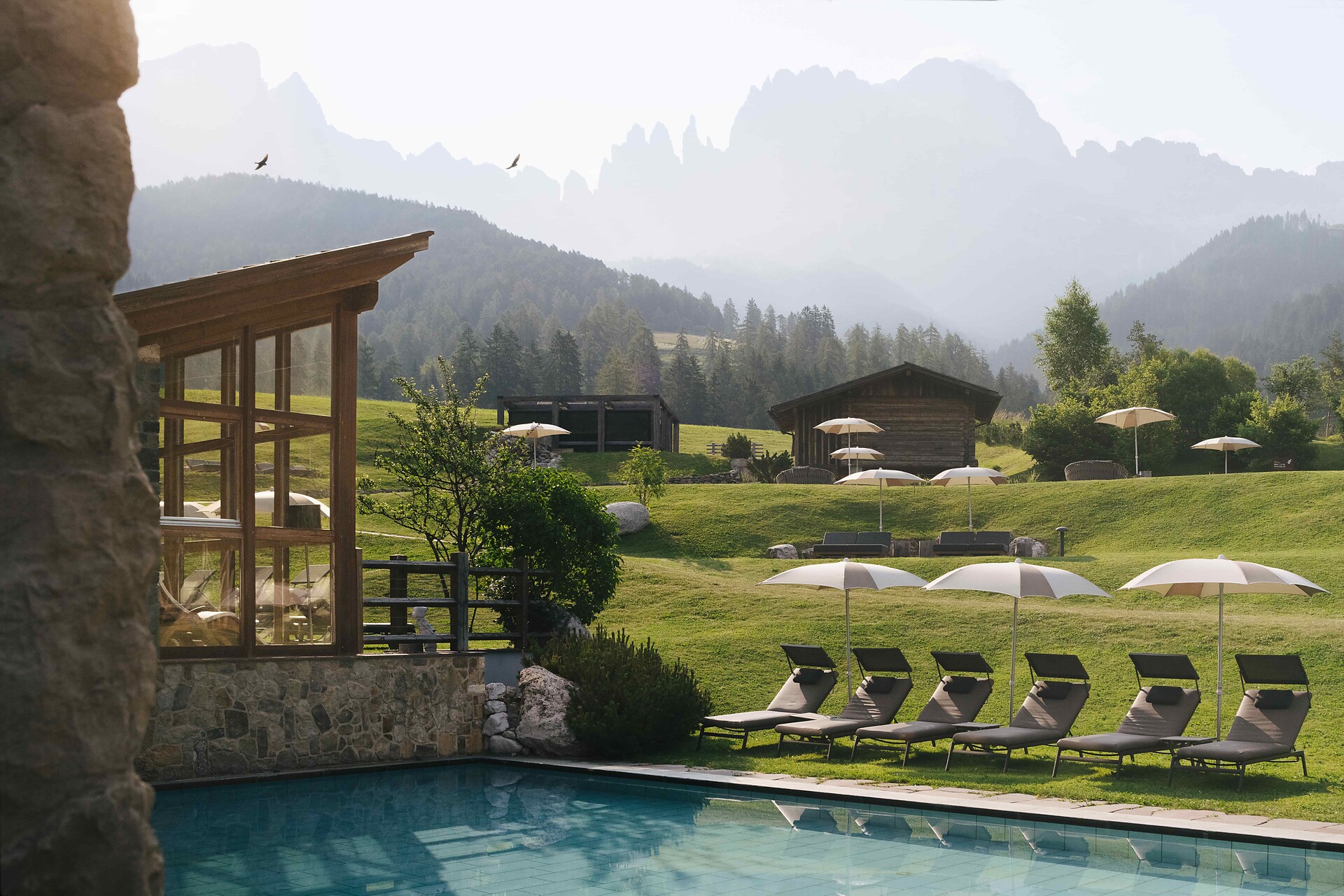
There is a moment at the Cyprianerhof that nobody warns you about. It happens on your first evening, just before sunset, when the five-course dinner is being plated and you are probably on your second glass of Gewürztraminer from the hotel's four-hundred-label cellar. You look up from the table and the Catinaccio has turned pink. Not sunset-pink, not a trick of the clouds. A deep, geological, full-body pink that moves through the rock face like a blush, holds for eight or nine minutes, then fades to violet and then to grey. The Ladins, the indigenous people of these valleys, call it enrosadira. The Germans, who also live here because this is South Tyrol and everybody lives here, call it Alpenglühen. The mountain does this every clear evening, winter and summer, and it has been doing it for longer than anyone has been alive to watch.
The locals have a story for why. King Laurin, a dwarf king who ruled the Dolomites in Ladin mythology, grew a garden of roses on the mountainside to win the love of a princess named Similde. When the plan failed and the king was captured, he cursed the roses so they would never be seen again, neither by day nor by night. He forgot about twilight. And so the roses return every evening, briefly, in the rock itself, before the mountain goes dark.
The hotel took the name Similde for its spa. The mountain is the reason the hotel exists at all. And the story of the Cyprianerhof Dolomit Resort, stretched across three generations of a single South Tyrolean family, is really the story of people who understood that when you build at the foot of something that extraordinary, the smartest thing you can do is get out of its way.
Sixty Years, Three Generations, One Address
The facts first. The Cyprianerhof sits at one thousand one hundred and seventy-five metres above sea level in San Cipriano (Sankt Zyprian in German, because everything here has at least two names), a hamlet in the municipality of Tires al Catinaccio, around 30 minutes by car from Bolzano. The village has a church, a cable car station, a handful of farms, and the kind of quiet that city visitors initially mistake for boredom before discovering it is the opposite.
In 1962, Luis and Inge Damian opened a Gasthof on this site with twelve rooms. A Gasthof, for anyone unfamiliar with the Alpine tradition, is a family-run inn. You sleep, you eat, and in winter you hope the heating works. The Damians' version was modest, built from local wood, and it looked out at the Rosengarten massif the way every building in the valley does, because the mountain does not give you a choice.
In 1985, their son Martin and his wife Margareth took over and began the transformation that would take the property from village inn to five-star resort. Martin was a builder and a believer. He saw possibilities in the valley that others in the village did not. Over two decades he expanded the hotel, added the spa, upgraded the rooms, earned the fifth star, and put a small hamlet that most guests had never heard of onto the map of serious European hotel keeping. He was, by all accounts, relentless.
Today the hotel is run by the third generation. Michael Damian manages the operation. His partner Diego Villegas, a classically trained opera singer born in South America, oversees the cultural programme. Their sister Monika Damian runs the kitchen. The three of them took full control recently, and the transition is visible in ways both obvious and subtle. The design is sharper. The cultural calendar is bolder. The food has a new structure. But the bones of the place, the wood, the stone, the view, the conviction that movement in the mountains and rest in the valley are the two halves of a single idea, those have not changed.
The Building and What It Is Made Of
The Cyprianerhof does not photograph the way most five-star mountain hotels photograph. There is no glass-and-steel statement, no cantilever over a cliff. The architecture is deliberately embedded in the landscape rather than imposed on it. The materials are the same essences that make up the forests around the property: pine, oak, stone pine, silver quartzite. The quartzite is typical of South Tyrolean building and has been used here for centuries. The wood is warm, pale, and everywhere. It lines the corridors, the ceilings, the room walls. It smells faintly of resin in the mornings and more strongly in the evenings when the heating has been running.
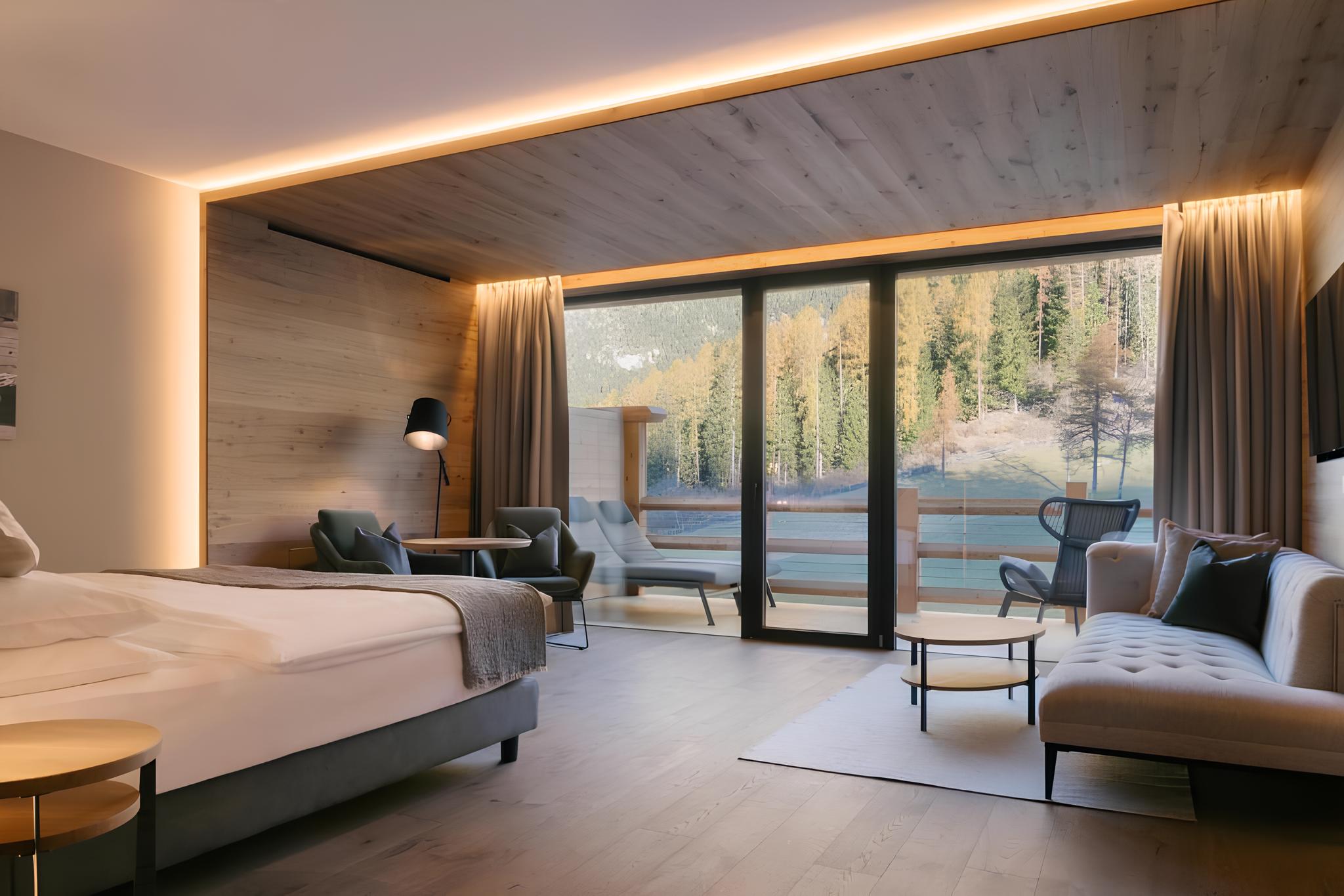
A 2022 renovation, led by the new generation, opened up the floor plans of the higher-category rooms and suites. The redesign leans toward natural materials, a calm palette, and large windows designed to bring the mountain inside. Beds are boxspring. Bathrooms have partner showers, stone-carved basins, and locally produced organic soaps and shampoos. There is underfloor heating throughout, which matters more than you think at this altitude in January. Every room has a balcony. And from almost every balcony, if you lean slightly to the right, the Catinaccio is there, doing whatever the light is telling it to do at that hour.
Ninety-Seven Rooms and the One You Want
There are ninety-seven rooms and suites across several categories, which is larger than the word "family hotel" usually implies. The entry-level rooms are the Delago Nature Rooms, thirty-six square metres of stone pine, Rosengarten views, and morning sun. The Alpinea Edelweiss Rooms sit on the third floor with a wider panorama. Alpinea Vajolet rooms are finished in fragrant stone pine and natural stone, with a warm, rustic register. Family rooms at forty-five square metres add a children's room separated by a sliding door, bunk beds, and a walk-in wardrobe.
Move up the range and things get more interesting. The Gartl Suite has two bedrooms, a generous living area in chopped oak and loden, and a private terrace with a jacuzzi and dining table. The Premium Rooms have large windows, morning sun, air conditioning, and a sofa. But the room to ask for, the one that has become the quiet benchmark of the property, is the Antermoja Suite. It comes with an effect fireplace, a corner sofa, a living area finished in natural stone and refined oak, floor-to-ceiling windows on multiple sides, and a private panoramic swimming pool looking directly at the Catinaccio massif. There is also a private Finnish sauna, a private steam bath, and a terrace large enough to dine on. If you are spending a week at the Cyprianerhof for a significant occasion, this is the room that justifies the trip.
The Similde Spa: Two Thousand Four Hundred Square Metres and No Chlorine
The wellness area is named after the princess from the King Laurin legend, and it covers two thousand four hundred square metres, which by South Tyrolean standards is generous without being excessive. The Damian family has said publicly that they made a conscious decision not to join the regional arms race for ever-larger spa footprints. Instead they focused on what goes into the water and what the space feels like.
The pools, indoor and outdoor, are filled with spring water from the Plafötsch natural source, heated to thirty degrees, and cleaned using a salt electrolysis plant rather than chlorine. The distinction is not marketing. You can feel it on your skin and smell the absence of it in the air. There is also a natural bathing pond on the property, fed by the same spring, for guests who want their swimming cold and chemical-free.
The sauna programme is where the Cyprianerhof distinguishes itself from the competition. There are five saunas, each built from different materials and each with a different character. The Swiss stone pine sauna runs between eighty-five and ninety-five degrees Celsius and fills the room with the scent of pine oil. The Argilla clay sauna is a hundred-percent ecological dome with a round stove in the centre, reflecting a high level of natural infrared radiation. The hay barn sauna is the one guests talk about most: a standalone rustic structure set in the middle of an Alpine meadow with an unobstructed view of the Catinaccio. And the newest addition, a glass sauna with panoramic windows facing the Rosengarten, allows you to watch the enrosadira happen while sitting in seventy-five degrees of heat. That is not an experience available at many other addresses.
After the saunas, there is a crushed ice grotto for cooling down, a Kneipp stream and Kneipp basin in the meadow for circulation, experience showers, hay beds in the relaxation area, and a saltwater outdoor whirlpool that has become one of the most photographed features of the hotel: warm water, cold mountain air, the Dolomites directly ahead, and nothing else to look at.
The beauty area has nine treatment cabins. Treatments use natural and locally sourced products: Sarntaler mugo pine peeling, marigold massages, herb-based rituals drawn from the traditional Alpine pharmacopoeia. The sauna master, Luca, runs Aufguss ceremonies that have developed their own following among return guests.
Quattro: A Kitchen Run by Four People Who Trust Each Other
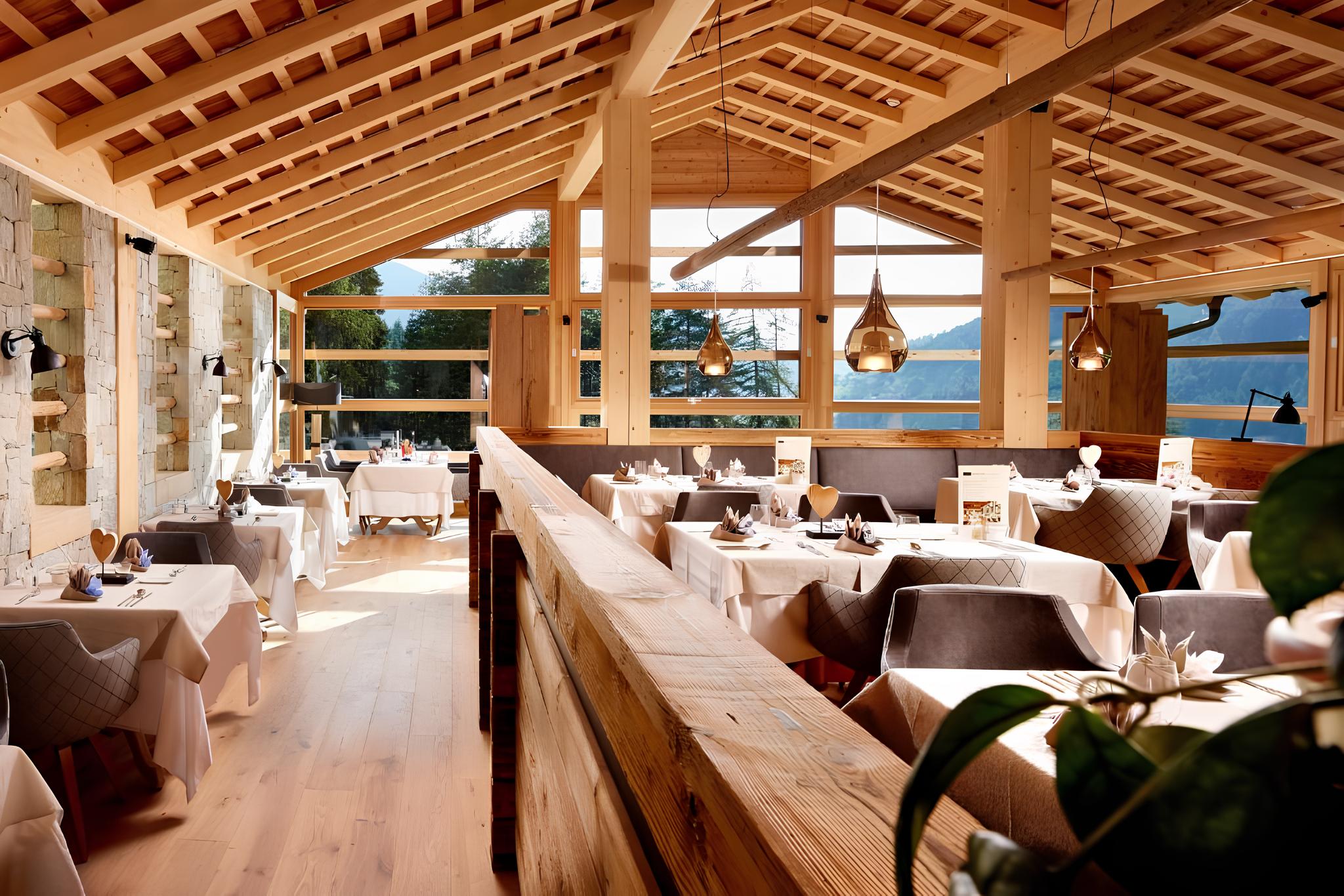
The restaurant at the Cyprianerhof is open only to hotel guests, seats two hundred, and serves a five-course dinner each evening with multiple options per course including a vegetarian choice and a traditional recipe. The wine list holds roughly four hundred labels, the majority South Tyrolean, curated by sommelier Silvia Bertoncello, who runs weekly guided tastings in the hotel's cellar.
But the real story is the kitchen model. Monika Damian has been cooking here since 2012 and now leads the full food and beverage programme. Rather than running a conventional brigade with a single executive chef, she built something the hotel calls Quattro: a team kitchen of four creative equals. Monika handles overall direction and development. Marion Mahlknecht is the pastry chef. Alessandro Plotegher runs the secondi. Alessandro Salvador handles the primi. The four of them have worked together for more than a decade, and the kitchen operates on a model of shared responsibility and shared authorship that is unusual at this level.
The cooking is South Tyrolean at its base but refuses to stay there. Monika reinterprets her grandmother's recipes with Mediterranean accents. A typical evening might move through South Tyrolean spinach dumplings to pink-roasted pork fillet stuffed with asparagus fern, veal tartare, vegan pulled pork made from king oyster mushrooms, and a dessert from Marion that references Alpine dairy and citrus in the same plate. The nose-to-tail philosophy is taken seriously. So is local sourcing: the kitchen works directly with farmers and livestock producers from the surrounding territory, and the menus shift with the seasons in ways you can actually taste.
Breakfast is the other anchor. It runs as a full mountaineers' breakfast with a vital corner: fresh-pressed juices, organic teas and coffee, pure water from the Plafötsch spring served in glass (no plastic bottles anywhere in the hotel), and a spread of South Tyrolean farmhouse products, breads, cured meats, cheeses, honey, and jams that would require a disciplined person to eat moderately. Most people do not manage it.
A newer addition is the community table, held weekly in the hotel library, where guests eat together at a long shared table. The idea came from Diego, and it fits the hotel's broader move toward what the family calls Cultura Dolomiti: the conviction that a mountain hotel should be a cultural venue as well as a place to sleep and ski.
Cultura Dolomiti: The Part Most Mountain Hotels Skip
This is where the third generation has made its most visible mark. Diego Villegas, a trained opera singer, created the cultural programme and runs it personally. The hotel now hosts regular concerts, lectures, and performance evenings that are open to guests and, notably, to locals. Chamber music recitals in the common areas. Alpine horn performances by mountain musicians. Discussions on subjects that range from the power of the human voice to the ecology of the Dolomites. A Culture Lounge where art is treated not as decoration but as provocation.
The ambition is to make the Cyprianerhof a cultural node in the valley, not just a hotel. The programme is young, still finding its edges, but the seriousness behind it is real. Diego's background in music and performance gives the events a register that hotel "entertainment programmes" almost never have. And the fact that locals attend, that the hotel opens its doors to the village rather than sealing itself off from it, is the detail that makes the whole thing credible.
The Mountain Programme: Five Crystal Rating and Serious Gear
The Cyprianerhof holds a five mountain crystal rating from the Wanderhotels association, the highest grade for hiking quality in the Alps. It is also a founding member of the Vitalpina Hotels Südtirol group and a member of the Belvita Leading Wellnesshotels Südtirol. These are not vanity badges. They come with obligations: guided programmes, equipment standards, staff training, and measurable commitments to the surrounding landscape.
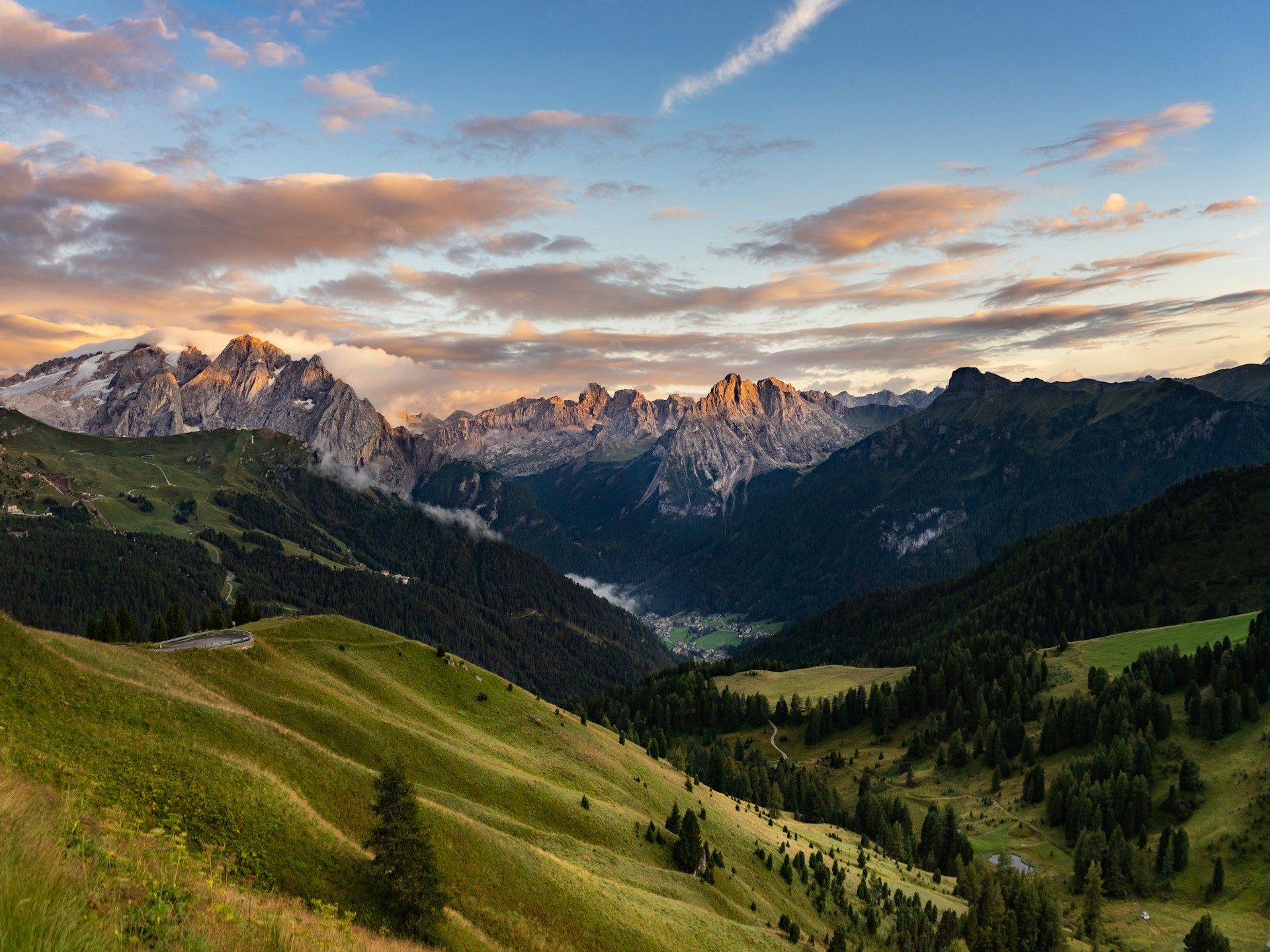
The hotel's location inside the Sciliar-Catinaccio Nature Park, a UNESCO World Heritage Site, puts it at the start of hiking, climbing, and biking routes that run in every direction. In summer the terrain is green, lush, and criss-crossed with marked trails ranging from gentle valley walks to serious via ferrata on the Catinaccio massif. In winter the same terrain becomes snowshoe and cross-country country, and the Carezza ski area, forty perfectly groomed slopes of every difficulty, is eight minutes away by car or, since the new Tires cable car opened directly across the road from the hotel, accessible on foot.
The hotel lends hiking backpacks, poles, drinking bottles, avalanche detectors, snowshoes, climbing gear, and via ferrata sets. There are guided hikes, guided snowshoe treks, mountain biking tours, ice climbing excursions, and winter waterfall climbing for guests who want their adrenaline managed by professionals. Morning yoga sessions run on the terrace. The area is avalanche-safe in winter, which is one reason the snowshoe programme has become a particular strength.
The philosophy, repeated by the family and visible in the way the day is structured, is simple: movement on the mountain, relaxation in the valley. You go out, you come back tired, you eat, you soak, you sleep. The hotel is engineered around that rhythm.
What the Hotel Gets Right and What You Should Know
The Cyprianerhof does several things better than almost any mountain hotel in the Alps. The spa water quality is exceptional. The food programme under Monika and her team is serious and improving. The cultural calendar under Diego is a genuine differentiator. The mountain programme is professional and well-equipped. The sustainability credentials are real: South Tyrol Ecolabel, Climahotel certification, solar panels, electric vehicle charging stations, glass water bottles throughout, locally produced bath products, a climate neutrality pact commitment. The spring water from Plafötsch runs through the taps in the rooms, which is a detail guests mention unprompted in reviews.
A few things to note. The hotel is large for a family-run property, ninety-seven rooms, and at full capacity it does not feel like a twelve-room boutique. The dining room seats two hundred. If you are looking for extreme intimacy, the Antermoja Suite or the Gartl Suite with its private terrace will give you that, but the common areas are shared and, during school holidays, busy. Some rooms face the valley and the Sciliar rather than the Rosengarten, which is fine but not the same. Ask for a Catinaccio view when booking. The saunas open at one in the afternoon and the whirlpool at two, so morning spa sessions are limited to the pools and relaxation areas. There is a hairdresser on site, which is an unusual touch. Dogs are welcome at a charge of fifty euros per night.
Getting There
The hotel is at Via San Cipriano 69, 39050 Tires al Catinaccio, South Tyrol, Italy. Bolzano Airport is the nearest, roughly forty kilometres by road and thirty to forty-five minutes by car. The hotel arranges transfers. Innsbruck Airport is the next option, about an hour and a half by road. Verona and Munich airports are both within roughly two and a half to three hours' drive. SkyAlps operates direct flights from London Gatwick to Bolzano, which take about two hours and twenty minutes. There are direct buses from Bolzano to Tires, or a taxi from Bolzano railway station takes about thirty minutes. Free private parking is available at the hotel.
The nearest major town is Bolzano, seventeen kilometres away, which has good restaurants, a weekly market, the South Tyrol Museum of Archaeology (home to Ötzi the Iceman), and the kind of bilingual, bicultural, Italian-Austrian energy that makes it one of the more interesting small cities in northern Italy. The Alpe di Siusi, Europe's largest high-altitude Alpine meadow, is a short drive. Carezza Lake, with its postcard reflection of the Latemar massif, is eleven kilometres away. The hotel sits roughly thirty minutes from the nearest Dolomiti Superski lift pass access point.
The View at the End of the Day
There is a German word, Stammgast, that means regular guest. The Cyprianerhof has a high Stammgast rate, and when you read through the reviews the pattern is obvious: people come once, plan to come back, and then do. The hotel does not need to sell itself aggressively because the mountain does most of the selling.
What the Damian family has done, across sixty years and three very different generations, is resist the temptation to compete with the mountain. The building is wood and stone because the mountain is stone. The water is from the local spring because the spring is there. The food is from the farms down the road because the farms are down the road. The spa faces the Catinaccio because there is nothing else worth facing. Every good decision in the hotel's history has been a decision to follow the landscape rather than fight it, and the result is a property that feels, in 2026, both entirely modern and entirely rooted in the place it stands.
Book the Antermoja Suite if you can. Eat everything Monika puts in front of you. Take the snowshoes out at least once. And be at a window, any window, at sunset, when the Catinaccio decides to remember its roses.
Frequently Asked Questions
What is the Cyprianerhof Dolomit Resort?
The Cyprianerhof is a five-star family-run resort in Tires al Catinaccio (Sankt Zyprian), South Tyrol, at the foot of the Rosengarten/Catinaccio massif in the Dolomites UNESCO World Heritage area. It has ninety-seven rooms and suites, a two-thousand-four-hundred-square-metre spa, a gourmet restaurant led by chef Monika Damian, and a guided mountain activity programme. The hotel has been owned and operated by the Damian family since 1962 and is now in its third generation.
What is the best time of year to visit?
Both winter (December through March) and summer (June through September) are strong seasons. Winter brings skiing at Carezza (eight minutes from the hotel), snowshoeing, and ice climbing, plus the particular pleasure of the outdoor pools and saunas in cold air. Summer offers hiking, via ferrata, mountain biking, and long evenings on the terrace. October and November and April and May are shoulder seasons with lower rates, fewer guests, and weather that can go either way. The enrosadira on the Catinaccio is visible year-round on clear evenings.
Is the hotel suitable for families?
Yes. Several room categories are designed specifically for families, including the Jungbrunn Family Room and the Alpinea Vajolet Family Room, both with separate children's sleeping areas. There is a children's playground and a kids' club. The mountain activity programme is tailored to individual fitness levels, including children. The Carezza ski area is particularly well suited to families with beginner and intermediate slopes. Children are welcome throughout the hotel, including the restaurant.
What does a stay cost?
Rates vary by season and room category. Entry-level rooms start at roughly two hundred euros per night in shoulder season. The Antermoja Suite at the top of the range commands significantly more. Half board (breakfast and five-course dinner) is included in most rates. The hotel guarantees the best rate on its own website and will improve by up to ten percent on any lower price found elsewhere.
How does the spa work?
The Similde Spa covers two thousand four hundred square metres and includes indoor and outdoor chlorine-free pools filled with spring water from the Plafötsch source, four saunas (Swiss stone pine, Argilla clay, hay barn, and panoramic glass), a crushed ice grotto, a Kneipp stream, experience showers, hay beds, a saltwater outdoor whirlpool, and nine treatment cabins. Pools are open throughout the day. Saunas open at one in the afternoon. The whirlpool opens at two. Day spa access is available for non-guests by reservation.
What is Cultura Dolomiti?
Cultura Dolomiti is the hotel's in-house cultural programme, developed by Diego Villegas. It includes concerts, lectures, art events, and the weekly community table dinner in the library. Events are open to hotel guests and to locals from the village. The programme reflects the third generation's ambition to make the Cyprianerhof a cultural venue as well as a hospitality property.
Can I ski directly from the hotel?
Almost. The Tires cable car, which connects directly to the Carezza ski area, has its departure station across the road from the hotel. Carezza offers forty groomed slopes across all difficulty levels with reliable snow conditions. The hotel lends ski equipment and can arrange ski guides. Cross-country skiing and ski touring are also accessible from the property.
How do I reach Tires al Catinaccio?
The easiest route is through Bolzano, seventeen kilometres away. Bolzano has its own airport (served by SkyAlps with direct flights from London and other European cities), a railway station on the Brenner line, and good road connections. The hotel is thirty to forty-five minutes by car or taxi from Bolzano. Innsbruck Airport is ninety minutes by road. Verona and Munich airports are roughly two and a half to three hours away. The hotel arranges airport and station transfers.