Brazil by Design: From Rio's Beachfront to Bahia's Rainforest
Philippe Starck's Bossa Nova homage, a fashion mogul's beachfront vision, and a rainforest retreat where turtles nest at dawn. Brazil beyond the postcard.
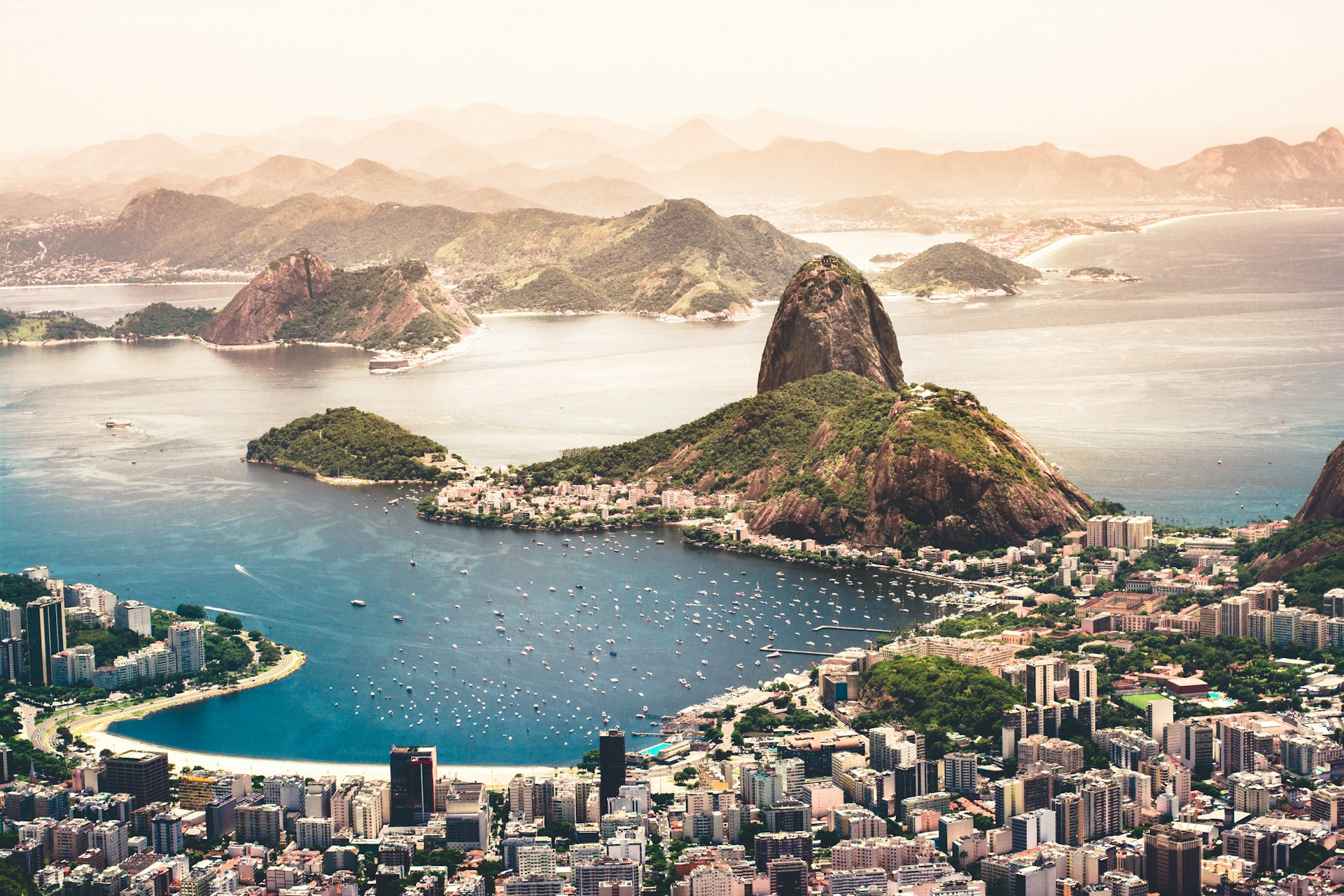
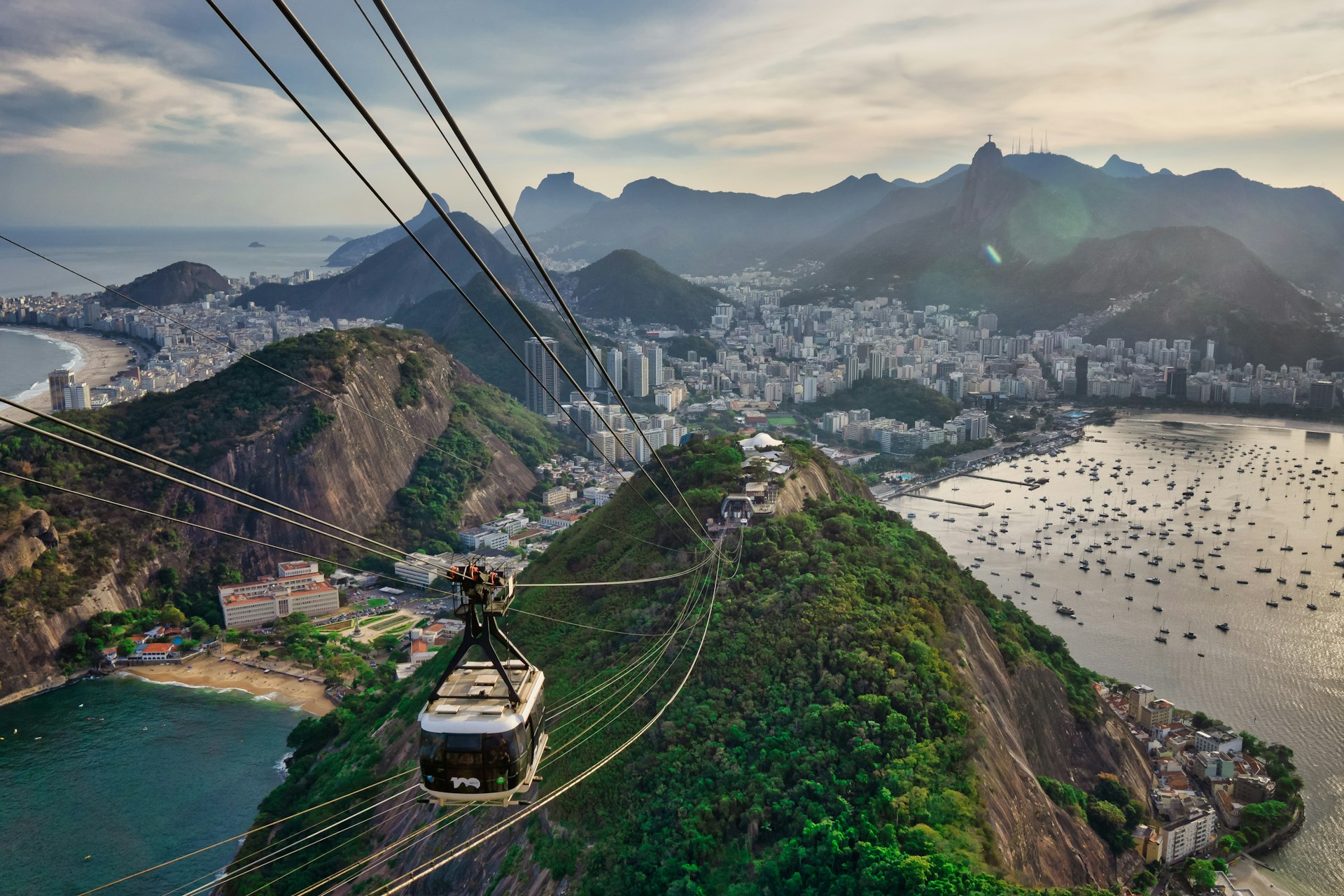
The plane descends over Guanabara Bay and the city reveals itself in pieces. First the mountains, improbably green and steep. Then the lagoon, the beaches curving like parentheses, the white apartment blocks climbing the hillsides. Christ the Redeemer appears through the window, arms extended, smaller than expected but somehow more affecting for it. Rio de Janeiro announces itself the way it always has: dramatically, unapologetically, with the confidence of a place that knows exactly what it is.
Most visitors never leave the postcard. They photograph Sugarloaf, walk Copacabana, drink caipirinhas at sunset, and fly home believing they have seen Brazil. They have seen a version of it, certainly. The samba and the beaches and the bodies. The chaos and the beauty and the particular energy of a city built between mountains and sea. But Brazil is a continent disguised as a country, and Rio is only one chapter of a much longer story.
That story includes Bahia, a thousand kilometers north, where the Atlantic Forest tumbles down to empty beaches and the culture carries African rhythms that Rio's European influences softened. It includes a design tradition that shaped modernism itself, architects and furniture makers whose work filled the pages of international magazines decades before Brazilian hotels appeared on anyone's radar. It includes a hospitality culture that developed in parallel with the great European traditions, Italian immigrants building dining empires in São Paulo while cariocas invented the beach club and the rooftop bar.
Three hotels tell this story. They span two cities and two ecosystems, two approaches to luxury and two visions of what it means to be Brazilian. One carries the legacy of a restaurant dynasty that has shaped how Brazilians eat for more than a century. Another emerged from a fashion empire built on the idea that sustainability and style need not be enemies. The third sits where the rainforest meets the sea, in a place that time and development have somehow missed.
Together, they offer something beyond the beach towel and the bikini. They offer Brazil by design.
The Fasano Legacy
The story begins in Milan, 1902. Vittorio Fasano, a young man with ambitions larger than his prospects, boards a ship bound for São Paulo. Brazil is booming, coffee money flowing through the city, immigrants arriving by the thousands to build the industries that the old agricultural economy could not sustain. Vittorio opens a small brasserie in the historic center, serving Italian food to a clientele hungry for European sophistication. The restaurant succeeds. Then it grows. Then it becomes an institution.
Four generations later, the Fasano name means something specific in Brazil. It means tables you cannot get without connections. It means kitchens where technique and tradition intersect at the highest level. It means a standard of hospitality that developed independently of the European luxury brands, rooted in the Italian understanding that food and welcome are inseparable.
Rogério Fasano, the great-grandson of Vittorio, extended the family business into hotels in 2003. The first, in São Paulo, established the template: design that honored Brazilian modernism, service that reflected the family's restaurant DNA, an atmosphere that felt more private club than corporate hospitality. Rio followed in 2007, and with it came a statement of intent so bold that it changed the city's luxury landscape overnight.
Hotel Fasano Rio de Janeiro occupies the best address on Ipanema Beach, the corner of Avenida Vieira Souto where the sand curves toward the Dois Irmãos mountains and the sunset light turns everything gold. The building itself made history. It was the first structure in Brazil designed by Philippe Starck, the French architect whose work had defined boutique hotels from New York to London. Rogério Fasano wanted someone who understood spectacle but could resist excess, who could honor the past while building something unmistakably contemporary. Starck delivered.
The design pays homage to Brazil's golden age, the 1950s and 1960s when Bossa Nova emerged from Ipanema's bars and Brazilian modernism conquered international architecture. The lobby features a reception desk carved from a single pekia tree, its organic form contrasting with the glass walls and the polished marble floors. Furniture by Sergio Rodrigues, the designer whose work helped define mid-century Brazilian style, appears throughout the public spaces. The color palette runs warm, wood tones and earth shades that reference the tropics without surrendering to them.
Eighty-nine rooms occupy the eight floors, divided into categories that reflect the eternal Rio question: ocean or courtyard? The courtyard rooms cost less and offer quiet, their windows facing an interior garden that filters the city's noise. The ocean rooms cost more and offer everything else. Beds are positioned at an angle toward the windows, a Starck touch that ensures guests wake to water and light. The effect is subtle but unmistakable. You are not merely staying at the beach. You are oriented toward it, drawn to it, reminded with every morning that the Atlantic waits outside.
The suites expand this logic. Oceanfront Deluxe accommodations add balconies deep enough for breakfast, living areas that function as genuine rooms rather than expanded hallways. The largest suites, facing the full sweep of Ipanema from Arpoador to the mountains, provide the kind of views that make you understand why people built cities in impossible places. Rio could have spread inland, found flat land, made things easier. Instead it wedged itself between the mountains and the sea because the beauty was worth the difficulty.
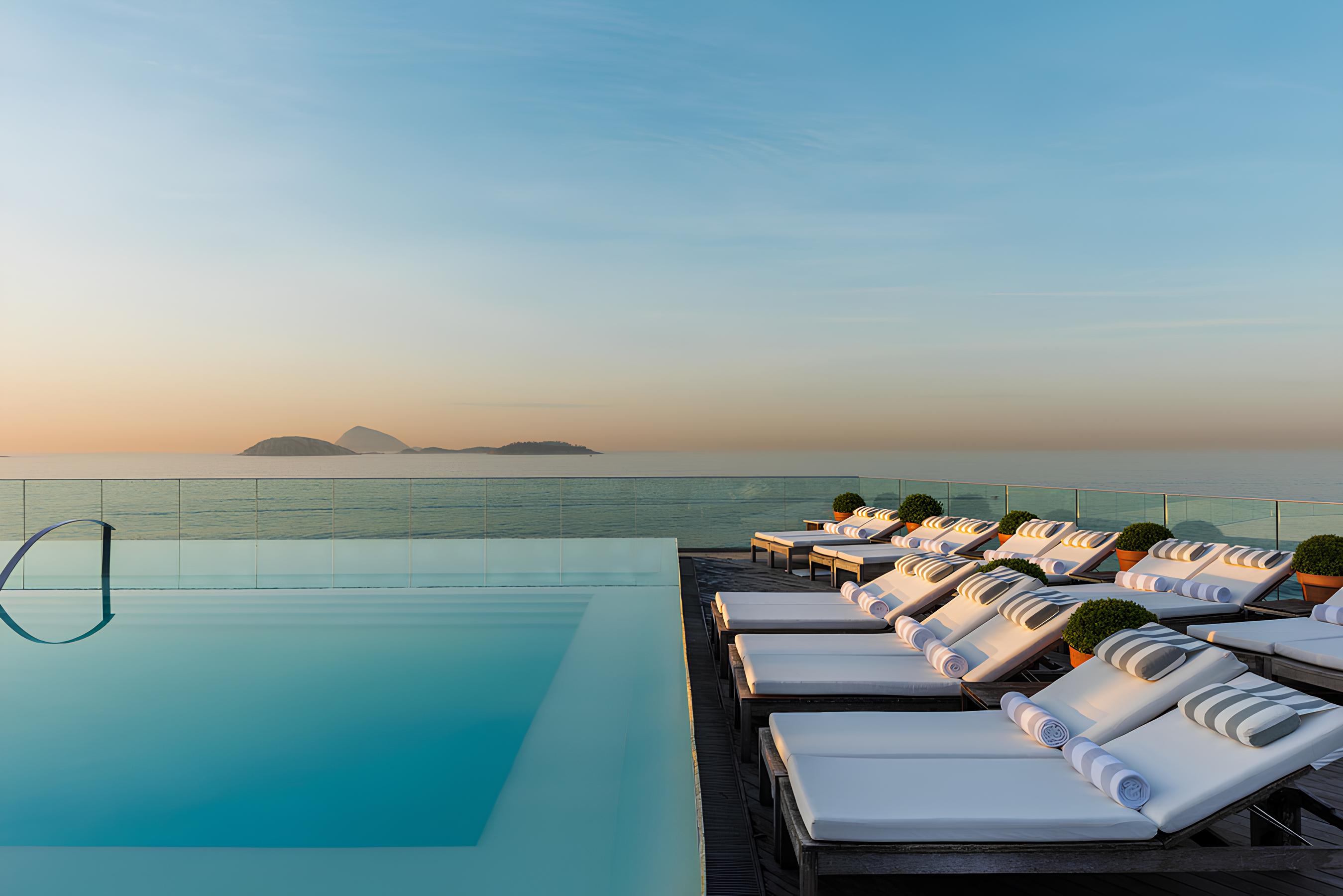
The rooftop pool has become one of Rio's iconic images, an infinity edge that appears to merge with the ocean eight floors below. Starck lined the surrounding walls with ear-shaped mirrors, reflective surfaces that capture the changing light and the blues of sea and sky. The pool bar serves through the day, coffee in the morning giving way to fresh juices, then cocktails as the afternoon stretches toward evening. The crowd is mixed, hotel guests and local members who pay for rooftop access, the combination giving the space an energy that purely private facilities cannot match.
Fasano Al Mare handles the food, continuing the family tradition in a setting designed to showcase both kitchen and coastline. The menu leans Mediterranean, seafood prepared with Italian technique and Brazilian ingredients. Chef Luigi Moressa, who helped open the original Gero restaurant in São Paulo, oversees a kitchen that produces dishes worthy of the family name. The carpaccio Fasano has become a signature, impossibly thin beef crowned with capers and pine nuts. Pastas are made in-house. The risotto arrives with enough scallops and calamari to remind you that the ocean is not merely scenery.
Baretto-Londra occupies the ground floor, a bar that Wallpaper magazine once named the best hotel bar in the world. The design references London, Rogério Fasano's favorite city, with Union Jacks rendered in Italian colors and Argentine brick walls covered in vintage LP covers. The cocktails are serious without being solemn. Live music appears on some nights. The atmosphere suggests a members' club that forgot to check memberships at the door.
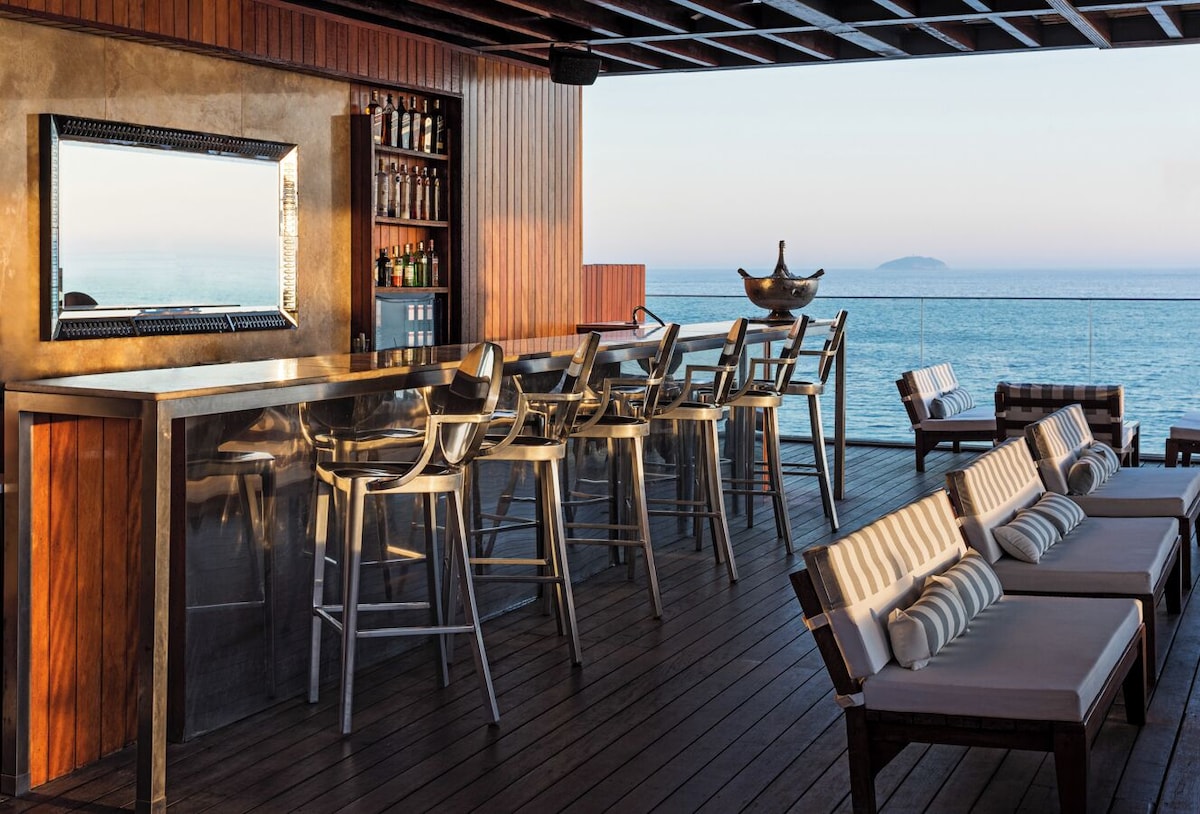
The service throughout reflects the Fasano philosophy. Staff members seem to anticipate needs before they become requests. The concierge speaks the particular language of Rio's best restaurants and hardest reservations. The beach service, provided on Ipanema's sand, extends the hotel's reach beyond its walls. Surfboards are complimentary. So are the sunbeds and umbrellas that mark the Fasano territory on the beach.
The Fashion Designer's Hotel
A fifteen-minute walk along the beachfront promenade, past the junction where Ipanema becomes Leblon, another hotel tells a different story. Janeiro Hotel opened in 2018, the creation of Oskar Metsavaht, a man whose resume defies easy categorization. Trained as a doctor. Founded Osklen, one of Brazil's most influential fashion brands. Photographer. Environmentalist. Member of expeditions to Antarctica and the Himalayas. The hotel represents his entry into hospitality, and it carries the particular intensity of someone who builds things rather than acquires them.
The philosophy here is what Metsavaht calls "new luxury," a concept that sounds like marketing until you experience it. The idea is that quality and sustainability should not require trade-offs, that design can be rigorous and materials can be responsible without sacrificing the pleasures that luxury provides. Janeiro attempts to prove this thesis with fifty-one rooms, a rooftop pool, and the quiet confidence of a place that knows exactly what it values.
The building sits on Avenida Delfim Moreira, Leblon's beachfront boulevard, facing a stretch of sand that locals consider the finest in the city. Leblon carries itself differently than Ipanema, slightly older, slightly wealthier, slightly less interested in being seen. The neighborhood's restaurants and boutiques cater to residents rather than tourists, and the beach, while beautiful, lacks Ipanema's international reputation. Janeiro benefits from this position. It draws travelers who have moved beyond the obvious, who want Rio's pleasures without Rio's crowds.
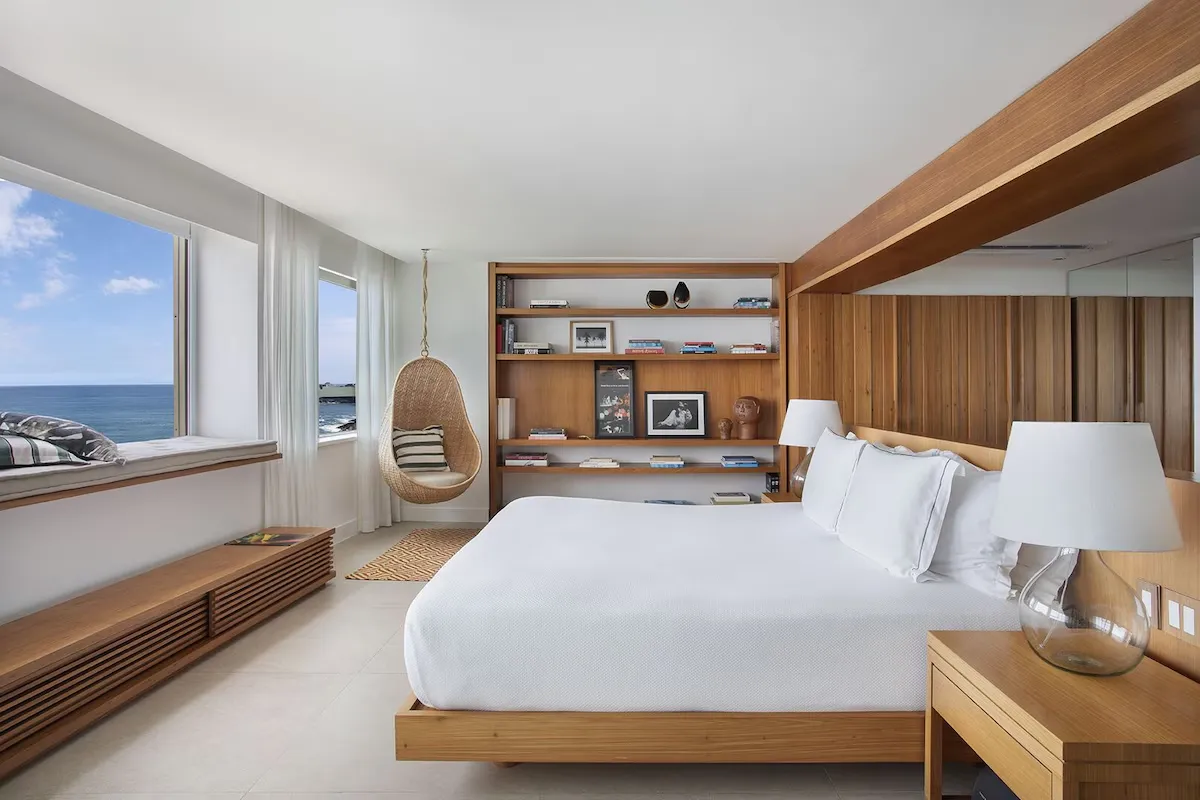
The interiors reflect Metsavaht's eye for materials and restraint. Brazilian freijó wood panels the walls, its honey tones warming spaces that might otherwise feel austere. Floors are pale. Furniture is sculptural but functional. Metsavaht's own photographs hang throughout, images from his expeditions that remind guests of the natural world that luxury hotels often ignore. The scent piped through the rooms comes from Osklen, subtle enough to register only subconsciously.
Rooms face either the courtyard or the ocean, with the ocean rooms commanding premiums that the views justify. Floor-to-ceiling windows frame Leblon Beach and, beyond it, the Atlantic stretching toward Africa. Suites add space and perspective, their living areas designed for the kind of unhurried mornings that Rio encourages. Breakfast is included for suite guests, served in the second-floor restaurant where the menu emphasizes health without sacrificing flavor, fresh juices and tropical fruits alongside eggs and pastries.
The rooftop pool is deliberately intimate, smaller than Fasano's famous infinity edge but equally focused on the view. A circular window in one wall frames the Dois Irmãos mountains, turning geology into art. The terrace bar operates until late evening, cocktails served as the sun drops behind the peaks and the city lights emerge. Christ the Redeemer appears in the distance, illuminated against the night sky, the kind of view that postcards cannot capture because postcards cannot convey the scale.
Janeiro's commitment to sustainability extends beyond marketing claims. The hotel participates in Instituto-e certification programs and has adopted dunes on the Leblon-Ipanema coastline as part of a restoration project. Toiletries use natural ingredients. The building's design minimizes energy consumption while maximizing natural light. These choices matter more in Brazil than in places where environmental rhetoric comes cheap. The Atlantic Forest that once covered this coast has been reduced to fragments. The ocean that defines Rio's identity faces pressures that residents understand viscerally. Janeiro positions itself as a hotel that takes these realities seriously.
The awards have followed. Wallpaper named it Best Urban Hotel in 2019. Tatler's Travel Awards recognized it in 2020. The iF Design Award came in 2022. The recognition matters less than what it represents: a hotel that emerged fully formed, with a point of view and the conviction to express it.
Service here differs from Fasano's polished formality. Janeiro feels lighter, younger, more inclined to suggest than to anticipate. The staff can arrange yoga classes, gym access at the nearby BodyTech facility, bicycles for rides around the lagoon. They know which restaurants require reservations and which reward spontaneity. They understand that the travelers drawn to this hotel probably want less management rather than more.
Where the Rainforest Meets the Sea
Five hundred miles north of Rio, the coast changes character. The beaches stretch longer, emptier, backed by coconut palms and the dense green of the Atlantic Forest. The cities thin out. The roads narrow. The tourism infrastructure that supports Rio's millions disappears into a landscape that development has largely bypassed.
This is Bahia, the state that gave Brazil its African heritage, its most distinctive cuisine, its particular relationship between the sacred and the secular. Salvador, the colonial capital, preserves the architecture of the sugar trade and the religious syncretism that emerged from slavery. But Salvador is only the beginning. South of the city, the coast unspools in a series of beaches and villages that feel decades removed from modern Brazil.
Txai Resort occupies one of these beaches, Itacarezinho, on the stretch of coastline known as the Cocoa Coast. The name references the crop that shaped this region's history, cacao plantations that made fortunes before a fungal plague devastated the industry in the 1980s. The economic collapse proved ecologically fortunate. Without agriculture's pressure, the Atlantic Forest survived here more completely than almost anywhere else on the Brazilian coast. UNESCO designated it a Biosphere Reserve in 1991. Today it shelters biodiversity that the rest of the coast has lost.
Txai (pronounced "chai") takes its name from a Kaxinawa indigenous word meaning "companion," a reference to the relationship the resort seeks with both guests and the surrounding community. The property joined Relais & Châteaux in 2013, a recognition that places it alongside the great rural properties of France and Italy. But Txai operates differently than European precedents. The luxury here is ecological as much as material, defined by what the resort protects as much as what it provides.
The numbers convey scale: ninety-two hectares of land, including Atlantic Forest that the resort has actively reforested. Forty bungalows and suites scattered across the property, most built on stilts with views of either ocean or forest. Six swimming pools, including a children's pool for the families that Txai welcomes. Kilometers of private beach, the sand so white and the water so clear that the Caribbean comparisons write themselves.
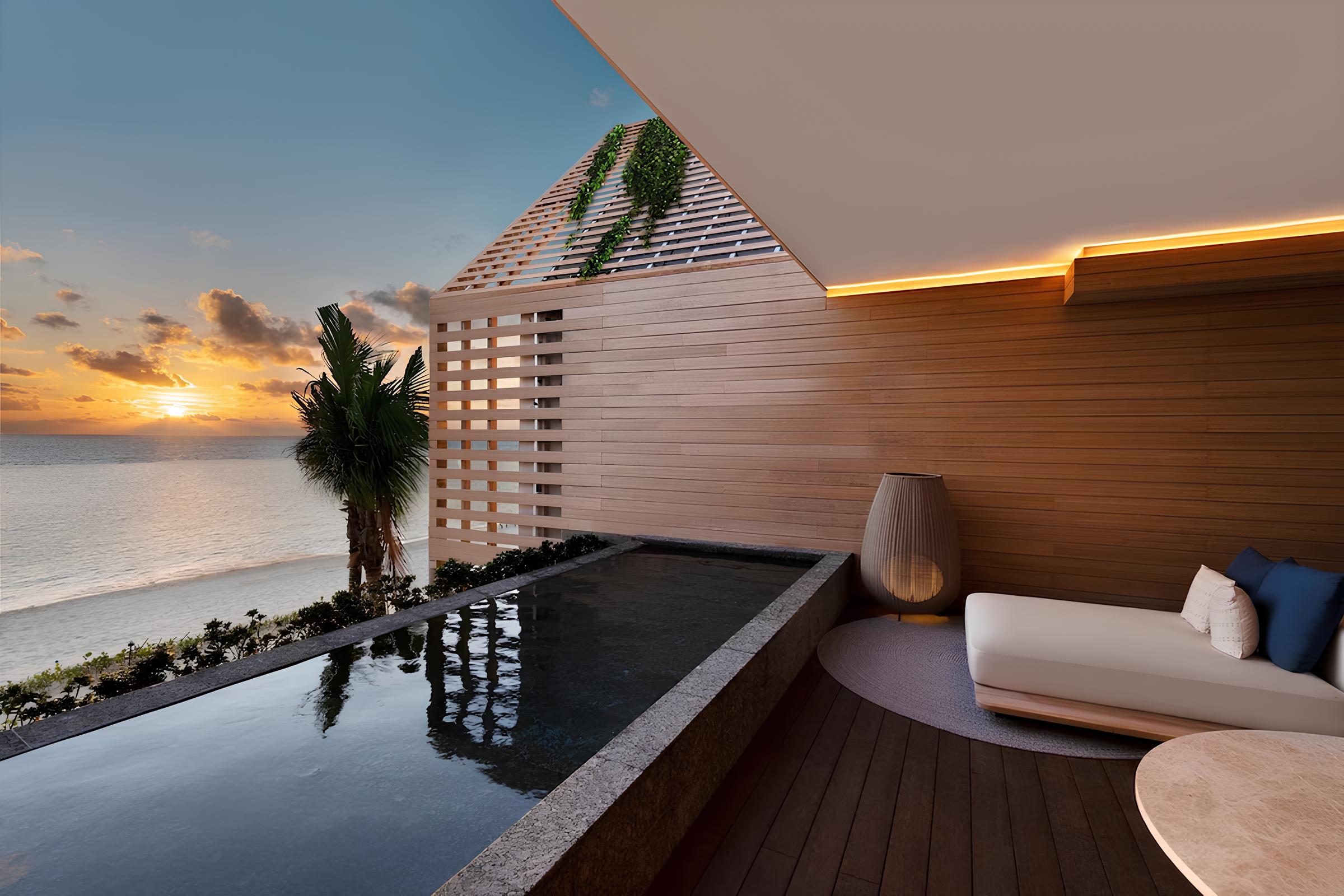
The bungalows deserve attention. They are built primarily from wood and natural materials, thatched roofs above decks that wrap around living spaces designed for the climate. King-size beds hang with mosquito netting that reads as romantic rather than necessary. Bathrooms open partially to the outdoors, showers where you can watch birds move through the canopy. Some bungalows add private plunge pools. Others offer Jacuzzis on their decks. All provide the particular luxury of space and solitude.
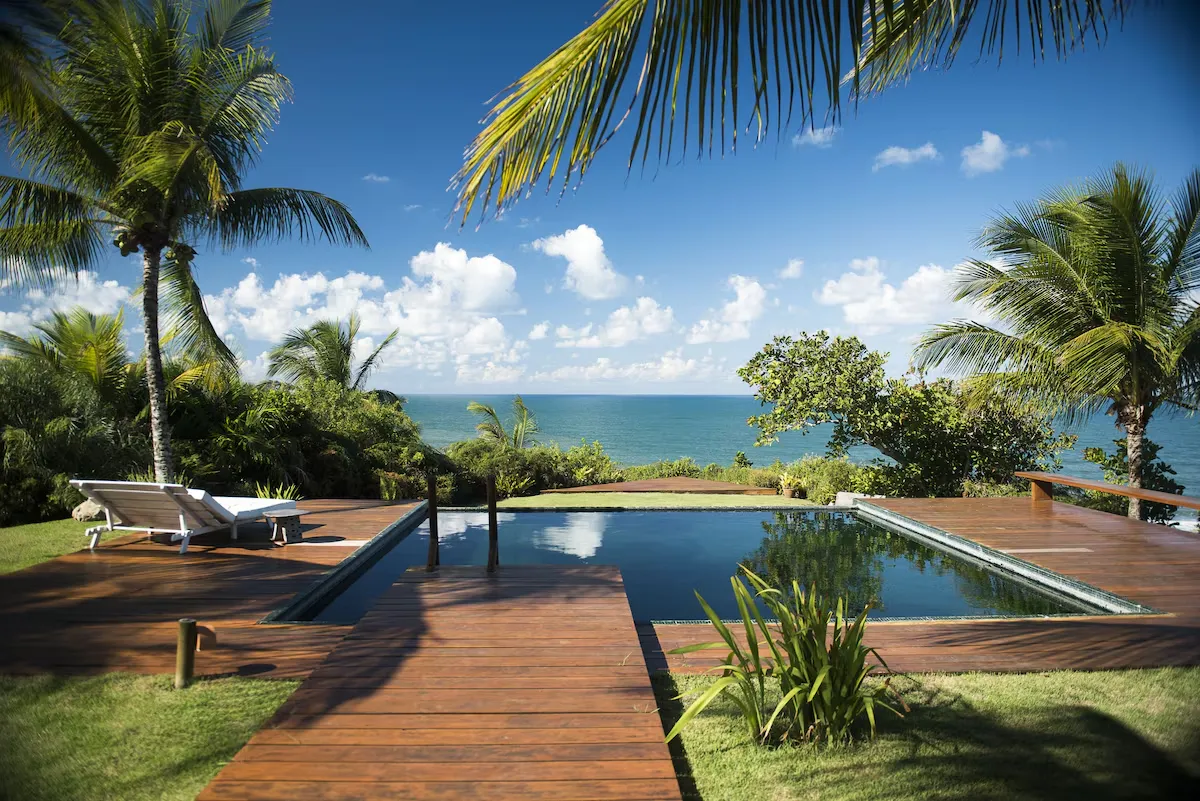
The design philosophy favors integration over imposition. Buildings sit low, painted in colors that reference the forest and the sand. Pathways wind rather than march. The main pools cascade down the hillside toward the beach, their blue tiles an accent rather than a statement. Guests move between beach and pool and restaurant without the sense that they have left one designed environment for another. The resort feels continuous with the landscape that surrounds it.
The Shamash Healing Space spa occupies a hillside position with views across the ocean. Treatments draw on both Brazilian traditions and imported techniques, local ingredients processed into products that smell of Bahia's particular botany. Yoga takes place on decks overlooking the water. The approach emphasizes restoration rather than pampering, the kind of wellness that integrates with the environment rather than retreating from it.
Two restaurants handle the food, their kitchens working with ingredients sourced from local farms and fishing boats. The Bahian cuisine that appears here carries African influences that distinguish it from southern Brazilian cooking, dendê oil and coconut milk and the particular heat of malagueta peppers. The resort's Companions of Txai program supports local families who grow organic produce, creating supply chains that benefit communities beyond the resort's gates.
The activities on offer reflect the location's possibilities. Surfing lessons take advantage of breaks that draw serious riders from across Brazil. Horseback excursions follow trails into the Atlantic Forest, crossing rivers and climbing hills to viewpoints that justify the effort. Kayaking on the Rio de Contas reveals mangroves and wildlife that the beach cannot provide. Hiking trails connect Txai's beach to neighboring coves, each one emptier and more beautiful than the last.
The turtle conservation project adds another dimension. Between October and February, sea turtles nest on Itacarezinho Beach. The resort monitors nesting activity and protects eggs from predators and poachers. Guests can observe hatchlings making their way to the ocean, tiny creatures following instincts that predate human civilization by tens of millions of years. The staff light paths with low-intensity flickers, guiding both turtles and guests toward the water's edge.
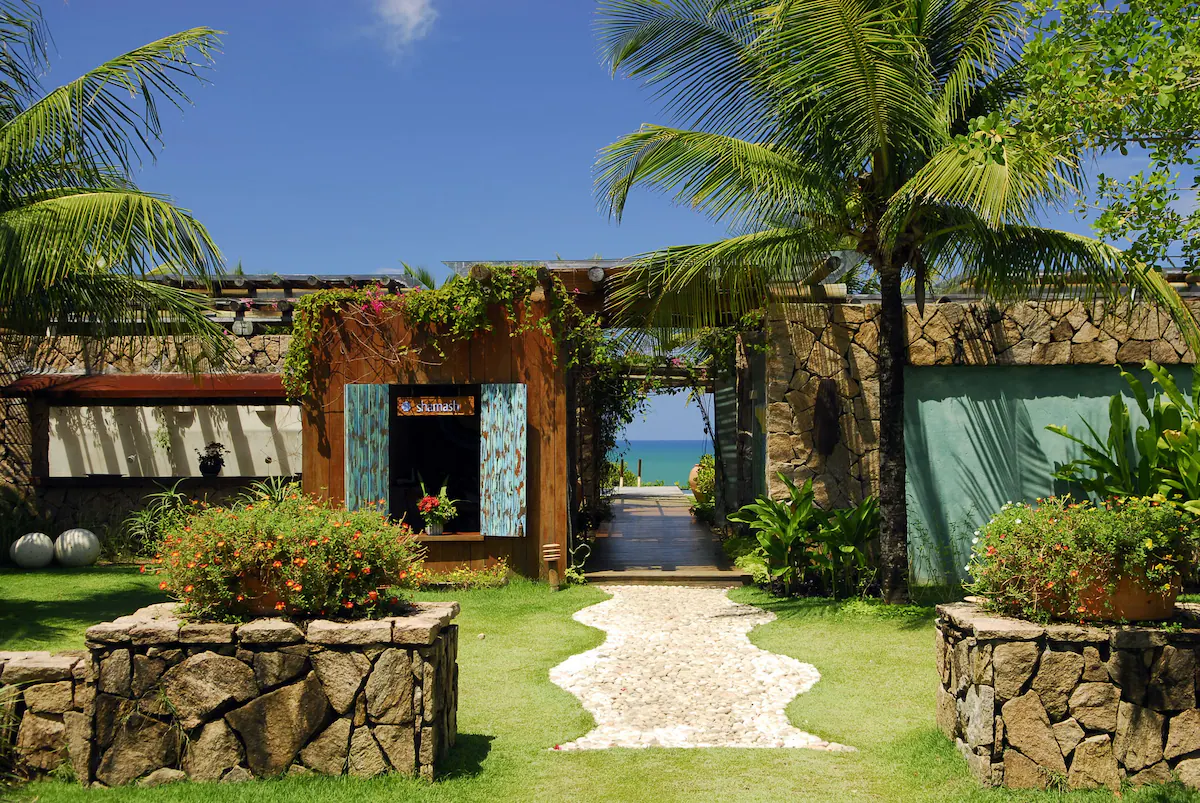
The town of Itacaré sits twenty minutes away by shuttle, a former cocoa port that has reinvented itself as a surf destination and bohemian retreat. The streets are cobblestone. The bars play forró, Brazil's accordion-driven dance music. The restaurants serve moqueca, Bahian fish stew, in clay pots brought directly from the kitchen. Txai provides access to this culture while offering refuge from its noise, the combination that defines great resort positioning.
Two Cities, Three Hotels, One Country
The distances here matter. Rio de Janeiro operates on urban rhythms, its pleasures available immediately and in abundance. You land, transfer to Ipanema or Leblon, and the city presents itself. Beaches within walking distance. Restaurants requiring only a taxi. Nightlife that starts late and ends later. The Fasano and Janeiro offer different expressions of this access, one formal and glamorous, the other relaxed and design-forward, both rooted in the particular energy of a city that has always known how to enjoy itself.
Txai requires more. The journey involves flights to Ilhéus, an hour's drive through countryside that reveals another Brazil entirely. The reward is proportional to the effort. You arrive at a place where the phone signal weakens and the boundaries between resort and wilderness blur. The beaches hold no crowds. The forest holds species that exist nowhere else. The pace slows to something that urban Brazil has forgotten.
The combination works for travelers who understand that a country this size cannot be reduced to a single experience. A week might begin in Rio, two nights at Fasano experiencing the glamour that made the city famous, then two at Janeiro exploring Leblon's quieter pleasures. It might end at Txai, four or five nights of decompression in a landscape so different from Rio that the flight might as well cross continents.
Each hotel reflects its creators' convictions. The Fasano carries the weight of family history, four generations of hospitality refined into a brand that now spans Brazil, Uruguay, and New York. Janeiro embodies one man's belief that fashion and ethics can coexist, that a hotel can be beautiful and responsible simultaneously. Txai demonstrates that luxury need not mean extraction, that a resort can support the communities and ecosystems that surround it.
Together they suggest what Brazilian hospitality might become as the country's tourism industry matures. For too long, Brazil offered visitors a choice between international chains that could have been anywhere and local properties that charmed but could not deliver consistency. The hotels in this story occupy middle ground. They are unmistakably Brazilian, designed with reference to national traditions and built by people who understand the country's particular possibilities. They also meet international standards, competing with the best hotels in any city without surrendering their identity.
The design matters. Brazil's modernist legacy runs deep, architects like Oscar Niemeyer and Lina Bo Bardi having created buildings that influenced the entire twentieth century. Furniture designers like Sergio Rodrigues and the Campana Brothers achieved international recognition for work rooted in Brazilian materials and sensibilities. This heritage appears throughout these hotels, from Fasano's mid-century references to Janeiro's contemporary minimalism to Txai's integration of natural materials. The design is not decoration. It is argument, proof that Brazilian aesthetics can support hospitality of the highest order.
The food matters equally. Brazil's culinary diversity parallels its geography, regional cuisines as distinct as the landscapes that produced them. The Italian traditions of São Paulo's immigrant communities. The African influences of Bahia's coast. The churrasco culture of the southern grasslands. The Amazonian ingredients that are only beginning to reach international kitchens. These hotels engage with this diversity seriously, their restaurants offering more than sustenance, providing education in what Brazilian food can be.
The Details
Hotel Fasano Rio de Janeiro
Location: Avenida Vieira Souto, Ipanema Beach, Rio de Janeiro. Corner position facing Dois Irmãos mountains.
Accommodations: 89 rooms and suites across five categories. Superior Courtyard rooms face interior garden. Superior Ocean, Deluxe Oceanfront, Oceanfront Suite, and Deluxe Oceanfront Suite face the beach.
Facilities: Rooftop infinity pool, Fasano Al Mare restaurant, Baretto-Londra bar, Fasano Spa, fitness center, beach service with sunbeds and surfboards.
Getting There: 11 km from Santos Dumont Airport (domestic), 22 km from Galeão International Airport. Valet parking available.
Rates: From €584 per night.
Janeiro Hotel
Location: Avenida Delfim Moreira, Leblon Beach, Rio de Janeiro. Beachfront position at Post 12.
Accommodations: 51 rooms including 15 suites. Deluxe rooms and suites available with ocean views.
Facilities: Rooftop pool and bar, Cedilha restaurant, spa treatment room, partnership with BodyTech gym, complimentary bicycles.
Getting There: 12 km from Santos Dumont Airport. Valet parking available at nearby garage.
Rates: From €565 per night.
Txai Resort Itacaré
Location: Itacarezinho Beach, Cocoa Coast, Bahia. Within the Itacaré-Serra Grande Environmental Protection Area, 15 km from Itacaré village.
Accommodations: 40 bungalows and suites on 92 hectares. Categories include Superior, Bungalow, Premium Bungalow with private pool.
Facilities: Six swimming pools, Orixás and Praia restaurants, Shamash Healing Space spa, tennis courts, fitness center, private beach, turtle conservation program.
Getting There: 48 km from Ilhéus Jorge Amado Airport (50-minute drive). Domestic flights connect Ilhéus with São Paulo, Rio, and Salvador.
Rates: From €455 per night.
Frequently Asked Questions
| Hotel Fasano Rio de Janeiro | suits travelers seeking glamour, formality, and the legendary Fasano hospitality tradition. The rooftop pool, Philippe Starck design, and fine dining define the experience. Janeiro Hotel appeals to design-conscious travelers who prefer sustainability, minimalism, and a younger atmosphere. Fasano is Ipanema; Janeiro is Leblon. Both beaches are beautiful, but Leblon is quieter and more residential. |